

 SkillClick
How Much Is a Junk Car Worth Without a Catalytic Converter?
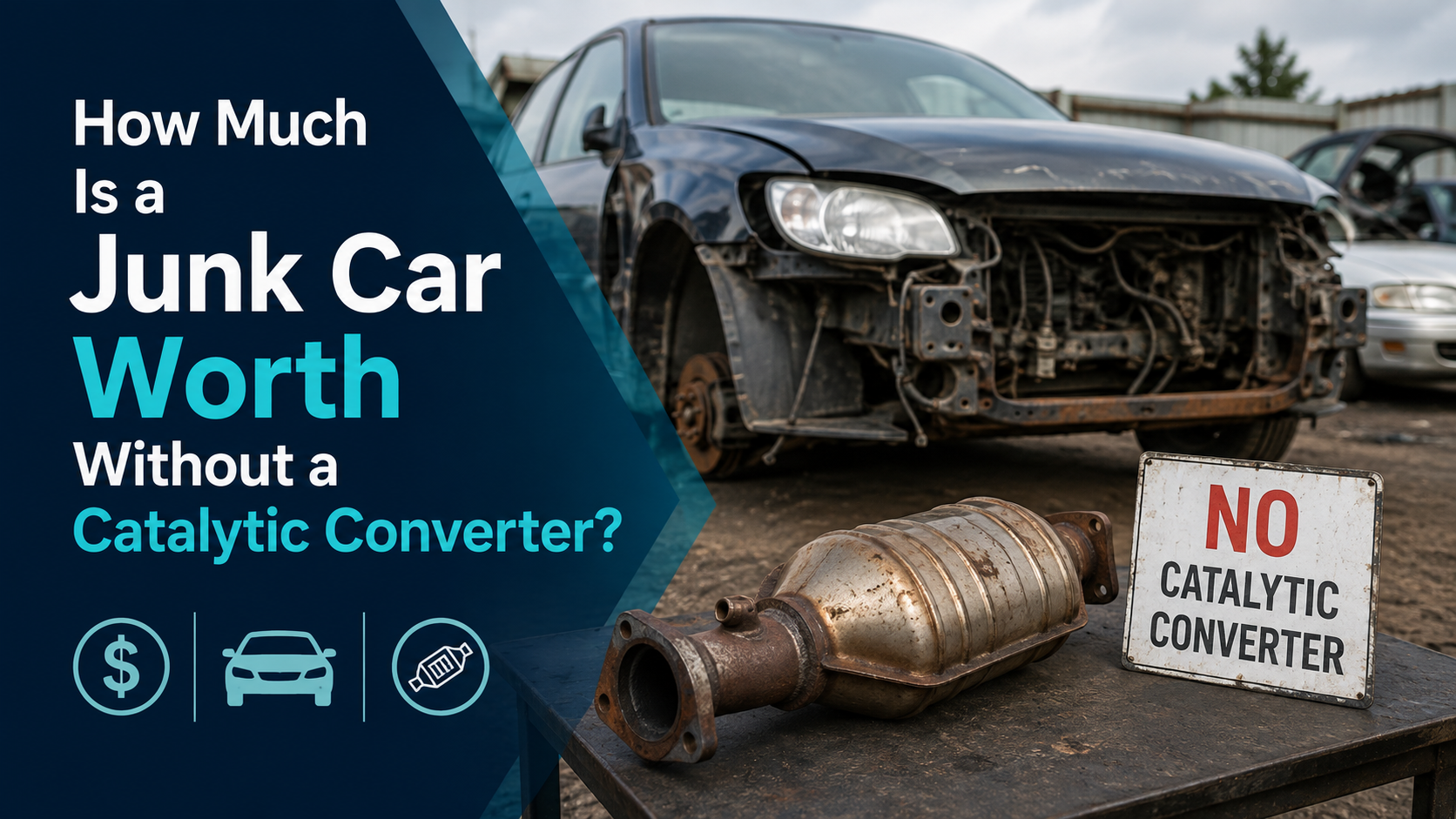
Typically $50 to $800 less than the same car with one, and the gap depends far more on which converter you lost than on the car itself. What remains is the scrap floor plus whatever other components still have resale value. A standard sedan loses somewhere between $75 and $300; a hybrid or a large truck can lose several times that. Establish your baseline first using a car scrap value calculator, then subtract, because the deduction is proportional to your specific vehicle rather than a flat figure.
Here is how buyers reprice a car without a converter, and whether replacing it is ever worth doing.
What the car is still worth
Two components survive, and they are the whole answer.
The scrap floor. Find your curb weight on the driver's door jamb sticker, subtract roughly 500 lbs for tires and fluids that yards deduct because they pay to dispose of both, then multiply by your state's per-ton rate. Auto scrap traded between roughly $120 and $206 per ton through 2026, with most state averages near $175.
A 3,200 lb sedan therefore yields about 1.35 payable tons, or roughly $236 in steel. That number does not change when the converter disappears.
The remaining parts. Engine, transmission, alternator, starter, wheels, panels, glass and modules all retain the value they had. A complete car minus one component is still substantially a parts donor.
The loss is the converter alone, plus a second effect covered below.
How large the deduction is
Converter values run from about $50 to over $1,200, so the deduction varies widely by vehicle.
Standard sedan converters generally fall between $75 and $300. Factory units across the broader market typically run $100 to $250. Toyota Prius converters sit at the top, quoted between $300 and $700 by some buyers and higher by others, and certain hybrid and European units exceed $1,000. Aftermarket replacements are near worthless at scrap, quoting as low as $15, so a car whose converter was replaced years ago loses very little by comparison.
Two adjustments apply in 2026. Converter payouts sit well below their peak because automakers deliberately substituted cheaper platinum for palladium in newer units, cutting demand for the metal that carried most of the value. So a missing converter costs less today than it would have three years ago.
Why the deduction sometimes exceeds the converter's value
This catches sellers out, and it is worth understanding rather than disputing.
A buyer pricing a complete vehicle values it as a parts donor. Remove the highest-value component and some buyers stop treating it as a donor at all, repricing it closer to tonnage. That shift can cost more than the converter would have fetched on its own.
Real transaction data shows the effect. A Toyota Camry, a high-demand model with strong parts appeal, sold for $425 rather than a higher figure for exactly one reason: its converter was already gone.
The practical consequence is that the same missing part produces different deductions from different buyers, depending on whether they price parts or tonnage.
Three situations, three different answers
The missing converter means something different depending on why it is gone.
Stolen from a car you still drive. The vehicle is now illegal to operate in emissions states and unpleasant to be near. Your decision is repair against scrap, and the repair cost decides it: $1,000 to $3,500 against a car that may be worth a few hundred.
Removed and sold by a previous owner. You may not discover it until a buyer inspects the car or points out the noise. Nothing to do except disclose it and price accordingly. Check whether a straight pipe was fitted in its place, since some buyers treat that differently from an open exhaust.
Removed by you, with the converter in hand. Here you have both halves and a decision to make. Selling them separately means meeting your state's converter documentation rules, while selling them together is simpler and often nets a similar total. Get a quote on each path before choosing.
Do not replace it before selling
The arithmetic here is decisive.
A replacement converter costs between $1,000 and $3,500 depending on the vehicle, according to figures from the National Insurance Crime Bureau. Installing one adds at most a few hundred dollars to a junk car's scrap value.
Spending $1,500 to recover $250 is not a repair, it is a donation. If the car is headed for scrap, sell it as it stands.
The calculation only changes if you intend to keep driving the vehicle, since a car without a converter cannot pass emissions testing and cannot be legally registered in states that require it.
If it was stolen
Theft is how most owners arrive at this question, though the problem has receded considerably.
Reported cases fell 68% in 2024, dropping to around 14,000 from roughly 44,000 the previous year. Three factors drove that: lower rhodium, palladium and platinum values reducing the profit motive, new state laws making detached converters hard to sell, and more owners fitting protective shields.
If yours was taken, take three steps in order.
File a police report. Insurers require it, and it is also the document that protects you if the part surfaces elsewhere.
Check your comprehensive coverage. Converter theft is generally a comprehensive claim rather than collision. Weigh the payout against your deductible and the likely premium effect, since on an older car the deductible may exceed what the claim returns.
Decide before repairing. If the car was already near end of life, a theft is a reason to scrap rather than a reason to spend $1,500 restoring a vehicle worth a few hundred.
The symptom is unmistakable, incidentally: a loud roaring noise at startup, usually with a check engine light and rough running.
A worked example, with and without
Take a 3,400 lb sedan, twelve years old, non-running but otherwise complete, clean title, in a state paying $175 per ton.
With its factory converter, the car has a scrap floor near $254 after the 500 lb deduction, plus a converter worth roughly $200 and remaining parts a full-asset buyer will pay for. That lands in the range most complete junk cars occupy, between $250 and $800.
Take the converter away and two things happen. The obvious one is the $200. The less obvious one is that some buyers now price the car nearer its tonnage, since the component that made it worth dismantling is gone. The first effect is fixed; the second depends entirely on which buyer you call.
That is why three quotes matter more on a converter-less car than on a complete one. The spread between buyer types is where the recoverable money now sits.
Your buyer pool narrows
This is the practical difficulty, separate from the price.
A car without a converter cannot serve as a legal daily driver in emissions states, so private buyers and dealerships have little use for it. Dealerships generally offer close to nothing.
Junk car buyers, scrap yards and parts recyclers remain willing purchasers, because they were never going to register the vehicle. Some buyers advertise that a missing converter is not an obstacle, which is accurate as far as it goes, though the offer still reflects the loss.
Disclose it when you request quotes. A buyer who learns about it at pickup has an honest reason to reduce the number, which is the outcome disclosure prevents.
The legal point worth knowing
If you removed the converter yourself and still hold it, selling it separately now carries requirements.
Many states have made it a felony to possess or sell a detached converter you cannot prove you own. Licensed recyclers must record your photo identification and the unit's origin, and pay by traceable method rather than cash. California restricts converter purchases to licensed dismantlers.
Selling the vehicle intact to a licensed yard avoids all of this, which is one more reason removing the part before a scrap sale rarely pays.
Frequently asked questions
Can I still sell a junk car without a catalytic converter? Yes. Junk car buyers, scrap yards and recyclers purchase these vehicles routinely, since they were never going to put the car back on the road. Expect a lower offer and disclose the missing part upfront.
How much less will I get? Usually $50 to $800, tracking what your specific converter was worth. A standard sedan loses roughly $75 to $300; hybrids and large trucks lose more.
Should I buy a cheap aftermarket converter to fit before selling? No. Aftermarket units contain almost no precious metal and quote as low as $15 at scrap, so a buyer will not pay you meaningfully more for one.
Will insurance cover the theft? Comprehensive coverage generally applies. Compare the likely payout against your deductible, because on a low-value vehicle the math often favors scrapping instead of claiming.
Does a missing converter affect my title or registration? Not the title. Registration is affected in states requiring emissions testing, since the vehicle cannot pass without a functioning converter.
Which buyer type handles these cars best? A full-asset buyer still pays for the remaining parts, while a scrap processor prices tonnage. Get one quote from each, since the gap between them narrows once the highest-value part is gone.
Can I drive it while I arrange the sale? It will run, but it fails emissions, sounds loud enough to attract attention, and is illegal to operate in most states. Arrange a tow instead, which the buyer should provide at no cost.
What if the converter was gutted rather than removed? A hollowed shell still attached to the exhaust has almost no scrap value, since the precious metal sat in the honeycomb inside. Buyers price it the same as a missing unit, so describe it accurately rather than reporting the car as having one.
What to do now
Work out your scrap floor from curb weight and your state rate, look up what your specific converter was worth, and treat the difference as your realistic expectation. Then get three quotes with the missing converter disclosed in the first sentence, since the honest description is what keeps the final number matching the quoted one.
- Managerial Effectiveness!
- Future and Predictions
- Motivatinal / Inspiring
- Fitness and Wellness
- Medical & Health
- Manufacturing
- Educação
- Real-Estate
- Food Industry
- Hospitality
- Online Games
- Sports
- Home Services
- Civil Engineering
- Safety and Protection
- Software Products & Services
- Fashion and Jewellery
- Artificial Intelligence
- Entrepreneurship
- Mentoring & Guidance
- Marketing
- Networking
- HR & Recruiting
- Literature
- Shopping
- Career Management & Advancement