

 SkillClick
Artificial Intelligence in Recruitment Is Creating Jobs, So Why Are Freshers Struggling?
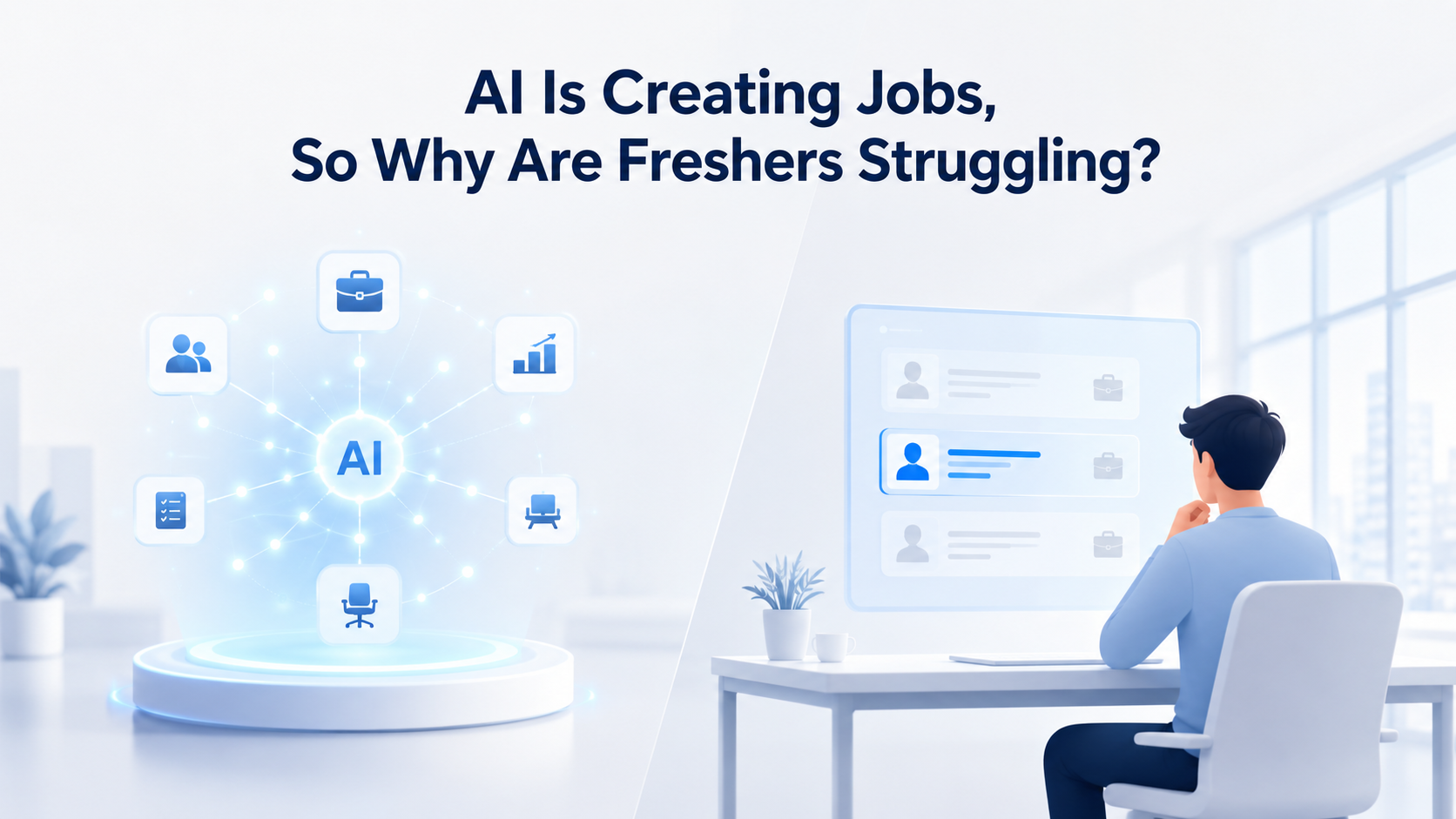
Imagine a company has hundreds of resumes for just a few open positions. Recruiters need to find the right people quickly, while candidates want a fair chance to get noticed.
Now add AI to the process.
The latest Economic Times report highlights an important shift in India's job market. AI is creating more jobs than it is eliminating, but freshers are facing increasing pressure because companies are reducing entry-level hiring. A Nomura analysis found around 131,000 AI-related jobs were created across Asia compared with about 61,000 jobs lost. India has so far seen a net positive impact.
The bigger question is not simply whether AI will create or destroy jobs. It is how companies can use artificial intelligence in recruitment to find, evaluate and develop the right talent for an AI-driven workplace.
What Is Artificial Intelligence in Recruitment?
Artificial intelligence in recruitment means using AI technologies to support different stages of hiring.
Instead of recruiters manually reviewing every resume, contacting candidates, and comparing skills, AI can help automate repetitive tasks and provide data-driven insights.
For example, an AI recruitment system can:
-
Screen resumes based on relevant skills
-
Match candidates with suitable roles
-
Identify skill gaps
-
Automate candidate communication
-
Schedule interviews
-
Analyze recruitment data
-
Support workforce planning
-
Recommend candidates based on job requirements
The goal is not to replace recruiters. It is to help recruiters spend more time on conversations, evaluation, and decision-making.
Why AI Recruitment Matters More Now
The current employment market makes this especially important.
According to the Economic Times report, 55% of 651 IT companies surveyed by ICRIER reported a decline in entry-level hiring, while only 14% reported a decline in senior-level hiring. Companies are increasingly looking for people who combine technical skills with business knowledge, communication, and experience.
This creates a new challenge for businesses.
They need to identify candidates who can work effectively with AI, while also understanding which traditional roles can be redesigned or automated.
This is where artificial intelligence in recruitment becomes useful.
How Artificial Intelligence in Recruitment Works
1. Understand the Job Requirement
The process starts by understanding what the company actually needs.
AI can analyze a job description and identify the required technical skills, experience, education, and soft skills. Recruiters can then create a clearer candidate profile.
For example, instead of simply searching for a "software developer", the system can identify requirements such as Python, cloud computing, machine learning and experience with AI applications.
2. Find and Screen Candidates
AI can process large numbers of resumes much faster than manual screening.
It can compare candidate profiles with the requirements of a position and identify people whose skills are closely aligned with the role.
This can reduce the time recruiters spend on repetitive resume screening.
However, AI should support human judgment rather than make final hiring decisions on its own.
3. Match Skills With Roles
One of the biggest changes is moving from job title-based hiring to skill-based hiring.
A candidate may not have the exact job title a company is looking for but may have the right skills to succeed.
AI can analyze skills, previous projects, and experience to identify these potential matches.
This is particularly useful as new AI-related roles continue to emerge.
4. Identify Skill Gaps
AI can also help companies understand what candidates are missing.
Suppose a candidate has strong software development skills but lacks experience with generative AI. An AI system can identify the gap and recommend suitable training.
This creates a more flexible approach to hiring.
Instead of asking, "Does this candidate have everything we need today?", companies can ask, "Can this candidate develop into what we need tomorrow?"
5. Improve Candidate Engagement
Recruitment does not end with resume screening.
Candidates often wait days or weeks for updates. AI-powered recruitment systems can automate routine communication, answer common questions, and provide application updates.
Recruiters can then focus on more important conversations with shortlisted candidates.
6. Support Interviews and Evaluation
AI can assist recruiters by organizing interview information, summarizing candidate responses, and comparing evaluation criteria.
Human interviewers should still remain responsible for important hiring decisions because communication, judgment, culture fit and other human factors cannot always be measured accurately by algorithms.
Where AI Staffing Fits In
The rise of AI is also changing AI staffing.
Companies increasingly need people with skills in artificial intelligence, machine learning, data engineering, automation and generative AI. Finding these professionals can be difficult because the demand for specialized skills is moving faster than traditional hiring processes.
AI staffing can help businesses identify relevant talent, understand candidate capabilities and build teams around specific technology requirements.
This is especially useful when companies are moving from small AI experiments to larger implementations.
Why AI Readiness Should Come Before AI Hiring
Hiring AI talent without understanding the organization's actual AI needs can create another problem.
This is why an AI readiness assessment can be valuable before making major hiring decisions.
An AI readiness assessment can help a business understand:
-
Which processes are ready for AI
-
What data and technology infrastructure already exists
-
Which skills are available internally
-
What skills need to be hired
-
Which roles may change because of automation
-
What training existing employees require
This gives recruiters and business leaders a clearer workforce strategy.
The Role of AI Consulting in Recruitment
For many businesses, implementing AI into recruitment is not simply a matter of purchasing a tool.
They need to decide which processes should be automated, what data can be used, how AI should connect with existing HR systems and how to reduce risks such as bias and privacy concerns.
This is where AI consulting can help.
An AI consulting partner can assess the existing recruitment process, identify suitable AI opportunities, recommend technologies and help implement solutions that fit the organization's workforce strategy.
AI Will Change Hiring, Not End It
The Economic Times report provides an important perspective. AI may be creating more jobs than it destroys in India today, but the benefits are not being distributed equally. Entry-level workers are experiencing the pressure as companies reduce some traditional junior roles and prioritize experienced talent.
That means businesses need to rethink recruitment.
Artificial intelligence in recruitment can help companies move toward faster, more skill-focused and data-driven hiring. But successful recruitment will still require people who can understand candidates, assess potential and make responsible decisions.
The future may not belong to companies that simply hire more people.
It may belong to companies that understand which people they need, which skills they need, and how AI can help those people perform better.
For businesses looking to prepare their workforce for this shift, combining AI readiness, AI staffing and AI consulting can provide a practical starting point.
- Managerial Effectiveness!
- Future and Predictions
- Motivatinal / Inspiring
- Fitness and Wellness
- Medical & Health
- Manufacturing
- Formazione
- Real-Estate
- Food Industry
- Hospitality
- Online Games
- Sports
- Home Services
- Civil Engineering
- Safety and Protection
- Software Products & Services
- Fashion and Jewellery
- Artificial Intelligence
- Entrepreneurship
- Mentoring & Guidance
- Marketing
- Networking
- HR & Recruiting
- Literature
- Shopping
- Career Management & Advancement