

 SkillClick
Accounting for Gift Cards
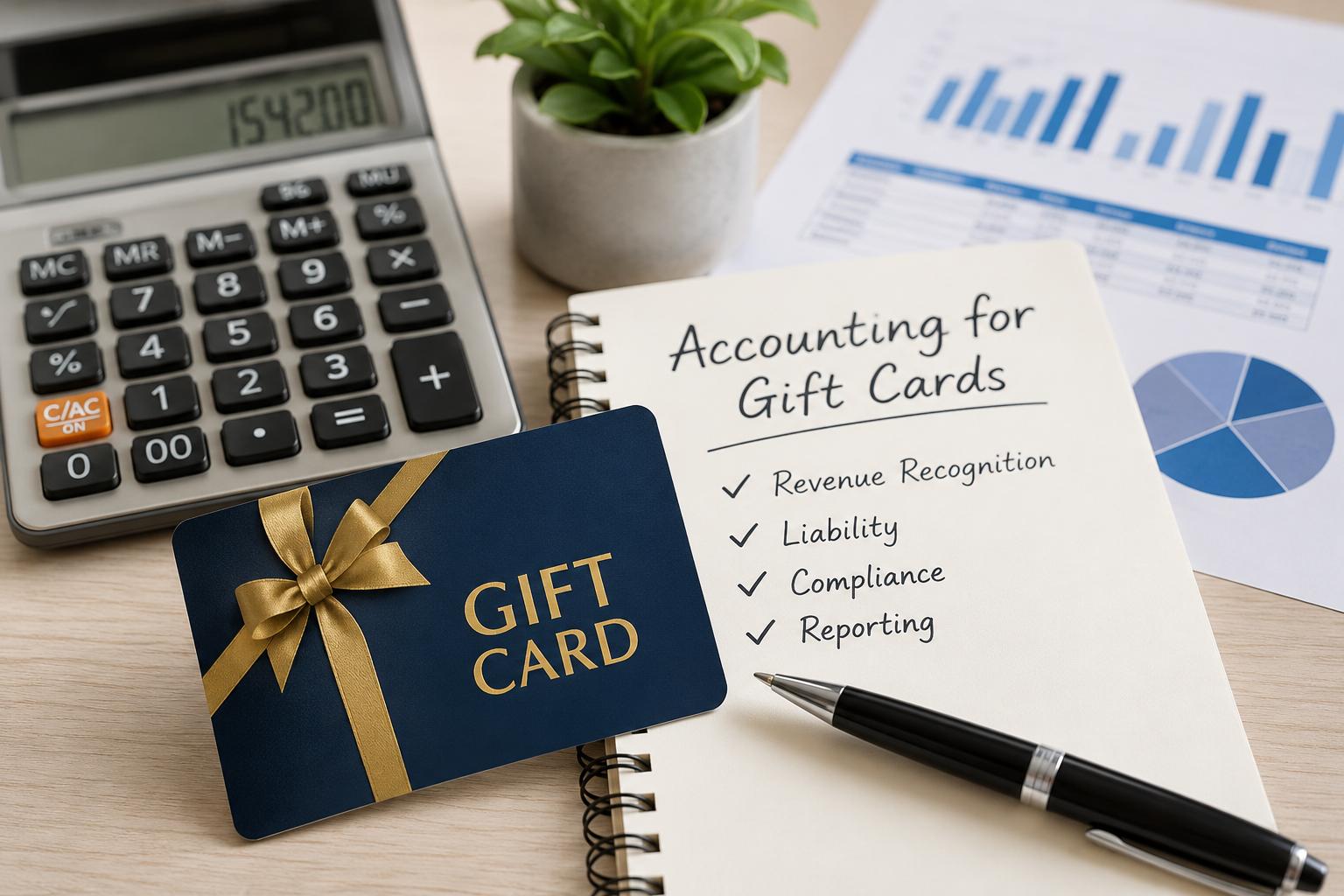
Gift cards have become a staple for UK retailers, restaurants, salons and online businesses. They bring cash in early, attract new customers, and often lead to spending above the card's face value.
The accounting is less obvious than the commercial case. A gift card sale looks like a sale — money arrives, the till records a transaction — but you usually haven't earned anything yet. You've taken payment for goods or services you still owe. Treating that money as revenue on day one overstates profit and creates problems at year end.
VAT adds a second layer, and it doesn't necessarily follow the same timing as the accounting treatment. This article covers both, where businesses go wrong, and when to take advice.
What Is a Gift Card From an Accounting Perspective?
When a customer buys a £50 gift card, they haven't bought anything yet. They've paid you in advance for a future supply, and you've taken on an obligation to provide goods or services later.
In accounting terms, that obligation is a customer liability — often called deferred revenue or a contract liability. It sits on your balance sheet as something you owe, not in your profit and loss account as income.
Think of it the way you'd think of a customer deposit. The cash is genuinely yours to use, but the earnings aren't yours to report until you've delivered.
This matters practically. A business recognising every gift card sale as immediate revenue shows strong figures in December and a puzzling gap in January, when redemptions arrive but no new income does. The trade hasn't changed — only the accounting has misrepresented it.
How Should Gift Card Sales Be Recorded?
The basic entry when a gift card is sold is straightforward:
- Debit Bank or Cash — the money you've received
- Credit Gift Card Liability — the obligation you've created
Nothing touches revenue at this point.
Worked example. A Milton Keynes homeware shop sells a £100 gift card in November. Cash rises by £100, a £100 liability is recorded, and November revenue is unchanged. In February the customer redeems it against a set of lamps — only then is the liability released and revenue recognised.
Variations follow the same logic. Spend £120 using the card plus £20 cash, and you release the £100 liability and record £120 of revenue. Spend £70, and a £30 balance remains a liability until used or dealt with under your expiry policy.
When Is Revenue Recognised?
Revenue is recognised at redemption — when you satisfy your obligation by handing over the goods or providing the service.
The sale of the card and the redemption of the card are two separate events, often in different accounting periods and sometimes different financial years. That timing gap is the whole reason gift cards need careful treatment.
It's worth noting that UK GAAP has changed here. Following the Financial Reporting Council's 2024 periodic review, FRS 102 Section 23 was replaced with a five-step revenue model broadly aligned to IFRS 15, effective for accounting periods beginning on or after 1 January 2026. For most gift card arrangements the principle is unchanged — recognise revenue as you satisfy the performance obligation — but the framework around measurement and breakage is now more prescriptive. If your business sells vouchers in volume, it's worth confirming your policy still holds up under the revised standard.
VAT on Gift Cards in the UK
This is where businesses most often go wrong, and where the rules are genuinely technical.
Since 1 January 2019, UK VAT treatment of vouchers has been governed by Schedule 10B of the Value Added Tax Act 1994, introduced by Finance Act 2019. The rules divide vouchers into two categories, and the category determines when VAT becomes due.
Single-purpose vouchers
A voucher is a single-purpose voucher if, at the time of issue, both the place of supply and the VAT rate applying to the underlying goods or services are known.
For an SPV, VAT is accounted for at issue, and on each subsequent transfer. The eventual redemption is not treated as a separate supply.
A likely example: a hair salon in Milton Keynes offering only standard-rated services in the UK. Everything the voucher can be spent on carries the same VAT treatment, so the position is known upfront.
Multi-purpose vouchers
A voucher that isn't a single-purpose voucher is a multi-purpose voucher. This is the common case for open-value gift cards.
For an MPV, the consideration received at issue is disregarded for VAT purposes. VAT falls due at redemption, based on the consideration paid for the most recent transfer of the voucher where the supplier knows it — and on the face value where it doesn't.
A likely example: a café selling both zero-rated cold takeaway items and standard-rated hot drinks. Because the customer could spend the card on either, the applicable rate isn't known when the card is sold.
Why the distinction matters
The practical consequence is timing. Sell an SPV and you may owe VAT on your next return even though nothing has been redeemed and no revenue has been recognised in your accounts. Sell an MPV and the VAT waits until redemption.
This is the point many businesses miss: the VAT point and the accounting revenue point are not always the same. For a single-purpose voucher they diverge, and your bookkeeping needs to handle that.
Voucher classification can be genuinely difficult — particularly for businesses with mixed VAT rates, multiple locations, or vouchers usable across a group. HMRC's guidance in VAT Notice 700/7 covers the detail, and the treatment depends on your specific circumstances. Where there's any doubt, take advice before setting your policy rather than after filing.
Accounting for Unused or Expired Gift Cards
Unredeemed balances sit on the balance sheet indefinitely unless you have a clear position on them. Settle these points in advance:
- Whether your terms include an expiry date, clearly communicated at the point of sale
- Whether that expiry is enforceable given your consumer law obligations
- How partial balances are handled, and when unredeemed balances are released
- What records evidence the decision
Consumer protection rules constrain what you can do with customers' money, so an expiry policy shouldn't be designed purely around the accounting outcome.
Gift Cards and Breakage
Breakage is the industry term for gift cards that are never redeemed. Cards get lost, forgotten in drawers, or left with small residual balances nobody bothers to spend.
Since that money is never claimed, the liability eventually needs to come off the balance sheet — but the timing and method matter.
Under the revised FRS 102 Section 23, where a business expects to be entitled to a breakage amount, it recognises that amount as revenue in proportion to the pattern of actual redemptions, rather than waiting. Where it doesn't expect to be entitled to breakage, the amount is recognised when the likelihood of redemption becomes remote.
Two caveats. Estimating expected breakage requires reliable historical redemption data, so a business in its first year of selling vouchers generally has no basis for the estimate and would wait. And micro-entities reporting under FRS 105 apply a different framework.
Because breakage directly affects reported profit, the treatment should be documented and reviewed rather than applied by instinct.
Managing Gift Cards in Accounting Software
Xero, QuickBooks, Sage and similar packages handle gift cards well — but only if configured deliberately. Left on default settings, most treat a gift card sale as ordinary sales income, which is exactly the mistake to avoid.
Set up:
- A separate gift card liability account, distinct from sales
- Sales records capturing issue date, value, card reference and voucher type
- Redemption tracking so partial redemptions reduce the correct balance
- VAT records reflecting the right tax point for the voucher type
- Monthly reconciliation between the liability account and the outstanding balance report from your till or e-commerce platform
- Reporting covering outstanding balances, redemption rates and ageing
Where your EPOS or online store manages gift cards separately from your accounting software, that reconciliation is the control that matters most.
Common Gift Card Accounting Mistakes
- Recognising all gift card sales as immediate revenue — the most frequent error, and it overstates profit
- Applying VAT incorrectly — usually by treating a single-purpose voucher as a multi-purpose one, or assuming all vouchers are outside the scope of VAT at issue
- Failing to track outstanding balances — leaving no reliable figure for the liability at year end
- Ignoring expired vouchers — liabilities accumulating for years with no review
- Mixing gift card liabilities with ordinary sales in a single nominal code
- Failing to reconcile the EPOS gift card report to the accounting records
- Not keeping sufficient records to evidence issue dates, values and redemptions
How an Accountant Can Help With Gift Card Accounting
Gift cards sit at the intersection of revenue recognition, VAT and record-keeping — three areas where small errors compound quietly.
An experienced accountant Milton Keynes can set the treatment up correctly at the outset: classifying vouchers for VAT, establishing the right nominal structure, configuring your software, and documenting a breakage and expiry policy that stands up to scrutiny. For businesses selling vouchers in volume, chartered accountants in Milton Keynes can also reconcile outstanding balances, review VAT returns for correct treatment, and prepare accounts that present the liability properly.
With a substantial retail and hospitality base — from centre:mk retailers to independent restaurants and salons across the city — voucher sales are common locally. If you're already trading and unsure your approach is right, a review by an accountancy firm in Milton Keynes is quicker and cheaper than correcting several years of records later.
Practical Gift Card Accounting Checklist
- Record every gift card sale to a liability account, not to sales
- Identify whether each voucher is single-purpose or multi-purpose
- Apply the correct VAT treatment and tax point for that type
- Track outstanding balances by card
- Record redemptions against the liability, recognising revenue at that point
- Review expired and long-dormant cards at least annually
- Reconcile the liability account to your EPOS or platform report monthly
- Keep supporting documentation for issue, redemption and any release
- Review the treatment with a qualified professional where the position is unclear
Final Thoughts
The core principle is simple: a gift card sale creates a liability, and revenue follows when the customer actually spends it. The complications come from VAT classification and from deciding what to do with balances that are never redeemed.
Get the structure right at the start — separate liability account, correct voucher classification, reliable reconciliation — and gift card accounting becomes routine. Get it wrong and it surfaces at year end as an unexplained liability, a VAT correction, or profit figures nobody trusts.
If you sell vouchers and aren't confident your treatment is correct, it's worth a conversation with a qualified accountant about your specific circumstances, particularly given the changes to FRS 102 now taking effect.
Frequently Asked Questions
Are gift cards treated as revenue?
Not when sold. The money received is recorded as a liability because you still owe the customer goods or services. Revenue is recognised when the card is redeemed.
Is VAT charged when a gift card is sold? It depends on the voucher type. For a single-purpose voucher, VAT is accounted for at issue. For a multi-purpose voucher, the consideration at issue is disregarded and VAT falls due at redemption.
How do you account for gift card redemptions?
Reduce the gift card liability by the amount redeemed and recognise the corresponding revenue, accounting for VAT where applicable. If the customer spends more than the card's value, the additional amount is recorded as a normal sale.
What happens to expired gift cards in accounting?
Once redemption is no longer expected — under your terms and applicable consumer law — the remaining liability is released to the profit and loss account. The timing depends on your accounting framework and should be documented.
What is gift card breakage?
Breakage is the portion of gift cards never redeemed. Under the revised FRS 102 Section 23, expected breakage may be recognised in proportion to actual redemptions where the business expects to be entitled to it.
Are gift cards a liability?
Yes. An unredeemed gift card is a customer liability on the balance sheet until it's redeemed or the balance is released.
Do gift cards need to be included in VAT returns?
Yes, at the correct point. Single-purpose vouchers are included in the return covering issue; multi-purpose vouchers in the return covering redemption. Correct classification is what determines the timing.
This article provides general information and does not constitute accounting or tax advice. VAT treatment of vouchers depends on the specific facts, and accounting treatment depends on the framework you report under. Refer to current HMRC guidance or speak to a qualified accountant about your circumstances.
- Managerial Effectiveness!
- Future and Predictions
- Motivatinal / Inspiring
- Fitness and Wellness
- Medical & Health
- Manufacturing
- Ausbildung
- Real-Estate
- Food Industry
- Hospitality
- Online Games
- Sports
- Home Services
- Civil Engineering
- Safety and Protection
- Software Products & Services
- Fashion and Jewellery
- Artificial Intelligence
- Entrepreneurship
- Mentoring & Guidance
- Marketing
- Networking
- HR & Recruiting
- Literature
- Shopping
- Career Management & Advancement