

 SkillClick
How Aircraft Tube and Duct Assemblies Support Fuel, Hydraulic, Pneumatic, and Environmental Control Systems
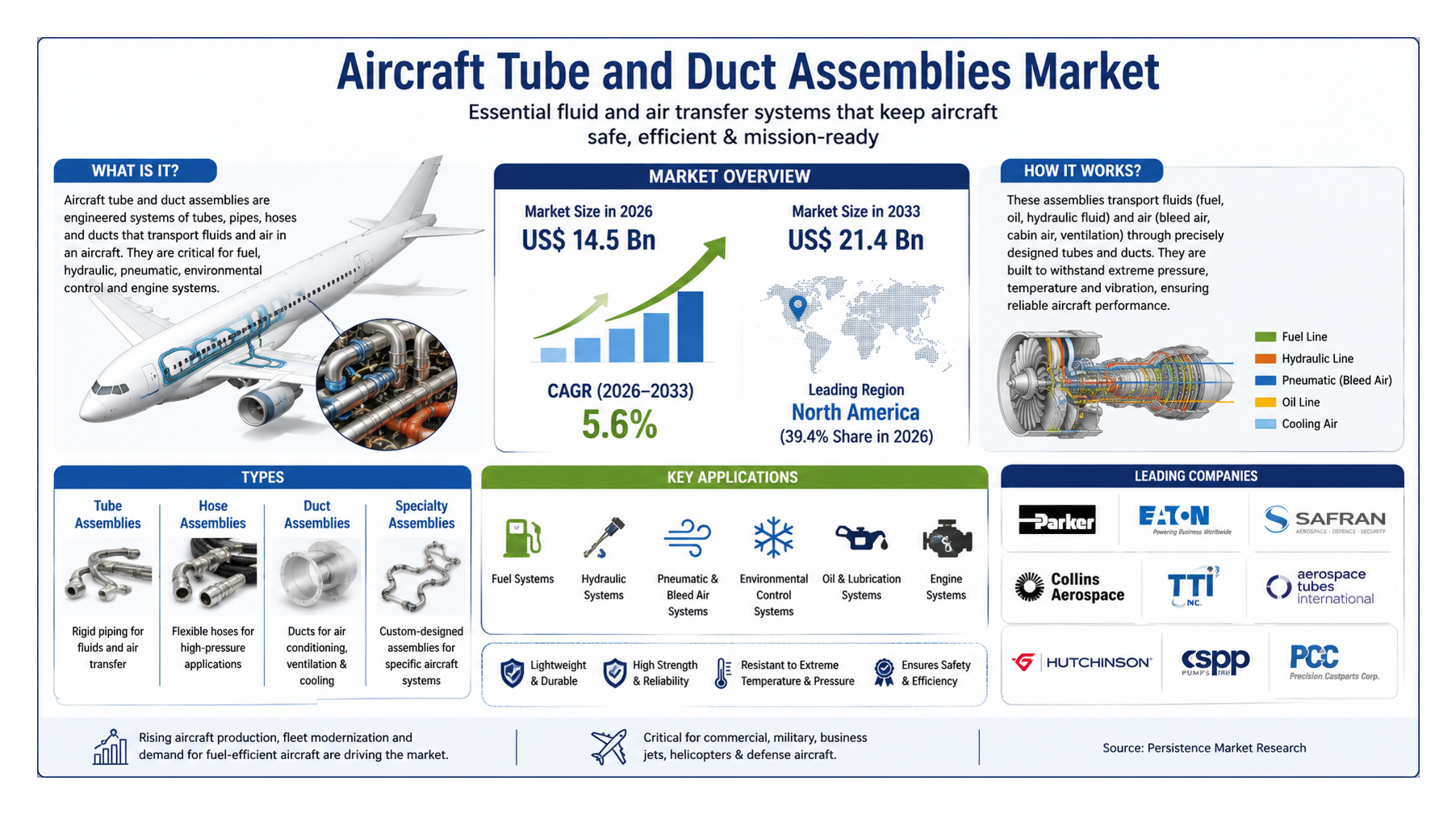
According to Persistence Market Research, the global aircraft tube and duct assemblies market is expected to be valued at US$ 2.30 Billion in 2026 and is projected to reach US$ 3.62 Billion by 2033, expanding at a CAGR of 6.7% between 2026 and 2033.
The aircraft tube and duct assemblies market is gaining importance as the aviation industry expands commercial fleets, modernizes existing aircraft, and invests in more efficient aerospace systems. Tube and duct assemblies are essential components used to transport fluids, gases, air, and other materials throughout an aircraft. They support critical systems, including fuel delivery, hydraulics, pneumatics, lubrication, cooling, and environmental control.
As aircraft become more technologically advanced, manufacturers are focusing on components that can withstand demanding operating conditions while reducing weight and improving efficiency. The growing number of aircraft deliveries, rising air passenger traffic, and replacement requirements for aging fleets are expected to create sustained opportunities for manufacturers of aircraft tube and duct assemblies.
Market Trends
One of the major trends shaping the aircraft tube and duct assemblies market is the increasing focus on lightweight materials. Weight reduction remains a major priority across the aerospace industry because lighter aircraft can improve fuel efficiency and reduce operating costs. Manufacturers are therefore exploring advanced alloys, titanium, composites, and other high-performance materials for tube and duct systems.
Another important trend is the development of more integrated and customized assembly solutions. Modern aircraft contain complex networks of tubes and ducts, requiring precise engineering to fit limited installation spaces while maintaining reliable fluid and airflow performance. Suppliers are increasingly offering complete assemblies rather than individual components, helping aircraft manufacturers simplify installation and reduce production complexity.
Digital manufacturing and automation are also influencing the industry. Advanced bending, forming, welding, inspection, and testing technologies are helping manufacturers achieve higher precision and consistency. Since aerospace components must meet strict quality and safety standards, improved manufacturing processes can play an important role in reducing defects and supporting regulatory compliance.
The aviation industry's growing emphasis on sustainability is creating additional demand for efficient aircraft designs. Tube and duct assemblies that support improved thermal management, fuel efficiency, and optimized environmental control systems are likely to become increasingly important as aerospace companies work toward lower-emission operations.
Market Drivers
Rising aircraft production is a key driver of the aircraft tube and duct assemblies market. Commercial aircraft manufacturers are expanding production to address growing airline demand, fleet replacement requirements, and the long-term increase in global air travel. Every newly manufactured aircraft requires a large number of specialized tubes and ducts across multiple systems, directly supporting component demand.
Fleet modernization programs are also contributing to market growth. Airlines and military organizations are upgrading older fleets to improve fuel efficiency, safety, and operational performance. These modernization activities often involve the replacement or upgrading of critical fluid and air management systems, creating opportunities for tube and duct assembly suppliers.
Increasing global air passenger traffic is another major growth factor. Rising urbanization, tourism, business travel, and expanding connectivity are encouraging airlines to add aircraft and increase fleet capacity. The resulting expansion of commercial aviation creates demand across both original equipment manufacturing and the aftermarket.
Military aviation is also expected to support demand. Defense organizations continue to invest in advanced fighter aircraft, transport aircraft, helicopters, and other aerial platforms. These systems require highly reliable tube and duct assemblies capable of operating under extreme temperatures, pressure levels, vibration, and demanding mission conditions.
Market Restraints and Challenges
Despite positive growth prospects, the industry faces several challenges. Strict aerospace certification and quality requirements can create significant barriers for manufacturers. Aircraft components must undergo rigorous testing and validation before being approved for use, increasing development costs and extending product qualification timelines.
The complexity of aircraft designs is another challenge. Tube and duct assemblies often require highly specific dimensions, materials, bends, connections, and pressure capabilities. Manufacturers must maintain exceptional precision while meeting individual requirements for different aircraft platforms. This customization can increase engineering complexity and limit production standardization.
Raw material costs and supply chain disruptions can also affect manufacturers. Aerospace-grade titanium, aluminum alloys, stainless steel, and advanced composite materials may experience price fluctuations or availability constraints. Since aircraft production depends on tightly coordinated supply chains, disruptions can affect component deliveries and manufacturing schedules.
In addition, the market requires substantial technical expertise and investment in advanced manufacturing equipment. Smaller suppliers may find it challenging to meet the high capital and certification requirements needed to compete with established aerospace component manufacturers.
👉 Get Detailed insights, segmentation breakdown, and competitive intelligence: https://www.persistencemarketresearch.com/samples/37313
Market Opportunities
The growing adoption of next-generation aircraft presents significant opportunities. New aircraft platforms are increasingly designed around fuel efficiency, reduced weight, and improved system integration. This creates demand for innovative tube and duct assemblies that offer high performance with lower weight.
The expansion of the aircraft aftermarket is another promising opportunity. Aircraft require regular maintenance, repair, and overhaul throughout their operational life. Tubes and ducts can be replaced because of wear, corrosion, damage, or maintenance requirements. As the global aircraft fleet grows, aftermarket demand for replacement assemblies is expected to expand.
Advanced propulsion technologies may create additional opportunities over the long term. The development of hybrid-electric, hydrogen-powered, and other alternative aircraft concepts could require new approaches to fluid transport, cooling, thermal management, and air distribution. Manufacturers capable of developing specialized assemblies for emerging aerospace technologies may benefit from future demand.
Growing aerospace manufacturing activity in emerging markets also offers expansion potential. As aviation infrastructure and domestic aircraft production capabilities develop, suppliers may find new opportunities through regional partnerships, localized production, and expanded service networks.
Segmentation Analysis
The aircraft tube and duct assemblies market can be segmented by material, aircraft type, application, end use, and region.
By Material: Metal-based assemblies remain important because of their strength, durability, and ability to withstand demanding pressure and temperature conditions. Titanium, aluminum alloys, and stainless steel are widely relevant across aerospace applications. Composite and other lightweight materials are expected to gain attention as manufacturers pursue further weight reduction.
By Aircraft Type: Commercial aircraft represent a major demand area due to large fleet sizes and continued aircraft production. Military aircraft also generate significant demand because of their complex systems and demanding operating environments. Business aviation, regional aircraft, and helicopters provide additional application opportunities.
By Application: Fuel systems, hydraulic systems, pneumatic systems, environmental control systems, and cooling applications all require specialized tube and duct assemblies. The need for safe and efficient transportation of fluids and air makes these components essential throughout aircraft architecture.
By End Use: Original equipment manufacturers account for substantial demand as assemblies are installed during aircraft production. The aftermarket also represents an important segment, supported by maintenance, repair, replacement, and fleet modernization activities.
Regional Outlook
North America is expected to remain an important market due to its established aerospace manufacturing industry, large commercial and military aircraft fleet, and strong presence of aircraft and component manufacturers. Continued investment in defense aviation and aircraft modernization supports demand for advanced aerospace systems.
Europe also represents a significant market, supported by major aircraft production activities, a strong aerospace supply chain, and ongoing investments in efficient aviation technologies. The region's focus on reducing aviation emissions could further encourage the development of lightweight and high-performance components.
Asia Pacific is likely to offer strong growth opportunities as air travel expands and airlines increase fleet capacity. Rising passenger demand, growing aviation infrastructure, and expanding aerospace manufacturing capabilities are expected to support the need for aircraft components across the region.
Other regions are also expected to contribute through fleet expansion, airline modernization, defense procurement, and increasing maintenance activities.
Competitive Landscape
Competition in the aircraft tube and duct assemblies market is centered on engineering capability, material expertise, manufacturing precision, quality assurance, and the ability to meet stringent aerospace certification standards. Suppliers are focused on developing lightweight, durable, and customized assemblies capable of supporting increasingly complex aircraft systems.
Strategic partnerships with aircraft OEMs and tier suppliers can provide an important competitive advantage. Companies are also investing in automated manufacturing, advanced inspection technologies, and improved production processes to enhance efficiency and maintain consistent product quality.
Overall, the market is positioned for steady expansion as aircraft production increases and aerospace systems become more advanced. With the market projected to grow from US$ 2.30 Billion in 2026 to US$ 3.62 Billion by 2033 at a CAGR of 6.7%, manufacturers that combine innovation, precision engineering, and reliable supply capabilities are expected to be well placed to capture future opportunities.
Explore the Latest Trending Research Reports:
- Managerial Effectiveness!
- Future and Predictions
- Motivatinal / Inspiring
- Fitness and Wellness
- Medical & Health
- Manufacturing
- Education
- Real-Estate
- Food Industry
- Hospitality
- Online Games
- Sports
- Home Services
- Civil Engineering
- Safety and Protection
- Software Products & Services
- Fashion and Jewellery
- Artificial Intelligence
- Entrepreneurship
- Mentoring & Guidance
- Marketing
- Networking
- HR & Recruiting
- Literature
- Shopping
- Career Management & Advancement