

 SkillClick
The Cost of Weak Retail Execution for Growing Product Businesses
Introduction
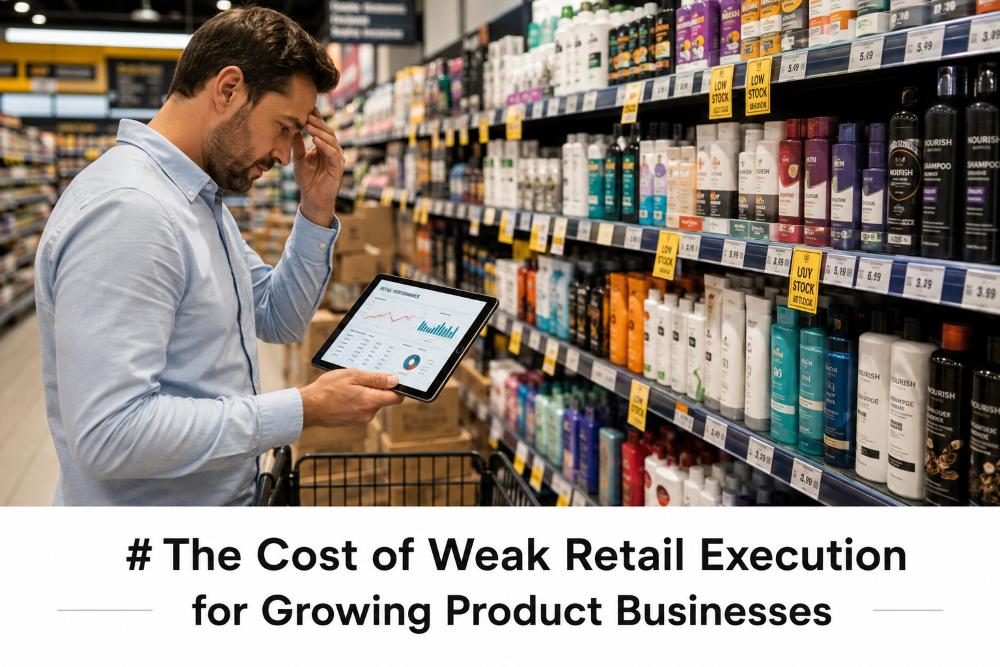
A growing product business finally lands placement in several retail stores. The owner expects a clear jump in sales. Instead, months pass and the numbers stay flat, sometimes even disappointing. The instinct is to blame the product. But often the real problem isn't what's inside the package, it's what happens after the product reaches the shelf. This is where retail execution comes in, and weak execution can quietly cost a business far more than most owners realize.
Getting Into Retail Is Only the Beginning
Securing shelf space feels like a milestone, and it is. But distribution alone doesn't guarantee sales. Once a product reaches a store, a business still has to manage visibility, availability, pricing, positioning, and how clearly the product communicates its value to shoppers. None of this happens automatically. It requires coordinated effort between the brand and the retailer, and businesses that treat placement as the finish line often find themselves confused when sales don't follow.
Poor Product Placement Can Reduce Product Discovery
Where a product sits on a shelf directly affects whether customers ever see it. A crowded store creates intense competition for attention, and placement in a low-traffic aisle or an awkward shelf position can bury even a strong product. Understanding customer traffic patterns, how a product category is typically shopped, where competitors sit, and general store layout all matter here. This isn't about packaging or display design. It's about strategic thinking around where a product has the best chance of being seen.
Stockouts Can Turn Customer Interest Into Lost Revenue
Strong demand means nothing if the product isn't on the shelf when a customer looks for it. Poor inventory forecasting, slow replenishment, weak communication with retail partners, and unexpected spikes in demand can all lead to stockouts. Every stockout is a missed sale, and often a missed opportunity to build loyalty with a customer who was ready to buy. Availability should be treated as a core part of retail execution, not an afterthought handled only when problems arise.
Inconsistent Retail Pricing Can Confuse Customers
When a product's price varies noticeably between stores or between online and offline channels, it can create confusion and erode trust. Customers who notice a price difference may question the brand's value or feel like they got a worse deal. Business owners should keep an eye on retail pricing, active promotions, discount patterns, and how their pricing compares to competitors. There's no universal rule for exact pricing, but consistency and intentionality matter more than most brands initially expect.
Weak Merchandising Can Waste Retail Investment
Getting a product into a store often takes real time and money. But if the product isn't supported once it arrives, that investment can go to waste. Merchandising decisions, meaning how a product is presented, arranged, and made visible, directly influence discovery and consideration. Some brands use tools like custom printed display boxes as one way to create a more organized, noticeable presence at retail, though the right approach depends heavily on the category and store environment. The larger point is that merchandising deserves the same strategic attention as the initial placement decision, not an afterthought once the product is already on the shelf.
Retail Staff Can Influence Product Performance
In categories where customers benefit from a quick explanation or recommendation, store employees play a bigger role than many brands realize. If staff don't understand a product's benefits, target customer, or key differentiators, they can't help sell it, even unintentionally. Businesses that invest a little effort into helping retailers understand their product often see better in-store outcomes, simply because the people closest to the customer are equipped to answer questions confidently.
Ignoring Competitor Activity Can Become Expensive
Retail environments shift constantly. Competitors adjust pricing, launch promotions, change placement, or introduce new products, and a strategy that worked six months ago may not work today. Brands that assume their original retail approach will keep performing without adjustment often get caught off guard. Regularly observing the competitive landscape helps businesses stay proactive instead of reactive.
Weak Measurement Makes Retail Problems Harder to Fix
Without solid measurement, it's difficult to know whether a sales slump is caused by weak demand, poor execution, availability issues, or pricing problems. Tracking sales by store, sales by product, stock availability, sell-through rates, repeat purchase behavior, promotional results, and retailer feedback gives businesses the clarity they need to diagnose issues accurately. Guessing at the cause of a problem often leads to the wrong fix. Measurement removes the guesswork.
The Business Cost Goes Beyond Lost Sales
Weak retail execution rarely stays contained to a single issue. It tends to cascade: poor execution leads to slower sales, which leads to excess inventory, which often forces deeper discounting, which then erodes margins. The ripple effects extend further still, touching cash flow, inventory planning, marketing efficiency, and relationships with retail partners. A business considering expansion into new stores or channels may also find those decisions delayed or complicated by unresolved execution problems in its existing footprint.
Building a Stronger Retail Execution System
- Define clear retail performance goals.
- Monitor product availability regularly.
- Review product placement where possible.
- Track sales by store and by product.
- Monitor competitor activity consistently.
- Coordinate promotions carefully across channels.
- Maintain consistent brand communication everywhere the product appears.
- Collect feedback directly from retailers.
- Identify underperforming locations quickly.
- Test improvements in a few stores before scaling them everywhere.
When Should a Business Reconsider Its Retail Strategy?
A few warning signs suggest it's time to look closer: sales stay below expectations even with strong customer interest, certain stores consistently underperform, products frequently go out of stock, inventory sits unsold for long stretches, promotions underdeliver, or retailers keep raising the same complaints. When a business can't clearly explain why some locations outperform others, that's usually a sign the execution process needs a closer look before assuming the product itself is the problem.
Conclusion
Retail expansion opens real opportunities, but placing products on shelves is not the same as building sustainable sales. Strong retail execution requires ongoing attention to availability, positioning, pricing, merchandising, competitor activity, staff communication, and performance measurement. Businesses that treat retail execution as a continuous strategic process, rather than a one-time distribution win, are the ones best equipped to turn physical shelf space into lasting, profitable growth.
- Managerial Effectiveness!
- Future and Predictions
- Motivatinal / Inspiring
- Fitness and Wellness
- Medical & Health
- Manufacturing
- Education
- Real-Estate
- Food Industry
- Hospitality
- Online Games
- Sports
- Home Services
- Civil Engineering
- Safety and Protection
- Software Products & Services
- Fashion and Jewellery
- Artificial Intelligence
- Entrepreneurship
- Mentoring & Guidance
- Marketing
- Networking
- HR & Recruiting
- Literature
- Shopping
- Career Management & Advancement