

 SkillClick
How a Dermatologist Diagnoses Skin Conditions
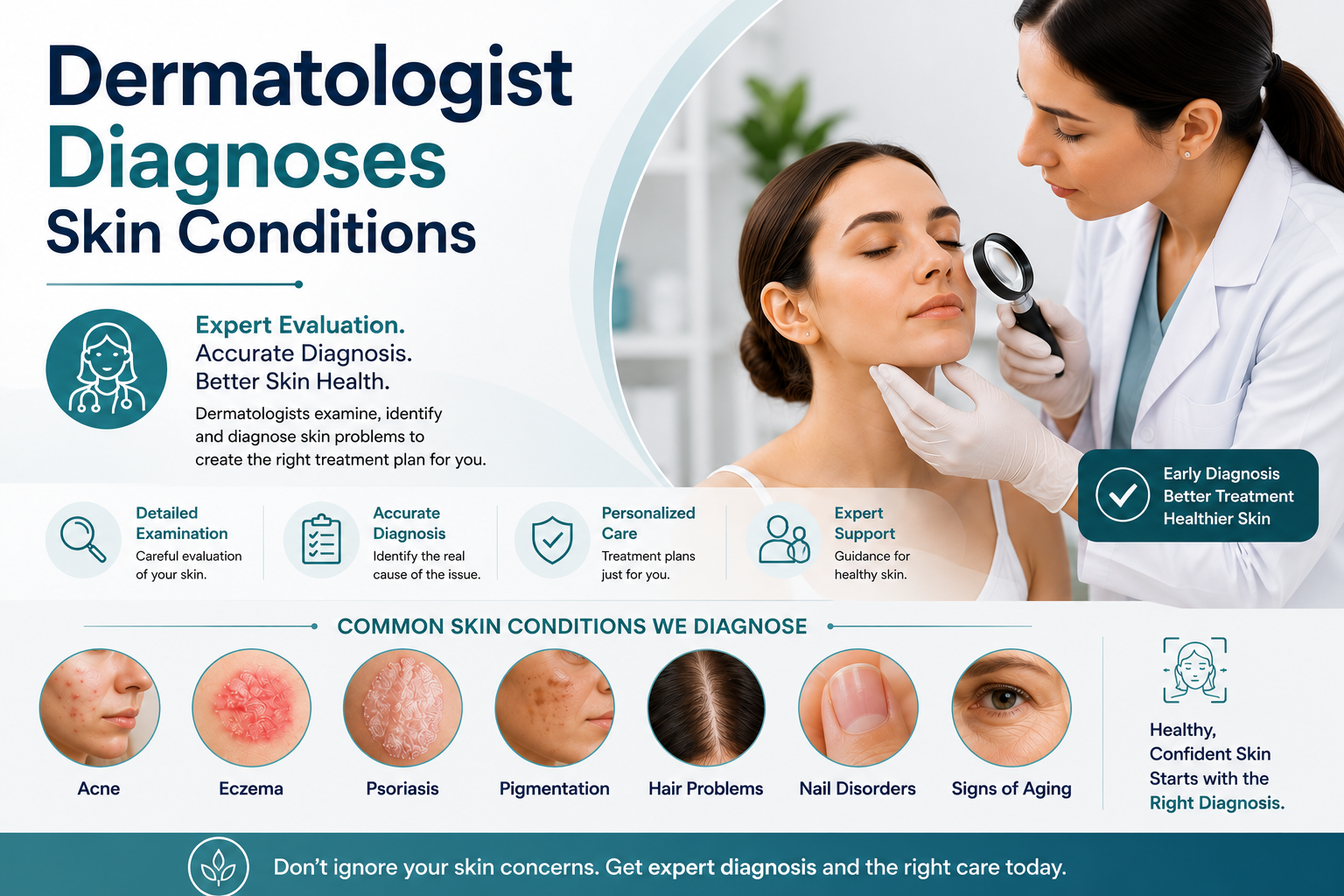
A rash, dark patch, recurring acne, unusual mole, or persistent itching may seem easy to identify, but many skin conditions can look similar. Redness, scaling, bumps, or changes in skin colour can have several possible causes, and the correct treatment depends on identifying the underlying condition.
This is why professional skin condition diagnosis involves more than simply looking at the affected area.
A dermatologist considers your symptoms, medical history, lifestyle, medications, and the appearance and distribution of the skin problem. In some situations, additional tests may be required to confirm a diagnosis.
Understanding how a dermatologist diagnoses skin conditions can make the consultation process clearer and help patients know what to expect.
The Diagnosis Starts with Your Medical History
Before examining the skin closely, a dermatologist will usually ask questions about the problem.
You may be asked:
- When did the symptoms begin?
- Did they appear suddenly or gradually?
- Have they become better or worse?
- Do you experience itching, pain, burning, or tenderness?
- Have you recently started any medicines or skincare products?
- Does anything seem to trigger the symptoms?
- Have you experienced the same problem before?
Your medical and family history may also be relevant.
For example, a history of allergies can provide useful context when evaluating certain rashes, while family history can sometimes be relevant to conditions such as psoriasis or particular patterns of hair loss.
Providing accurate information helps the dermatologist build a clearer picture before making a diagnosis.
Visual Examination of the Skin
A careful physical examination is one of the most important parts of dermatological diagnosis.
Dermatologists are trained to recognise patterns in skin changes. They look at characteristics such as colour, shape, texture, border, size, distribution, and location.
The location of symptoms can provide important clues. Certain skin conditions commonly affect particular areas of the body, while others follow distinctive patterns.
A dermatologist may also examine areas beyond the spot that concerns you. Looking at surrounding skin, the scalp, nails, or other body areas can sometimes provide additional information.
Understanding the Pattern of Symptoms
The way a skin problem develops can be just as important as how it looks.
For example, a dermatologist may consider whether the condition:
- Appeared after exposure to a new product
- Gets worse in certain weather
- Spreads gradually
- Repeatedly disappears and returns
- Affects both sides of the body
- Occurs alongside other symptoms
These patterns help narrow down possible causes.
This is especially useful because eczema, fungal infections, allergic reactions, psoriasis, and other conditions may occasionally share similar visible features.
Dermoscopy for a Closer Look
Sometimes a dermatologist needs a magnified view of the skin.
A dermatoscope is a handheld device that provides magnification and specialised lighting, allowing the dermatologist to examine structures beneath the skin surface that are difficult to see with the naked eye.
Dermoscopy is commonly used when assessing moles and other pigmented skin lesions, although it can also assist in evaluating various skin and hair conditions.
The examination is non-invasive and can provide additional information that helps determine whether a lesion should simply be monitored or requires further investigation.
Skin Scraping and Microscopic Examination
When a fungal infection or certain other conditions are suspected, the dermatologist may take a small scraping from the affected skin.
The sample can be examined or sent for testing to look for evidence of fungi or other organisms.
This can be particularly helpful when a rash resembles a fungal infection but the diagnosis isn't clear from appearance alone.
Confirming the cause helps prevent unnecessary or inappropriate treatment.
When Are Blood Tests Needed?
Blood tests aren't necessary for every dermatological condition.
However, they may sometimes be recommended when symptoms could be associated with an underlying medical problem.
For example, certain cases of hair loss may lead a dermatologist to consider tests for nutritional deficiencies, thyroid-related problems, or other relevant factors based on the patient's history and examination.
Blood tests may also be used before or during some systemic treatments to monitor health and medication safety.
The tests requested depend entirely on the individual situation.
Skin Biopsy
A skin biopsy involves removing a small sample of skin so it can be examined under a microscope by a pathologist.
Dermatologists may recommend a biopsy when the diagnosis cannot be confidently established through examination alone or when a particular skin disease or lesion requires confirmation.
Depending on the situation, different biopsy techniques may be used.
The area is usually numbed with local anaesthetic before the sample is taken. The tissue is then sent to a laboratory for analysis.
A biopsy can provide valuable information, but it is not required for most routine skin concerns.
Allergy and Patch Testing
When contact allergy is suspected, a dermatologist may recommend patch testing.
Small amounts of selected substances are placed on the skin, usually on the back, and monitored over a period of time for reactions.
This can help identify substances that may be triggering allergic contact dermatitis.
Patch testing is different from other forms of allergy testing, and whether it is appropriate depends on the symptoms and suspected condition.
Diagnosing Hair and Scalp Conditions
Dermatologists also diagnose problems involving the hair and scalp.
The assessment may include examining the pattern of hair loss, scalp condition, hair density, and individual hair shafts.
A dermatologist may ask about recent illness, stress, diet, medications, family history, hormonal changes, and how quickly the hair loss developed.
Depending on the findings, further investigations such as blood tests, microscopic examination, or occasionally a scalp biopsy may be considered.
Identifying the cause is important because different forms of hair loss require different approaches.
Diagnosing Nail Conditions
Changes in nail colour, shape, thickness, or texture can result from many causes.
Fungal infections are one possibility, but nail changes may also be associated with trauma, inflammatory skin conditions, or other factors.
A dermatologist may examine the nails and surrounding skin and, when necessary, collect nail material for laboratory testing.
This helps avoid treating every abnormal-looking nail as a fungal infection.
Why Self-Diagnosis Can Be Difficult
Online information and photographs can help people learn about skin conditions, but they cannot always provide a reliable diagnosis.
Many conditions share similar symptoms. A red patch could represent dermatitis, an infection, psoriasis, or another condition. Hair loss can have multiple causes. Pigmentation changes can also develop for different reasons.
Using treatment intended for the wrong condition may fail to help and can sometimes change the appearance of the problem, making later diagnosis more difficult.
A dermatologist combines visual examination with medical history and appropriate diagnostic tests to reach a more informed conclusion.
What Happens After the Diagnosis?
Once the likely condition has been identified, the dermatologist can discuss suitable treatment options.
Treatment may include skincare changes, topical medication, oral medicines, lifestyle recommendations, procedures, or monitoring, depending on the diagnosis.
Some conditions improve after a short course of treatment, while chronic skin diseases may require ongoing management and follow-up.
Patients should also have an opportunity to understand their diagnosis, how to use prescribed treatments, possible side effects, and when they should return for review.
When Should You Seek a Dermatological Evaluation?
Consider consulting a dermatologist if you experience a skin problem that persists, repeatedly returns, spreads, becomes painful, causes significant itching, or doesn't improve with appropriate basic care.
Unexplained hair loss, persistent scalp problems, recurring infections, and unusual changes in the nails may also warrant evaluation.
A new or changing mole or skin growth should be professionally assessed, particularly if there are changes in its size, shape, colour, border, or behaviour.
Conclusion
Understanding how a dermatologist diagnoses skin conditions shows why accurate diagnosis is an important part of effective treatment.
Dermatologists don't rely on appearance alone. They combine medical history, symptom patterns, physical examination, and tools such as dermoscopy, skin scrapings, blood tests, patch testing, or biopsies when appropriate.
Not every skin problem requires extensive testing. In many cases, a dermatologist can make a diagnosis through history and examination. When additional information is needed, targeted tests can help clarify the cause and guide treatment.
Getting the diagnosis right helps ensure that treatment is directed at the actual condition rather than simply the symptoms visible on the skin.
Frequently Asked Questions
Can a dermatologist diagnose a skin condition just by looking at it?
Many common skin conditions can be diagnosed through medical history and physical examination. Additional tests may be needed when the diagnosis is uncertain.
Does every skin problem require a blood test?
No. Blood tests are only used when a dermatologist suspects an underlying issue or needs additional information relevant to diagnosis or treatment.
Why would a dermatologist perform a skin biopsy?
A biopsy may be recommended when microscopic examination of a skin sample is needed to confirm or clarify a diagnosis.
How long does a dermatology diagnosis take?
Some conditions can be identified during the first consultation, while others may require laboratory tests, a biopsy, or follow-up before a diagnosis is confirmed.
- Managerial Effectiveness!
- Future and Predictions
- Motivatinal / Inspiring
- Fitness and Wellness
- Medical & Health
- Manufacturing
- Education
- Real-Estate
- Food Industry
- Hospitality
- Online Games
- Sports
- Home Services
- Civil Engineering
- Safety and Protection
- Software Products & Services
- Fashion and Jewellery
- Artificial Intelligence
- Entrepreneurship
- Mentoring & Guidance
- Marketing
- Networking
- HR & Recruiting
- Literature
- Shopping
- Career Management & Advancement