

 SkillClick
RFID Card Manufacturing & Supply in India
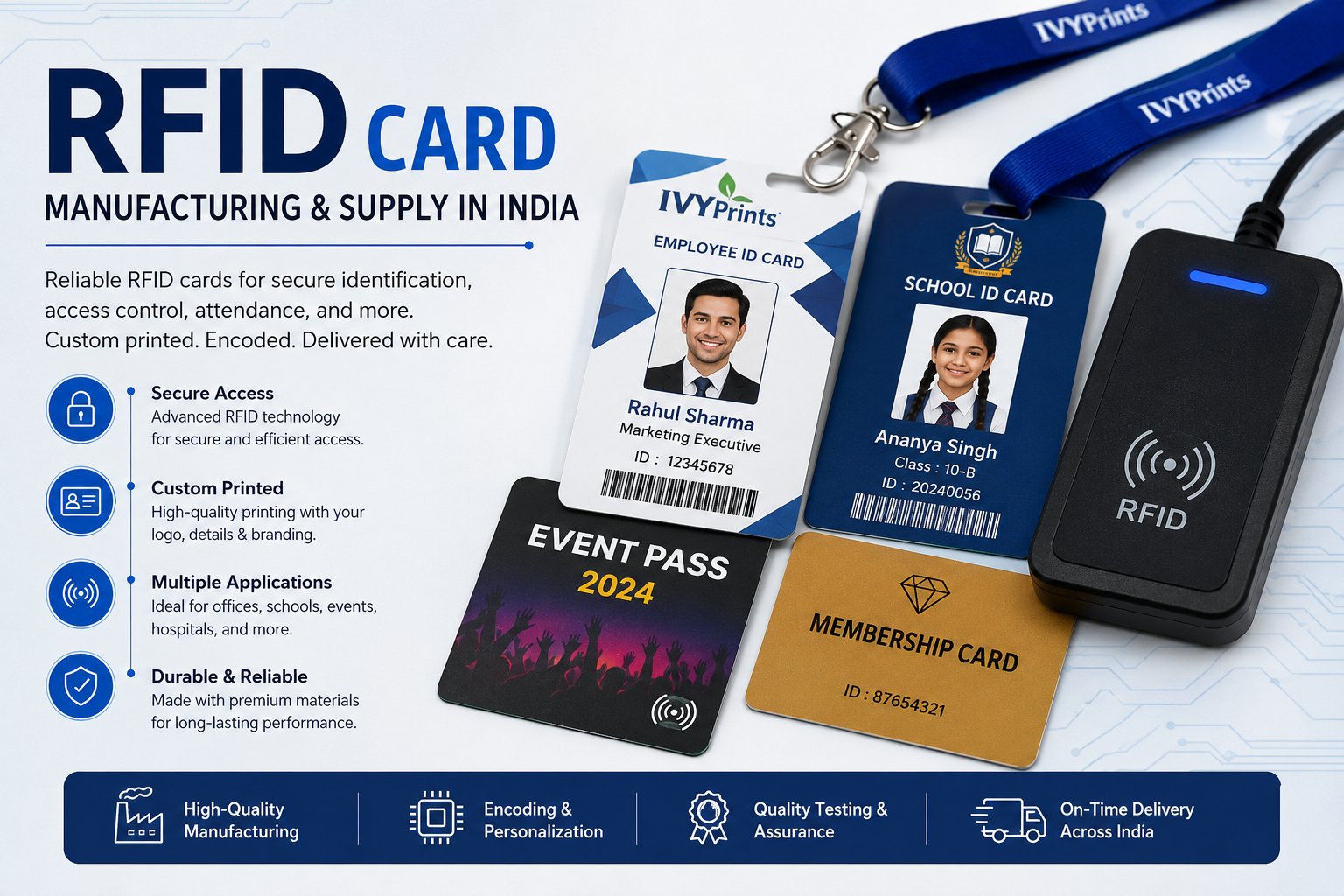
Individuals from the business, school, hospitals, offices and event organiser fields are increasingly calling for identification systems that are fast, reliable and hassle-free. The RFID card technology provides an additional level of convenience since no contact is required with a reader to be identified and data transmitted. RFID-enabled cards can be used in a variety of applications, including employee access cards, student identification and event management.
In India, the production of RFID cards and their supply requires more than just printing a design on a plastic card. The right card should be equipped with the proper RFID technology, built to withstand wear and tear, properly encoded, readably compatible, and professionally personalized.
What is an RFID Card?
An RFID card is a card with an RFID chip and antenna that communicates with a compatible reader, wirelessly. The card can be a different type of technology and can communicate at different frequencies, with different distance and applications.
Don't consider RFID as a monolithical technology. There are differences between low frequency (LF), high frequency (HF) and ultra-high-frequency (UHF) systems. Passive UHF RFID, also known as RAIN RFID, is used extensively for applications where the identification needs to be captured quickly and without direct line of sight viewing, GS1 says.
Proximity identification cards are the subject of standards like ISO/IEC 14443, which outline physical features and communication needs for contactless proximity objects.
How Are RFID Cards Manufactured?
The manufacturing process depends on the card material, chip type, antenna design, printing requirements, and intended application. A typical production workflow includes several stages.
1. Selecting the RFID Inlay
The RFID inlay generally contains the chip and antenna. The choice of inlay depends on the reader, operating frequency, memory requirements, read range, and application.
For example, a short-range access-control card may require a different technology from a UHF card designed for inventory or asset identification.
2. Card Construction
The inlay is placed between layers of PVC, PET, PETG, or another suitable card material. These layers are bonded or laminated to create a durable card body.
Good manufacturing practices are important at this stage because poor bonding, incorrect positioning, or excessive heat can affect the performance of the embedded RFID component.
3. Printing and Personalization
Once the card structure is prepared, it can be customized with company logos, employee photographs, names, identification numbers, QR codes, barcodes, or other information.
For organizations, personalization is often just as important as RFID functionality because the card also serves as a visible identification credential.
4. Encoding and Testing
The RFID chip can be programmed or encoded according to the requirements of the application. Each card may receive a unique identifier or other approved data.
Finished cards should be tested with compatible readers to check communication and confirm that the required data can be read correctly.
Types of RFID Cards Available in India
RFID card suppliers may offer different options depending on the intended use.
HF RFID Cards
The most popular application for HF cards is proximity. They can be used in access control, identification, membership management, and other applications that require short-range communication.
UHF RFID Cards
The advantages of UHF technology are for applications that demand greater read distance or faster identification. GS1's EPC Gen2 air-interface technology is optimized for passive UHF RFID systems that work in the 860-930 MHz frequency band.
NFC-Compatible Cards
NFC is similar to HF contactless technology and can be beneficial in a variety of applications related to smartphones, digital identification, information sharing and contactless communication. Actual capabilities are dependent on the chip and implementation.
Custom RFID ID Cards
RFID may be integrated with traditional visual identification for organizations. Along with the embedded RFID component, a card can contain a photo of the employee, their department, company branding, a barcode or a QR code.
Applications of RFID Cards
RFID cards can be customized for various ID and access needs.
Common applications include:
Employee access and identification
Student cards and college ID cards.Student and college ID cards.
Attendance systems
Visitor management
Membership cards
Event identification
Hotel and hospitality applications.
Access-control systems
Transport and facility management.
Library identification
Campus security
When combined with appropriate readers and software, the technology can decrease the need for manual identification and can increase the speed of routine verification.
What to Consider When Choosing an RFID Card Supplier
Choosing a supplier should not be done simply on the basis of a price per card.
It is essential to ensure that the chip and frequency compatibility are met.
First, make sure that the card has a technology called RFID that is compatible with your current reader and software. If the embedded card fails to communicate with the deployed system, then the card is of little value.
Printing Quality
Check for clarity in text, uniform colour, correct photographs and solid finish. Professional printing also helps with usability and organization for employee/Student cards.
Encoding Requirements
If each card is to be individually identified or coded, be sure to explain how this coding is to be done before ordering. Inquire if the supplier can offer any of the following: number it, print it on a database, or batch it.
Card Durability
Day-to-day use, storage and environmental conditions should not cause failure of cards used daily. The service life can be influenced by material selection and lamination.
Testing and Quality Control
Good supplier should provide a means to test the finished cards. Visual inspection, chip reading, personalization accuracy, and batch-level quality tests are examples of testing that may be performed.
IVYPrints for RFID Card Manufacturing and Supply
IVYPrints offers RFID card solutions for organisations requiring customised ID cards that include RFID functionality. It can be customized to suit various applications like employee ID cards, educational identification, access control, events and more.
Working with a specialised card supplier means that the need for printing and RFID can be taken into account simultaneously. Organizations can define the whole card requirement from the outset, rather than the different steps of card design, card finishing, and card treatment as separate.
It is helpful to provide the required card size, quantity, whether the card needs to be RFID, the type of card being printed, personalization information and intended applications when requesting a quotation. This will help the supplier to make more suitable recommendations instead of just supplying an ‘off the shelf' card.
Why RFID Card Quality Matters
There are various factors that influence the performance of a RFID system: the RFID chip, the antenna, the RFID reader, the operating environment, the type of the card and the system configuration. A card that is effective in a certain environment may not be so effective in another.
This is why it is important for organisations to test the samples prior to ordering a high volume production run, especially if the cards are to be used with existing access-control/attendance systems.
Standards also matter. There are several ISO and GS1 specifications for various aspects of contactless cards and RFID systems. For instance, GS1 standards for RFID include those for the EPC data format, UHF air-interface protocols, and more.
Conclusion
For organisations seeking quicker identification, contactless interaction and enhanced integration with access control or management systems, RFID cards are becoming a viable alternative. But the first step in successfully implementing RFID is selecting the right technology and supplier that can provide the consistent card quality necessary to achieve success.
Instead of choosing the supplier based on the price, the buyer must consider some other factors, such as chip compatibility, construction of the card, printing quality, encoding, testing, customization, and after-sales support, when purchasing cards in India.
When properly designed and managed, RFID cards can form a reliable identification and access-control tool for an organization.
- Managerial Effectiveness!
- Future and Predictions
- Motivatinal / Inspiring
- Fitness and Wellness
- Medical & Health
- Manufacturing
- Education
- Real-Estate
- Food Industry
- Hospitality
- Online Games
- Sports
- Home Services
- Civil Engineering
- Safety and Protection
- Software Products & Services
- Fashion and Jewellery
- Artificial Intelligence
- Entrepreneurship
- Mentoring & Guidance
- Marketing
- Networking
- HR & Recruiting
- Literature
- Shopping
- Career Management & Advancement