

 SkillClick
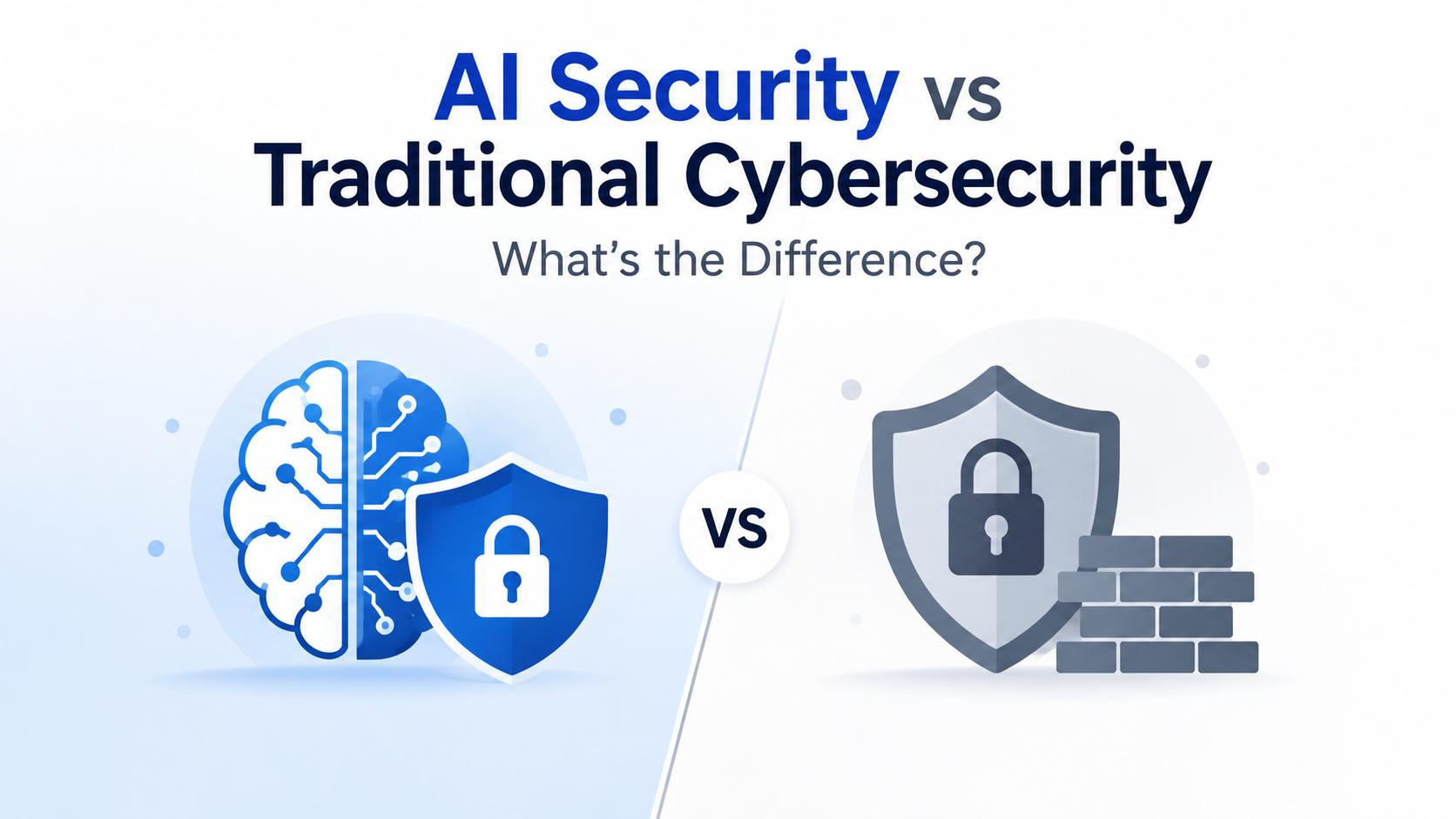
AI Security vs Traditional Cybersecurity: What’s the Difference?
Imagine your business network suddenly gets hundreds of suspicious login attempts. A traditional security system may recognize known attack patterns and block some of them. But what happens when the attacker changes the pattern every few minutes?
That is where AI security becomes valuable. It uses artificial intelligence to study behavior, identify unusual activity, and help security teams respond faster.
The important point is that AI security does not replace traditional cybersecurity. Instead, it adds new capabilities to an existing security strategy.
What Is the Difference Between AI Security and Traditional Cybersecurity?
The main difference is how threats are detected and handled. Traditional cybersecurity mainly depends on predefined rules, signatures, and security controls. AI security can learn from data and recognize unusual behavior.
Traditional cybersecurity remains essential for protecting networks, devices, applications, and data. AI adds another layer that can help security teams deal with large amounts of information and changing threats.
For example, a traditional system may block a login because the password is incorrect several times. An AI powered cybersecurity system could also notice that the login came from an unusual location, at an unusual time, using a device the employee has never used before.
The two approaches work best together.
|
Area |
Traditional Cybersecurity |
AI Security |
|
Threat detection |
Uses known rules and signatures |
Finds patterns and unusual behavior |
|
Response |
Often follows predefined actions |
Can recommend or automate responses |
|
Data analysis |
Mainly rule based |
Can analyze large volumes of data |
|
Unknown threats |
Can be harder to identify |
Better suited to spotting unusual activity |
|
Human involvement |
Often higher |
Can reduce repetitive investigation |
|
Adaptability |
Requires rule and signature updates |
Can learn from new data and patterns |
How Does AI Security Detect Threats Differently?
AI security looks for patterns that may indicate something is wrong. Instead of asking only whether an action matches a known attack, it can also ask whether the action looks normal for that user, device, or network.
This makes behavioral analysis one of its biggest strengths.
An AI system can examine signals such as login times, device activity, network traffic, file access, and application behavior. When several signals look unusual together, the system can raise an alert.
AI cyber security can also help security teams prioritize alerts. This matters because security professionals may receive thousands of alerts, while only a small number may represent serious threats.
IBM’s 2025 Cost of a Data Breach research found that organizations making extensive use of AI in security reported an average savings of $1.9 million compared with organizations that did not use these capabilities.
Still, AI is not perfect. Poor quality data, incorrect models, and unusual legitimate behavior can produce false alarms.
Why Is Traditional Cybersecurity Still Important?
Traditional cybersecurity is still the foundation of a strong security program. Firewalls, encryption, identity controls, access policies, secure software practices, and regular updates remain necessary.
AI does not remove the need for these basic protections.
In fact, AI cyber security solutions work best when they are connected to strong security fundamentals. If an organization has weak passwords, poor access controls, outdated software, or unmanaged devices, adding AI will not magically solve those problems.
Think of it like protecting a house. A smart security camera is useful, but you still need strong doors and locks.
Organizations should continue to focus on:
-
Strong identity and access controls
-
Regular software and security updates
-
Network and endpoint protection
-
Data encryption and backup
-
Employee security awareness
-
Tested incident response plans
NIST also notes that cybersecurity risks remain relevant throughout the design, development, deployment, evaluation, and use of AI systems.
What New Risks Does AI Introduce?
AI can strengthen security, but it can also create new risks. Businesses using AI must protect the AI systems themselves, along with the data they process.
This is where AI Risk Management becomes important.
Organizations need to consider risks such as sensitive information entering AI tools, unauthorized access to AI systems, manipulated data, unreliable AI outputs, and attacks designed to influence AI behavior.
NIST created its AI Risk Management Framework to help organizations manage risks connected with designing, developing, deploying, and using AI systems. Its guidance focuses on building trustworthy and secure AI rather than simply adding AI as another technology layer.
A practical example is an employee using a public AI tool to summarize a confidential customer document. The employee may have good intentions, but the organization could still create a data exposure risk.
That is why AI governance and access controls matter.
Can AI Security Replace Traditional Cybersecurity?
No. AI security should complement traditional cybersecurity, not replace it.
Traditional controls provide the basic protection needed to secure infrastructure and information. AI can improve detection, analysis, prioritization, and response.
A strong security strategy combines both approaches.
AI powered cybersecurity can help organizations identify suspicious behavior faster, reduce repetitive investigation work, and support security analysts. However, human judgment remains important, particularly when an alert could affect customers, employees, systems, or business operations.
AI systems can also make mistakes. Security teams need clear rules for when automated actions are allowed and when a human should review a decision.
The best approach is therefore not AI versus traditional cybersecurity. It is AI plus strong cybersecurity fundamentals.
How Should Businesses Combine Both Approaches?
Businesses should start with their existing security foundation and then identify where AI can provide the most value.
A practical approach includes four steps.
First, understand the current security environment. Identify critical systems, sensitive data, common threats, and existing gaps.
Second, strengthen basic controls. Improve identity protection, access management, patching, backups, monitoring, and employee awareness.
Third, introduce AI where it can solve a clear problem. This could include unusual behavior detection, alert prioritization, fraud detection, or automated investigation.
Fourth, create AI Risk Management practices. Define who can use AI, what data can be shared, how AI systems are monitored, and what happens when something goes wrong.
IBM’s 2025 research also highlights a major AI governance gap. Globally, 63 percent of surveyed organizations lacked AI governance policies to manage AI or prevent shadow AI, while 97 percent of organizations reporting an AI related security incident lacked proper AI access controls.
These numbers show why adopting AI without security planning can create another problem instead of solving one.
Which Approach Is Better for Modern Businesses?
Neither approach is better on its own. Modern businesses need both traditional cybersecurity and AI security.
Traditional cybersecurity provides proven controls for protecting infrastructure, accounts, applications, and data. AI adds speed, pattern recognition, and the ability to process large amounts of security information.
At Rubixe, businesses can look at AI as part of a broader security strategy rather than treating it as a replacement for established cybersecurity practices.
The right solution depends on the organization’s size, industry, data, technology environment, and risk level.
Frequently Asked Questions About AI Security
Is AI security better than traditional cybersecurity?
AI security is not simply better. It provides capabilities that traditional tools may not offer, especially for behavioral analysis and large scale threat detection. Both approaches work best together.
What are AI cyber security solutions used for?
AI cyber security solutions can help with threat detection, unusual behavior analysis, alert prioritization, fraud monitoring, security automation, and incident investigation.
Does AI make cybersecurity completely automatic?
No. AI can automate many repetitive tasks, but human oversight remains important. Security teams still need to validate important decisions and manage complex incidents.
Why is AI Risk Management important?
AI Risk Management helps organizations identify and control risks related to AI systems, including data exposure, access problems, unreliable outputs, and security vulnerabilities.
What is the future of AI powered cybersecurity?
AI powered cybersecurity is likely to become a larger part of modern security operations. However, organizations will still need strong identity controls, secure infrastructure, governance, skilled professionals, and clear response processes.
Conclusion
The difference between AI security and traditional cybersecurity is mainly about how security information is analyzed and how threats are detected.
Traditional cybersecurity provides the foundation. AI can make that foundation more responsive by finding unusual patterns, helping teams prioritize threats, and automating selected tasks.
The smartest strategy is not to choose one over the other. Businesses should combine proven security controls with carefully governed AI capabilities.
If your organization is exploring AI cyber security solutions, start by identifying your biggest security gaps and then choose AI capabilities that address real business risks. Rubixe can help organizations evaluate where AI can strengthen their broader cybersecurity strategy while keeping security, governance, and human oversight at the center.
- Managerial Effectiveness!
- Future and Predictions
- Motivatinal / Inspiring
- Fitness and Wellness
- Medical & Health
- Manufacturing
- Education
- Real-Estate
- Food Industry
- Hospitality
- Online Games
- Sports
- Home Services
- Civil Engineering
- Safety and Protection
- Software Products & Services
- Fashion and Jewellery
- Artificial Intelligence
- Entrepreneurship
- Mentoring & Guidance
- Marketing
- Networking
- HR & Recruiting
- Literature
- Shopping
- Career Management & Advancement