

 SkillClick
Master of Social Work in One Year: Admission, Eligibility & Career Guide
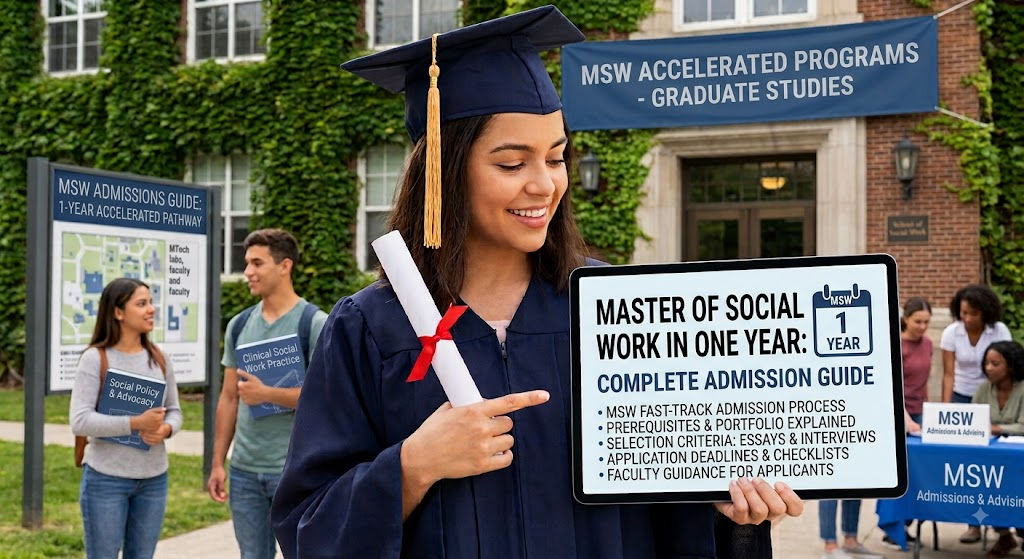
A Master of Social Work in one year is an option that attracts graduates, working professionals and students who want to build advanced knowledge in social welfare, community development, counselling, human services and development-sector management.
Social work has expanded beyond traditional welfare activities. Today, trained professionals work with NGOs, hospitals, schools, government projects, corporate social responsibility teams, community organisations and international development agencies. This has increased interest in postgraduate programmes such as the Master of Social Work (MSW).
At the same time, students should be careful when searching for a one-year MSW course. The duration of a master's programme depends on the student's previous qualification, the university's academic structure and applicable higher-education regulations. A course advertised as "MSW in one year" should therefore be verified before admission.
What Is a Master of Social Work?
The Master of Social Work (MSW) is a postgraduate programme that prepares students for professional work in social welfare and human services.
The course generally combines theoretical learning with practical exposure. Students may study social policy, community development, counselling, research, social welfare administration and social work methods.
Depending on the university, common areas of study can include:
-
Social work theory and practice
-
Community organisation
-
Social welfare administration
-
Social research
-
Counselling
-
Human rights
-
Community development
-
Family and child welfare
-
Medical and psychiatric social work
-
Labour welfare
-
Rural and urban development
-
Disaster management
-
NGO management
An MSW can therefore provide a broad foundation for careers involving individuals, families, communities and social-development programmes.
Can You Complete MSW in One Year?
The answer depends on the specific university, programme structure and eligibility route.
Under the UGC's 2025 postgraduate regulations, higher education institutions can offer different master's structures based on the student's undergraduate qualification and credits. A one-year postgraduate programme can be available to eligible students who have completed a relevant four-year bachelor's degree with Honours or Honours with Research, subject to the applicable academic framework.
This does not mean that every student with a bachelor's degree can automatically complete MSW in 12 months.
Students should ask the university:
-
What is the official programme duration?
-
Which undergraduate qualifications are accepted?
-
Does the one-year route require a four-year bachelor's degree?
-
How many credits are required?
-
Is the programme currently offered under the applicable regulations?
-
Is the programme recognised for the relevant academic session?
-
What practical training is required?
-
What degree will be awarded after completion?
These questions are particularly important when comparing programmes advertised online.
Eligibility for MSW in One Year
Eligibility varies between universities.
For a conventional MSW programme, universities may accept candidates with a bachelor's degree from a recognised institution. Some institutions may have specific subject, percentage or entrance requirements.
For a one-year postgraduate route, eligibility can be more specific under the applicable UGC framework.
Students may need to consider:
-
Duration of their bachelor's degree
-
Undergraduate specialisation
-
Minimum marks or CGPA
-
Honours or Honours with Research status, where applicable
-
Entrance examination requirements
-
University-specific eligibility rules
Candidates should always check the latest admission notification of the university instead of assuming that a general graduation degree is sufficient.
MSW After Graduation
Students from a variety of academic backgrounds may be interested in pursuing social work.
Graduates from subjects such as sociology, psychology, political science, education, economics, humanities and other disciplines may find social-work education relevant, depending on the university's eligibility requirements.
For example:
BA Sociology → MSW
BA Psychology → MSW
BA Political Science → MSW
BBA/BCom → MSW, where accepted by the institution
The suitability of a particular academic background depends on the university and the chosen MSW programme.
One Year MSW Admission Process
The admission process can vary, but students can generally follow these steps.
1. Select an MSW Specialisation
Decide which area of social work interests you most. Possible areas include community development, medical social work, counselling, human resource management, rural development and NGO management.
2. Check Eligibility
Review the university's official admission requirements and confirm that your undergraduate qualification meets the conditions for the programme.
3. Check Admission Method
Some institutions offer admission based on academic merit, while others may conduct entrance examinations, interviews or counselling.
4. Verify Recognition
Confirm the university's authority to award the degree and check the programme's applicable status for the academic session.
5. Submit Documents
Common documents may include:
-
Bachelor's degree certificate
-
Semester marksheets
-
Transfer certificate
-
Migration certificate, where required
-
Identity proof
-
Passport-size photographs
-
Entrance scorecard, where applicable
-
Category or other supporting documents, if required
6. Complete Enrolment
After selection, students can complete fee payment and enrolment through the university's authorised admission process.
MSW in One Year Fees
The MSW one-year course fees vary according to the university, programme structure and mode of education.
The total cost may include:
-
Application fee
-
Tuition fee
-
Examination fee
-
Study materials
-
Fieldwork or practical charges
-
Project or dissertation fee
-
Administrative charges
Students should request a complete fee structure before admission.
Do not compare programmes only on the basis of their initial admission fee. Find out whether examination, fieldwork, project and other charges are included in the advertised amount.
Fieldwork: An Important Part of Social Work Education
Social work is a practical profession, so field exposure can be an important component of an MSW programme.
Students may gain experience working with:
-
NGOs
-
Hospitals
-
Schools
-
Community organisations
-
Rehabilitation centres
-
Government welfare programmes
-
Corporate social responsibility projects
-
Rural development organisations
Fieldwork can help students understand how social-work theories are applied in real situations.
Anyone considering a one-year MSW degree should therefore ask how fieldwork, internships and practical training are incorporated into the programme.
A programme that focuses only on issuing a certificate without meaningful academic or practical requirements should be approached with caution.
Popular MSW Specialisations
Community Development
This area focuses on improving social and economic conditions within communities through development programmes and participation.
Medical and Psychiatric Social Work
Professionals in this area may work in healthcare environments, supporting patients and families and coordinating social resources.
Family and Child Welfare
This specialisation focuses on children, families, vulnerable groups and welfare interventions.
Rural Development
Students learn about rural communities, development programmes, livelihoods and social-economic challenges.
Human Resource Management
Some social-work programmes provide exposure to employee welfare, organisational behaviour, labour relations and workplace development.
NGO and Development Management
This area is relevant to students interested in managing social-development programmes, fundraising, community initiatives and non-government organisations.
Career Opportunities After MSW
An MSW can open career opportunities across public, private and non-profit organisations.
Depending on the candidate's specialisation and employer requirements, potential roles include:
-
Social Worker
-
Community Development Officer
-
Programme Coordinator
-
NGO Professional
-
Counsellor
-
Welfare Officer
-
Medical Social Worker
-
Child Welfare Professional
-
Rehabilitation Professional
-
CSR Professional
-
Project Officer
-
Social Researcher
-
Human Resource or Employee Welfare Professional
Career opportunities vary according to the organisation, location, experience and job requirements.
Government Jobs After MSW
MSW graduates may find opportunities in government welfare departments, social-development programmes, hospitals, child welfare services, rehabilitation organisations and other public institutions.
However, government recruitment rules vary from position to position. Some posts may require a specific degree, experience, entrance examination or professional qualification.
Therefore, students should always check the latest official recruitment notification before applying.
An MSW degree does not automatically guarantee a government job.
MSW for Working Professionals
A one-year MSW for working professionals can be attractive to people already employed in NGOs, healthcare, education, human resources or community-development organisations.
Flexible education can allow professionals to continue working while studying.
Before choosing a programme, working professionals should check:
-
Class requirements
-
Attendance rules
-
Examination schedule
-
Fieldwork requirements
-
Project deadlines
-
Online or offline learning format
-
Recognition status
-
Total programme fees
The programme should fit your professional schedule without compromising academic requirements.
Online and Distance MSW
Online and Open and Distance Learning programmes can provide flexibility for students who cannot attend conventional classes.
However, students should verify the specific programme's status rather than assuming that every university can offer every programme through every mode.
Before enrolling in an online MSW or distance MSW, check:
-
University recognition
-
Programme entitlement for the relevant session
-
Mode of education
-
Examination method
-
Fieldwork requirements
-
Project requirements
-
Total fees
Official regulatory information should be preferred over claims made by education agents or third-party websites.
Benefits of Pursuing MSW
A recognised MSW can provide several benefits.
Professional Knowledge
Students develop advanced knowledge of social welfare, community development and social-work practices.
Practical Exposure
Fieldwork can provide experience working with real communities and organisations.
Career Flexibility
Graduates can explore opportunities in NGOs, hospitals, schools, government programmes and corporate organisations.
Specialisation
Students can focus on areas such as medical social work, child welfare, rural development or community development.
Further Education
Eligible graduates may pursue research programmes, doctoral studies or other advanced qualifications.
How to Choose the Right One-Year MSW Programme
Before admission, compare programmes on more than duration.
Check eligibility: Confirm that your undergraduate qualification meets the requirements.
Verify recognition: Make sure the institution and programme are properly authorised.
Review the curriculum: Look for subjects relevant to your intended career.
Check practical training: Ask how fieldwork and internships are organised.
Compare fees: Calculate the complete cost.
Research career requirements: If you have a specific job in mind, check its educational criteria.
Check future study options: If you intend to pursue research or a PhD, verify whether the programme meets the relevant eligibility requirements.
Beware of Unverified One-Year MSW Claims
The growing demand for fast-track education can result in misleading advertisements.
Students should be cautious about claims such as:
-
"MSW without exams"
-
"Direct MSW certificate"
-
"Guaranteed MSW degree in 12 months"
-
"Backdated MSW degree"
-
"MSW without study"
-
"Government job guaranteed"
A legitimate postgraduate programme should clearly explain its eligibility, curriculum, credits, examinations, fieldwork and degree-awarding authority.
Always verify these details before paying admission fees.
Frequently Asked Questions
Is MSW available in one year?
A one-year postgraduate route may be available for eligible students under applicable academic frameworks. The exact availability depends on the university and programme.
Can I do MSW after graduation?
Yes, subject to the university's eligibility requirements. Some institutions accept graduates from various disciplines.
Can I do MSW after a three-year bachelor's degree?
Eligibility depends on the programme. A one-year master's route may have different eligibility requirements from a conventional two-year MSW.
Is an online MSW valid?
An online MSW may be valid when offered by an institution under the applicable regulatory framework. Students should verify the specific programme and academic session before admission.
What can I do after MSW?
Graduates can explore social-work, NGO, community-development, healthcare, CSR, welfare, research and related roles, depending on their qualifications and employer requirements.
Conclusion
A Master of Social Work in one year can be an appealing option for eligible graduates and professionals who want to gain postgraduate knowledge in social welfare and community development within a shorter academic period.
However, students should not choose an MSW programme simply because it promises fast completion. Eligibility, recognition, academic credits, fieldwork, curriculum, fees and career relevance are equally important.
The UGC's current postgraduate framework provides a one-year master's pathway for eligible students with relevant four-year undergraduate qualifications, but the exact availability and structure of a one-year MSW depend on the university and its approved programme.
Before admission, verify the MSW eligibility, programme duration, recognition, mode of study, fieldwork requirements and total fees. A properly structured and recognised MSW can provide a strong foundation for careers in social services, community development, healthcare, NGOs, CSR and welfare organisations.
- Managerial Effectiveness!
- Future and Predictions
- Motivatinal / Inspiring
- Fitness and Wellness
- Medical & Health
- Manufacturing
- Education
- Real-Estate
- Food Industry
- Hospitality
- Online Games
- Sports
- Home Services
- Civil Engineering
- Safety and Protection
- Software Products & Services
- Fashion and Jewellery
- Artificial Intelligence
- Entrepreneurship
- Mentoring & Guidance
- Marketing
- Networking
- HR & Recruiting
- Literature
- Shopping
- Career Management & Advancement