

 SkillClick
India Leads Electric Three Wheeler Market While Southeast Asia Gains Momentum
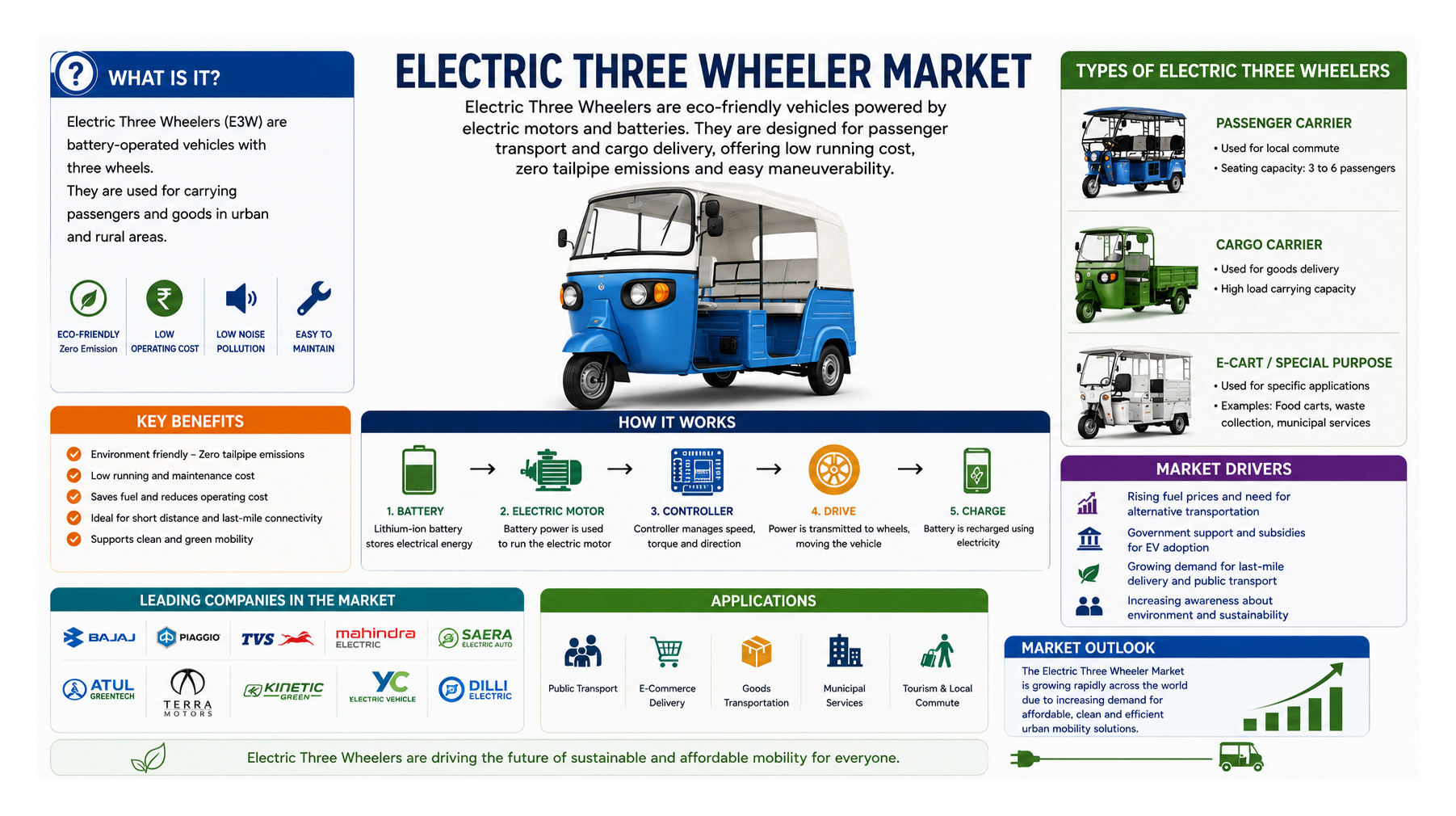
The global electric three-wheeler market is entering a high-growth phase as urban mobility systems increasingly shift toward cleaner, more economical transportation. The market is expected to be valued at US$ 4.8 billion in 2026 and projected to reach US$ 12.0 billion by 2033, expanding at a CAGR of 14.0% between 2026 and 2033. Rising government support for electric mobility, declining lithium-ion battery costs, and growing demand for efficient last-mile transportation are creating favorable conditions for market expansion.
Electric three-wheelers are particularly suited to densely populated cities because of their compact size, maneuverability, comparatively low operating costs, and ability to support passenger as well as cargo transportation. India currently represents the largest market, while Southeast Asia and Africa are emerging as promising markets as governments, fleet operators, and consumers accelerate the transition toward low-emission mobility.
🔗 Learn more: https://www.persistencemarketresearch.com/market-research/electric-three-wheelers-market.asp
Market Trends
A defining trend reshaping the electric three-wheeler industry is the rapid integration of advanced battery and connected vehicle technologies. Manufacturers are increasingly developing models with improved battery capacity, longer driving ranges, faster charging capabilities, and intelligent energy management systems. These improvements are addressing earlier concerns related to range limitations and charging convenience.
The emergence of battery-swapping models is another notable trend, particularly for commercial operators with high vehicle utilization. Swapping depleted batteries for charged units can significantly reduce downtime compared with conventional charging. Connected fleet-management platforms are also gaining importance, allowing operators to monitor vehicle location, battery health, energy consumption, and maintenance requirements.
At the same time, manufacturers are expanding product portfolios beyond traditional passenger vehicles. Electric cargo three-wheelers are becoming increasingly relevant to e-commerce, grocery delivery, parcel distribution, and small-business logistics, strengthening the industry's connection with the rapidly expanding last-mile delivery economy.
Market Drivers
Government policies supporting vehicle electrification represent one of the strongest growth drivers. Governments across Asia are introducing purchase incentives, subsidies, tax benefits, financing programs, charging infrastructure investments, and emission-reduction targets to encourage the adoption of electric commercial vehicles. Such initiatives can reduce the upfront price gap between electric and conventional three-wheelers, making electrification more accessible to individual drivers and fleet operators.
Lower total ownership costs are another major factor. Electric three-wheelers generally require fewer moving components than internal combustion engine vehicles, resulting in lower maintenance requirements. Electricity costs can also be substantially lower than conventional fuel expenses, particularly for vehicles operating intensively on urban routes. For drivers and commercial fleet owners whose profitability depends heavily on daily operating costs, these savings can provide a strong incentive to switch to electric models.
The growth of urban delivery services is further supporting demand. E-commerce expansion and changing consumer expectations for rapid deliveries are increasing the number of vehicles required for short-distance logistics. Electric three-wheelers provide a practical solution for navigating congested urban streets while helping businesses reduce fuel expenditure and emissions.
Market Restraints and Challenges
Despite strong growth prospects, high initial purchase costs remain a key challenge. Batteries represent a significant portion of an electric three-wheeler's overall cost, making the upfront investment higher than that of many conventional alternatives. Although battery prices have declined considerably, affordability remains important for price-sensitive commercial users.
Charging infrastructure is another constraint. Limited access to reliable public charging stations can restrict adoption, particularly in smaller cities and developing markets. Operators may also experience range-related concerns when vehicles are used continuously throughout the day. Battery degradation and replacement costs can further influence purchasing decisions.
Additionally, inconsistent regulations, differences in vehicle standards, financing availability, and limited consumer awareness can slow adoption in emerging markets. Addressing these barriers will require coordinated efforts among manufacturers, governments, financial institutions, energy providers, and fleet operators.
Market Opportunities
Last-mile logistics represents one of the most attractive opportunities for electric three-wheeler manufacturers. The expansion of online retail, food delivery, pharmacy distribution, and hyperlocal commerce is creating sustained demand for compact commercial vehicles. Electric cargo three-wheelers can offer operators a combination of low running costs, maneuverability, and zero tailpipe emissions.
Battery-swapping infrastructure also presents a significant opportunity. Developing standardized battery platforms and strategically located swapping stations could improve vehicle utilization and make electric three-wheelers more practical for high-mileage commercial operations.
Emerging markets in Southeast Asia and Africa offer additional long-term potential. Rapid urbanization, growing populations, expanding informal transportation networks, and increasing government interest in clean mobility could create new demand as electrification programs mature.
👉 Businesses seeking detailed regional forecasts, competitive intelligence, and segment analysis can get a free sample here: https://www.persistencemarketresearch.com/samples/29317
Segmentation Analysis
By Vehicle Type: Passenger electric three-wheelers maintain a leading position because of widespread use for shared mobility, urban commuting, and short-distance transportation. Cargo electric three-wheelers are expected to gain momentum as e-commerce and organized last-mile delivery networks expand.
By Battery Type: Lithium-ion batteries are gaining prominence because of their higher energy density, longer lifecycle, and improving cost competitiveness. Their increasing adoption is expected to support longer driving ranges and improved vehicle performance.
By Application: Passenger transportation represents a major demand segment, particularly in countries where three-wheelers are an established part of urban mobility. Cargo and logistics applications are expanding rapidly as businesses seek economical and environmentally responsible delivery vehicles.
By Power Source: Battery-electric three-wheelers dominate the market as manufacturers and governments focus on eliminating tailpipe emissions and improving urban air quality.
Regional Outlook
Asia Pacific leads the global electric three-wheeler market, with India representing the largest individual market. Strong passenger and cargo adoption, supportive government policies, increasing charging infrastructure, and the presence of established domestic manufacturers are strengthening regional demand. China and Southeast Asian countries are also contributing to regional growth as electric mobility becomes increasingly integrated into urban transportation and logistics.
Southeast Asia represents a high-potential growth region due to expanding cities, rising demand for affordable transportation, and increasing electrification initiatives. Countries with established three-wheeler ecosystems provide a favorable foundation for electric model adoption.
Africa is another emerging opportunity, particularly in urban centers where three-wheelers play an important role in passenger transportation and informal logistics. Lower operating costs and growing interest in clean mobility could accelerate electrification over the forecast period.
Competitive Landscape
The competitive environment includes established automotive manufacturers, electric mobility companies, commercial vehicle producers, and regional three-wheeler specialists. Competition is increasingly centered on battery range, vehicle durability, affordability, charging solutions, connected features, and after-sales support.
Companies are focusing on expanding model portfolios for both passenger and cargo applications while developing financing partnerships and fleet solutions to improve accessibility. Manufacturers that can combine affordable pricing with dependable battery performance, efficient service networks, and scalable fleet-management capabilities are likely to strengthen their competitive positions.
Future Outlook
The electric three-wheeler market is positioned for substantial expansion as economic, environmental, and technological factors converge. From US$ 4.8 billion in 2026, the market is projected to reach US$ 12.0 billion by 2033, reflecting a strong 14.0% CAGR. Continued government support, falling battery costs, expanding logistics demand, and improving vehicle technology will remain central to this growth.
As cities prioritize cleaner transportation and businesses seek lower-cost delivery solutions, electric three-wheelers are expected to become an increasingly important component of urban mobility. The strongest opportunities will likely emerge where supportive policies, charging or battery-swapping infrastructure, accessible financing, and robust after-sales ecosystems develop together.
Explore the Latest Trending Research Reports:
· Last Mile Delivery Tires Market Size & Forecast, 2033
· U.S. Charging As A Service Market Size & Forecast, 2033
· Jet Engine Market Size & Top Players Analysis, 2033
· Drone Services Market Size & Competitive Analysis, 2033
- Managerial Effectiveness!
- Future and Predictions
- Motivatinal / Inspiring
- Fitness and Wellness
- Medical & Health
- Manufacturing
- Education
- Real-Estate
- Food Industry
- Hospitality
- Online Games
- Sports
- Home Services
- Civil Engineering
- Safety and Protection
- Software Products & Services
- Fashion and Jewellery
- Artificial Intelligence
- Entrepreneurship
- Mentoring & Guidance
- Marketing
- Networking
- HR & Recruiting
- Literature
- Shopping
- Career Management & Advancement