

 SkillClick
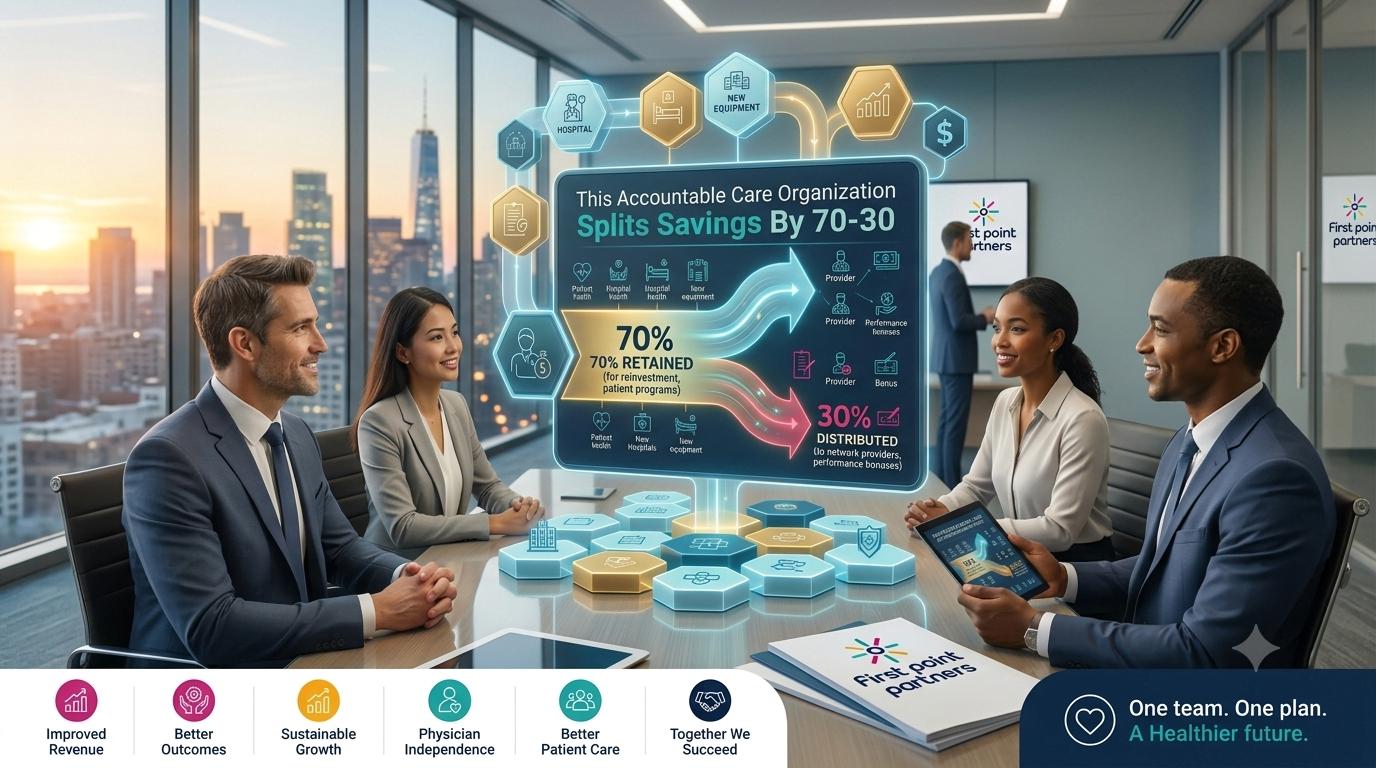
This Accountable Care Organization Splits Savings By 70-30
I still remember a conversation with a family physician in Chicago who told me, half joking and half exhausted, that joining an ACO felt like doing extra homework for a grade someone else decides. She wasn't wrong. For years, that's honestly how most Accountable Care Organization models have worked. Physicians take on the reporting burden, absorb the financial risk, and then wait, sometimes over a year, to see if there's any shared savings check waiting at the end of it. And even then, the split usually lands somewhere near fifty-fifty.
So when a model comes along that flips that math, it's worth paying attention.
What an Accountable Care Organization Actually Does
An Accountable Care Organization, or ACO, is a group of doctors, hospitals, and healthcare providers who voluntarily come together to coordinate care for Medicare patients. The idea, on paper, is simple. Better coordinated care means fewer duplicate tests, fewer avoidable hospital visits, and better outcomes overall. When an ACO hits its quality and cost benchmarks under the Medicare Shared Savings Program (MSSP), the government shares a portion of the savings generated back with the ACO.
The catch, and there's usually a catch, is how those savings get divided once they trickle back down to the actual practices doing the work.
Most traditional ACOs split shared savings 50/50 with participating practices. Physicians take on downside risk, adjust their workflows, sometimes even switch EMR systems, and still end up with half the value they helped create. It's not a scandal exactly, it's just how the industry settled into doing things.
Why the 70/30 Split Changes the Conversation
First Point ACO, run under First Point Partners, does this differently. Instead of the usual 50/50 arrangement, physicians participating in First Point ACO keep 70% of shared savings, while First Point continues to provide the infrastructure, reporting, and support needed to actually succeed in MSSP.
I'll be honest, when I first read the number, my instinct was skepticism. Seventy percent sounds generous enough that you assume there's a hidden downside somewhere. But the model holds up because the logic behind it is fairly straightforward: physicians are the ones generating the value through patient relationships, clinical decisions, and day-to-day care. So physicians should keep the majority of what that value creates.
There's also no downside financial risk on the practice side, which honestly might matter more than the percentage itself. If savings targets aren't met in a given year, the practice still receives its upfront funding. That single detail removes a lot of the anxiety physicians usually associate with value-based care participation.
No EMR Overhaul, No Workflow Disruption
Here's something I've noticed talking to smaller, independent practices: the fear isn't really about the ACO concept itself. It's about what joining one might do to daily operations. Will staff need retraining? Will billing change? Will the whole practice feel like it's being run by someone else?
With this model, practices continue billing Medicare fee-for-service exactly as they already do. There's no new EMR, no forced care protocols, and no operational overhaul. First Point handles the MSSP mechanics behind the scenes, things like:
-
Care gap identification and closure
-
Quality tracking and MSSP submission
-
Data, analytics, and performance reporting
-
Patient outreach and care coordination
-
Post-discharge follow-up
That last one, post-discharge follow-up, is a small piece of care management that usually gets overlooked, but it's often where readmissions quietly happen. Having a centralized team catching those gaps takes real pressure off front desk and clinical staff who are already stretched thin.
Chronic Care, Remote Monitoring, and the Revenue Physicians Are Already Owed
One thing that stood out to me is how First Point bundles in Chronic Care Management (CCM), Remote Patient Monitoring (RPM), and Transitional Care Management (TCM) alongside the ACO work. These aren't separate, unrelated add-ons. They're revenue streams tied to care physicians are usually already providing, just not always billing for consistently.
Frankly, a lot of practices leave money on the table here, not out of neglect, but because tracking and documenting this kind of ongoing care takes time nobody has spare. Centralizing that support means the revenue tied to real patient care actually gets captured instead of quietly disappearing into a busy schedule.
Skin in the Game: Why That Matters More Than People Realize
What I found genuinely interesting, and honestly a little rare in this space, is that First Point Partners doesn't just sponsor an ACO from a distance. They also own and operate primary care clinics that participate in the same ACO alongside independent practices. That means their team experiences the same reporting requirements, the same workflows, and the same expectations as the physicians they're supporting.
It sounds like a small detail, but it changes incentives. When the people building the infrastructure are also living inside it daily, the solutions tend to actually work in real practice settings, not just look good in a slide deck.
Should Your Practice Consider This Model?
I won't pretend every ACO arrangement fits every practice. Patient population size, geography, and current Medicare panel all play a role in whether participation makes sense financially. Usually, though, the fastest way to know is simply reviewing your practice's Tax Identification Number (TIN) data, which is essentially the first step First Point uses to determine funding eligibility and amount.
If your practice already participates in Medicare and you're curious whether a 70/30 split with no downside risk applies to your patient mix, that conversation tends to be short and pretty low pressure.
Final Thoughts
The traditional Accountable Care Organization model asked physicians to shoulder risk and administrative weight for a delayed, uncertain reward. First Point ACO rebuilds that equation around a simple idea: physicians create the value, so physicians should keep most of it. A 70/30 split, an upfront payment structure, and zero disruption to your existing EMR or billing process isn't just a better deal on paper, it's a genuinely different way to think about value-based care for primary care.
If you've been putting off exploring MSSP because the math never felt worth it, this might be the moment that changes. Practices looking for a practical, low-risk entry into value-based care for primary care don't need to overhaul how they operate to get there. Reach out to First Point ACO and see what your practice's numbers actually look like. Sometimes the best decisions start with one honest conversation.
Two small placements, once in each paragraph, so it reads like a natural continuation of the argument rather than an inserted phrase. Want me to update the full blog file with this revision and re-export it?
Frequently Asked Questions
1. What is an Accountable Care Organization, in simple terms?
An Accountable Care Organization is a network of physicians and healthcare providers who work together to improve patient outcomes while reducing unnecessary Medicare spending. When the ACO meets its cost and quality goals, it earns a share of the savings generated.
2. How is First Point ACO different from a traditional ACO model?
The biggest difference is the shared savings split. Instead of the common 50/50 arrangement, First Point ACO gives participating practices 70% of shared savings while taking on the operational and financial responsibilities itself.
3. Does my practice take on financial risk by joining?
No. Practices receive an upfront payment regardless of whether savings targets are ultimately met. First Point absorbs that financial risk, not the participating practice.
4. Will I need to change my EMR or daily workflow?
No changes are required. Practices keep their existing EMR, billing processes, and staff structure. The only addition is participation in care management and population health programs designed to support, not replace, your current operations.
5. How long does it take to get started with an Accountable Care Organization like this?
It usually moves faster than people expect. Once your practice's TIN is reviewed to determine funding eligibility, and the agreement is signed, onboarding can begin right away with guided support at each step.
- Managerial Effectiveness!
- Future and Predictions
- Motivatinal / Inspiring
- Fitness and Wellness
- Medical & Health
- Manufacturing
- Education
- Real-Estate
- Food Industry
- Hospitality
- Online Games
- Sports
- Home Services
- Civil Engineering
- Safety and Protection
- Software Products & Services
- Fashion and Jewellery
- Artificial Intelligence
- Entrepreneurship
- Mentoring & Guidance
- Marketing
- Networking
- HR & Recruiting
- Literature
- Shopping
- Career Management & Advancement