

 SkillClick
Medical Necessity Documentation Explained: How Better Clinical Documentation Improves Reimbursement and Compliance
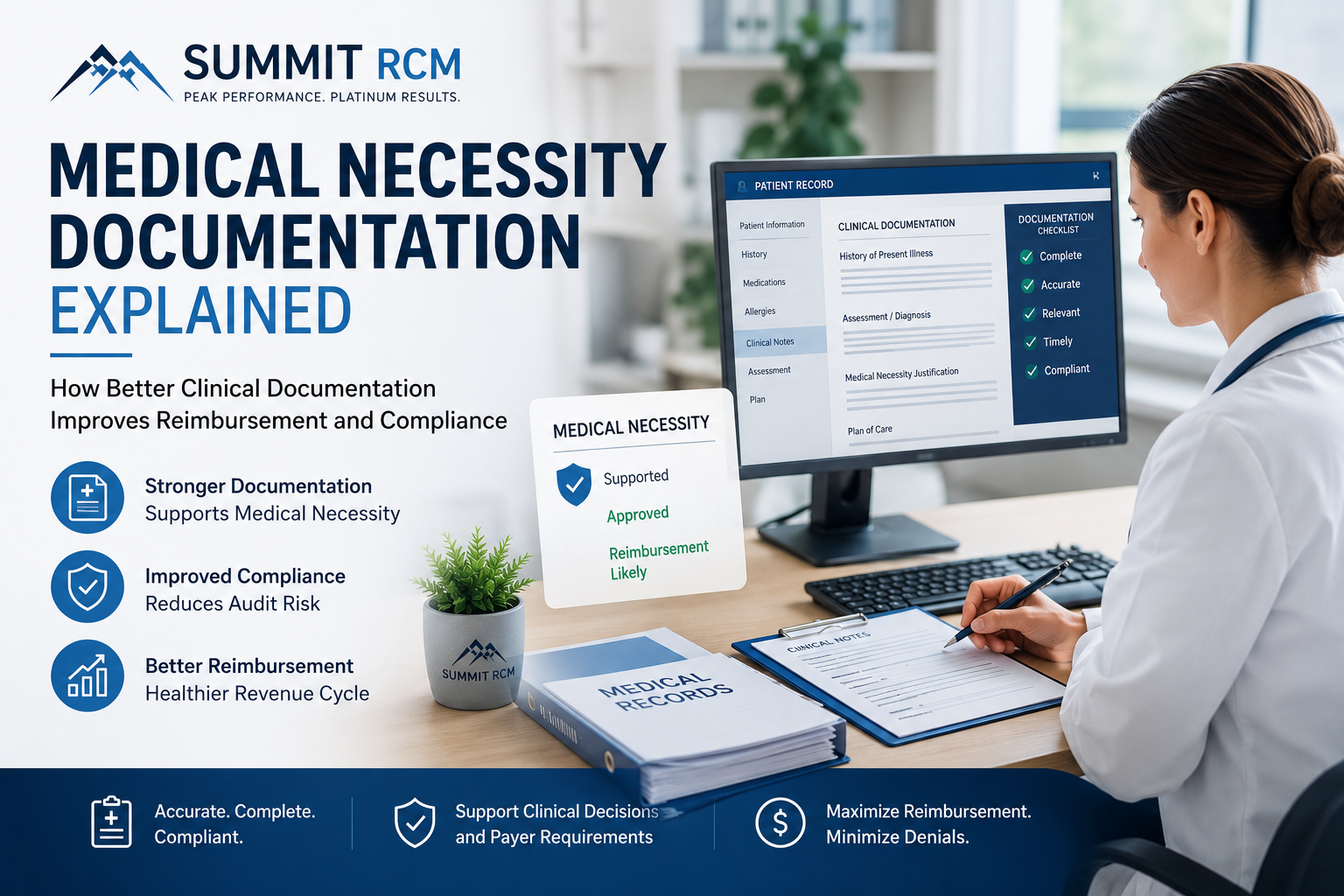
Why does one provider's claim sail through a payer's review while an almost identical claim from another provider gets flagged for additional records? The answer often has nothing to do with the care that was delivered and everything to do with how it was documented. Medical necessity documentation is the bridge between clinical judgment and payer approval, and when that bridge has gaps, reimbursement and compliance both suffer.
This article looks at what medical necessity documentation actually requires, where practices commonly fall short, and how stronger documentation habits support both cleaner claims and a more defensible compliance posture.
What You'll Learn
-
What medical necessity documentation means in practical terms
-
Why documentation gaps lead to denials and audit exposure
-
A practical approach to strengthening clinical documentation
-
Compliance considerations tied to CMS and payer expectations
-
Expert recommendations for building sustainable documentation habits
What Medical Necessity Documentation Actually Requires
Medical necessity, at its core, means that a service or procedure was reasonable and appropriate given the patient's diagnosis and clinical presentation. Payers don't take a provider's word for this — they look for documentation that connects the diagnosis, the clinical findings, and the service billed into a coherent clinical story.
Industry best practices recommend that documentation answer three basic questions for every encounter: What was the patient's condition? Why was this particular service or treatment appropriate for that condition? What supports the frequency, duration, or intensity of the service billed? When any one of these threads is missing, a payer reviewer has grounds to question the claim, regardless of whether the care itself was appropriate.
The Difference Between Clinical Accuracy and Billing-Ready Documentation
A note can be clinically accurate and still fall short of what billing and coding require. A physician may know exactly why a service was necessary without writing it down in a way that translates into ICD-10 and CPT code selection. This gap between clinical intent and documented detail is one of the most common — and most avoidable — sources of denials tied to medical necessity.
Why Documentation Gaps Happen
Healthcare providers often experience documentation shortfalls not because of a lack of clinical knowledge, but because of operational pressure. Common contributors include:
-
Time constraints during high-volume clinical days
-
Templates that don't prompt for necessity-specific detail
-
Inconsistent understanding of payer-specific documentation requirements
-
Copy-forward habits in electronic health records that carry outdated information forward
-
Limited feedback loops between coding/billing teams and clinical staff
Every practice has unique revenue cycle challenges, and documentation habits often reflect the workflow pressures of a specific specialty or setting. A high-volume primary care practice faces different documentation risks than a surgical specialty group, even though the underlying principle — connect diagnosis to service — applies to both.
The Financial and Compliance Impact
Reimbursement Consequences
When documentation doesn't clearly establish medical necessity, claims are more likely to be denied or downcoded. Downcoding — where a payer reimburses at a lower level than billed — quietly reduces revenue without triggering the same attention a denial does, making it a harder problem to detect.
Proper documentation can significantly reduce claim denials tied to medical necessity, but the reverse is also true: recurring documentation gaps tend to produce recurring denial patterns that consume staff time on appeals and resubmissions.
Compliance and Audit Exposure
Beyond reimbursement, medical necessity documentation is central to compliance. CMS guidelines and payer audit programs frequently focus on whether documentation supports the level and type of service billed. Insufficient documentation is a commonly cited finding in payer audits, and in some cases it can lead to recoupment of previously paid claims. HIPAA compliance also intersects here, since documentation must be accurate and appropriately secured throughout the record-keeping process.
Actionable Takeaway: Review a sample of recent charts against their corresponding claims to check whether documentation independently supports the diagnosis-to-service connection, without relying on staff memory of the encounter.
Building a Stronger Documentation Workflow
-
Standardize documentation prompts within templates. Build EHR templates that prompt for necessity-relevant details — symptom duration, severity, prior treatments tried — rather than relying on free text alone.
-
Train clinical staff on the "why" behind documentation requirements. Providers who understand how documentation connects to reimbursement and compliance tend to document more consistently than those following a rule without context.
-
Establish a pre-submission documentation review step. A brief review before claims are finalized can catch necessity gaps before they become denials.
-
Create specialty-specific documentation checklists. Generic checklists often miss nuances that matter for specific procedure types or diagnoses.
-
Build a feedback loop from denials back to documentation training. When a denial is tied to medical necessity, that pattern should inform future training rather than being resolved and forgotten.
-
Conduct periodic internal documentation audits. Regular review helps identify drift before a payer audit does.
Common Errors That Undermine Medical Necessity
-
Documentation that describes symptoms but doesn't connect them to the specific service billed
-
Missing documentation of prior conservative treatment before a more intensive service
-
Generic or templated language that doesn't reflect the individual patient encounter
-
Diagnosis codes that don't align with the documented clinical findings
-
Absent or vague documentation of medical decision-making complexity
Documentation-Driven Denials vs. Coding Errors
|
Factor |
Medical Necessity Denials |
Pure Coding Errors |
|
Root cause |
Documentation doesn't support the service billed |
Incorrect code selection despite adequate documentation |
|
Resolution |
Often requires provider involvement to clarify or amend the record |
Can typically be corrected by the coding team alone |
|
Prevention approach |
Clinical documentation training and templates |
Coding audits and staff certification |
|
Appeal complexity |
Higher — requires demonstrating clinical rationale |
Lower — often a straightforward code correction |
|
Audit risk |
Directly tied to compliance exposure |
Primarily a claim accuracy issue |
Understanding this distinction matters because the two problems require different solutions. A practice that only invests in coding audits may see little improvement if the underlying issue is documentation quality.
A Realistic Practice Scenario
An orthopedic clinic noticed a pattern of denials for imaging services, with payers citing insufficient documentation of medical necessity. On review, the clinic found that providers were documenting the imaging order but not consistently recording the conservative treatments attempted beforehand or the specific clinical findings that justified escalation. After updating documentation templates to prompt for this information and providing targeted training to providers, the clinic saw a reduction in necessity-related denials for imaging services over the following billing cycles. Outcomes like this vary by practice, payer mix, and service line, and should not be treated as a guaranteed result.
Warning Signs of Documentation-Related Revenue Risk
-
A rising share of denials citing "insufficient documentation" or "medical necessity not established"
-
Increasing downcoding on evaluation and management claims
-
Payer requests for additional records becoming more frequent
-
Inconsistent documentation quality across providers within the same practice
-
A widening gap between clinical notes and the codes ultimately billed
-
Low clean claim rate specifically tied to necessity-related fields
Left unaddressed, these signs tend to compound into greater A/R days, more staff time spent on appeals, and heightened exposure during payer or CMS audits.
Expert Recommendations
-
Treat documentation training as ongoing, not one-time. Payer requirements and audit focus areas shift, and periodic refreshers keep documentation current.
-
Use coding audits to inform documentation improvements, not just code accuracy.
-
Involve providers directly in denial review for necessity-related claims so they see the direct link between documentation and outcomes.
-
Leverage healthcare analytics to identify which providers, service lines, or diagnosis codes generate the most necessity-related denials.
-
Monitor compliance guidance regularly, since CMS and payer documentation expectations are updated periodically.
Frequently Asked Questions
What is medical necessity documentation?
Medical necessity documentation is the clinical record that justifies why a specific service, procedure, or treatment was appropriate for a patient's diagnosis and condition, supporting the claim submitted to a payer.
Why do claims get denied for medical necessity even when the care was appropriate?
Denials often occur when documentation doesn't clearly connect the diagnosis, clinical findings, and service billed — even if the care itself was clinically sound, the record may not demonstrate that connection to a payer's satisfaction.
How is a medical necessity denial different from a coding error denial?
A coding error involves selecting the wrong code despite adequate documentation, while a medical necessity denial reflects a gap in the documentation itself, often requiring provider input to resolve.
Can better documentation templates alone solve necessity-related denials?
Templates help by prompting for relevant detail, but they work best alongside provider training and periodic audits, since templates can't substitute for individualized clinical detail.
How often should practices review documentation for medical necessity gaps?
Industry best practices recommend periodic internal audits — often quarterly or aligned with denial trend reviews — rather than waiting for a payer audit to reveal patterns.
Conclusion
Medical necessity documentation sits at the intersection of clinical care, reimbursement, and compliance, which is exactly why gaps in this area create ripple effects across the entire revenue cycle. Strengthening documentation isn't about adding administrative burden for its own sake — it's about making sure the clinical story that already exists in a provider's judgment is captured clearly enough for a payer to recognize it. Practices that invest in documentation training, targeted templates, and regular internal review tend to build a more resilient claims process, with fewer necessity-related denials and a stronger position if an audit does occur.
- Managerial Effectiveness!
- Future and Predictions
- Motivatinal / Inspiring
- Fitness and Wellness
- Medical & Health
- Manufacturing
- Educação
- Real-Estate
- Food Industry
- Hospitality
- Online Games
- Sports
- Home Services
- Civil Engineering
- Safety and Protection
- Software Products & Services
- Fashion and Jewellery
- Artificial Intelligence
- Entrepreneurship
- Mentoring & Guidance
- Marketing
- Networking
- HR & Recruiting
- Literature
- Shopping
- Career Management & Advancement