

 SkillClick
How Fonetic English Supports Self-Paced English Learning
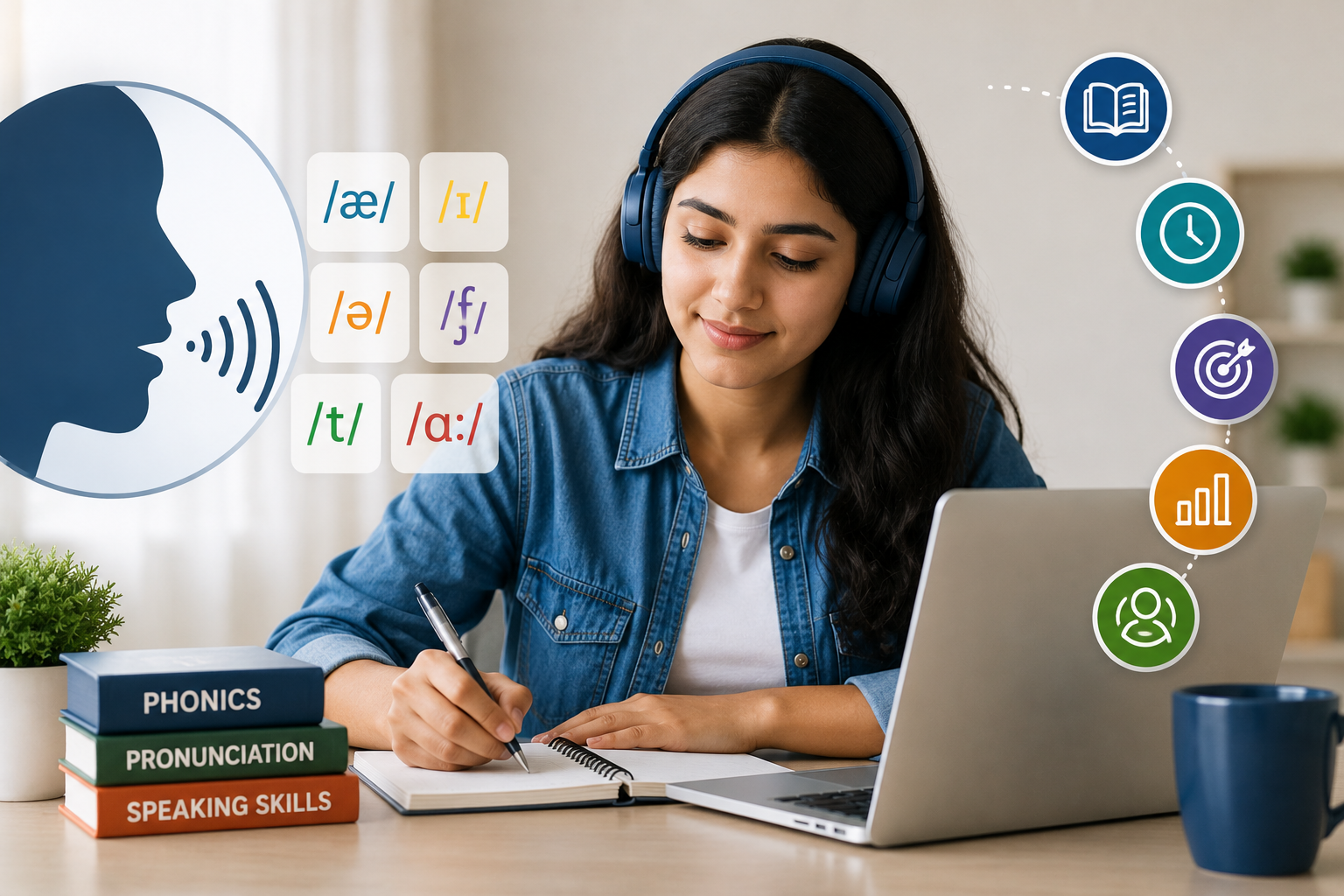
Self-paced English learning breaks down at a very specific point, and it is almost always the same point. The learner meets a word on the page, understands roughly what it means, and has no reliable way to work out how it sounds. There is no teacher in the room to say it aloud. Fonetic English is a phonetic mark-up system that addresses exactly this gap. It adds pronunciation information on top of ordinary English spelling without altering a single letter, so a learner working alone can decode a word the first time they see it.
That sounds like a small thing. It is not. It is the difference between studying independently and stalling.
Why independent English study stalls
English spelling does not tell you how to say English words. Research on orthographic depth puts the figure at roughly three quarters of English words that cannot be accurately decoded from their spelling alone. The letters are there. The instructions for turning them into sound are not.
Compare "though", "through", "thought", "tough" and "thorough". Same five letters at the front. Five different pronunciations. A learner sitting at a kitchen table with a textbook has no way to resolve that from the page. They can guess, and the guess will often be wrong, and the wrong guess will be the one that sticks.
The consequence is that English gets learnt by memorisation rather than by decoding. Estimates from reading research suggest a word learnt by rote needs somewhere between twenty and fifty exposures before it is reliably recognised, while a word that can be decoded needs between two and five. For a learner with a teacher, that is a heavy workload. For a learner without one, it is the reason they quit.
The evidence from other languages
Anyone who has taught both Spanish and English to beginners already suspects that English is doing something unusual. The research confirms it. Seymour, Aro and Erskine published a study in 2003 comparing early reading acquisition across thirteen European countries. Children learning transparent orthographies such as Finnish, Italian and Spanish reached basic decoding accuracy within roughly the first year of instruction. Children learning English took around two and a half to three times longer to reach the same point.
Paulesu and colleagues found something related in 2001. Working with Italian and English university students, they reported that Italian readers with the same underlying processing difficulty as their English speaking counterparts showed far milder reading problems in practice. The difficulty had not disappeared. The transparent writing system was simply not amplifying it.
The conclusion both studies point towards is uncomfortable and useful. A great deal of what looks like slow English learning is not a learner problem. It is a writing system problem.
What the mark-up actually does
Fonetic English leaves the spelling exactly as it is and layers information over it. The system marks where syllables break, and distinguishes a stressed break from an unstressed one so the learner knows which part of the word to lean on. Long vowels are marked distinctly from short ones. The sounds that regularly trip learners up, including the vowel in "put", the voiced version of "th" as in "this", and the small "u" sound that attaches to certain consonants, all carry their own marks.
The rule that governs the entire system is that spelling is never changed. This matters more than it first appears. Systems that respell words to make them easier to read, and there have been several over the past century, teach the learner to read something that does not exist outside the classroom. The learner then has to unlearn it. Because Fonetic English marks the real spelling, every word a learner practises is a word they have also learnt to spell and will recognise anywhere.
Why this suits solo learners in particular
The method was developed with Professor Emeritus John Sweller of UNSW, who originated cognitive load theory. Sweller co-authored a white paper on the system in 2024 and described it as "a series of brilliant innovations that will revolutionize language teaching".
The relevance of cognitive load theory here is direct. Working memory is small and it is easily swamped. A learner reading unmarked English is holding several jobs at once: recognising letters, guessing at pronunciation, checking that guess against a half memory of hearing the word, and trying to follow the meaning of the sentence. Loaded up that way, comprehension is the first thing to go.
Putting the pronunciation on the page removes the guessing job entirely. What remains is decoding and meaning, which is what reading is supposed to be. There is a fuller explanation of the cognitive load theory applied to reading on the Fonetic English site for anyone who wants the underlying argument in detail.
For a self-paced learner this is the whole point. They cannot ask anyone. They need the page to answer the question.
A practical way to use it alone
Read aloud from the start. Silent reading lets a wrong pronunciation settle in without ever being tested, and once it settles it is stubborn. Reading aloud from marked text means you are hearing the correct form in your own voice from the first attempt.
Work with material you would read anyway. News, a novel, technical documents for your job. The mark-up applies to ordinary text, so there is no need to work through graded readers that have nothing to do with your life.
Then, and this is the step people skip, reread the same passage unmarked. The goal was never to depend on the mark-up. The goal is to build accurate pronunciations of enough words that ordinary English text becomes readable, and the marks come off.
The honest limitation
Marked text solves decoding. It does not solve vocabulary, grammar or the confidence to speak to another person, and no one should claim otherwise. What it does is remove the single obstacle that makes independent study of English harder than independent study of Spanish, Finnish or Indonesian. That obstacle has stopped a lot of capable people. Removing it is worth doing.
- Managerial Effectiveness!
- Future and Predictions
- Motivatinal / Inspiring
- Fitness and Wellness
- Medical & Health
- Manufacturing
- Onderwijs
- Real-Estate
- Food Industry
- Hospitality
- Online Games
- Sports
- Home Services
- Civil Engineering
- Safety and Protection
- Software Products & Services
- Fashion and Jewellery
- Artificial Intelligence
- Entrepreneurship
- Mentoring & Guidance
- Marketing
- Networking
- HR & Recruiting
- Literature
- Shopping
- Career Management & Advancement