

 SkillClick
Robotic Spine Surgery vs Traditional Spine Surgery
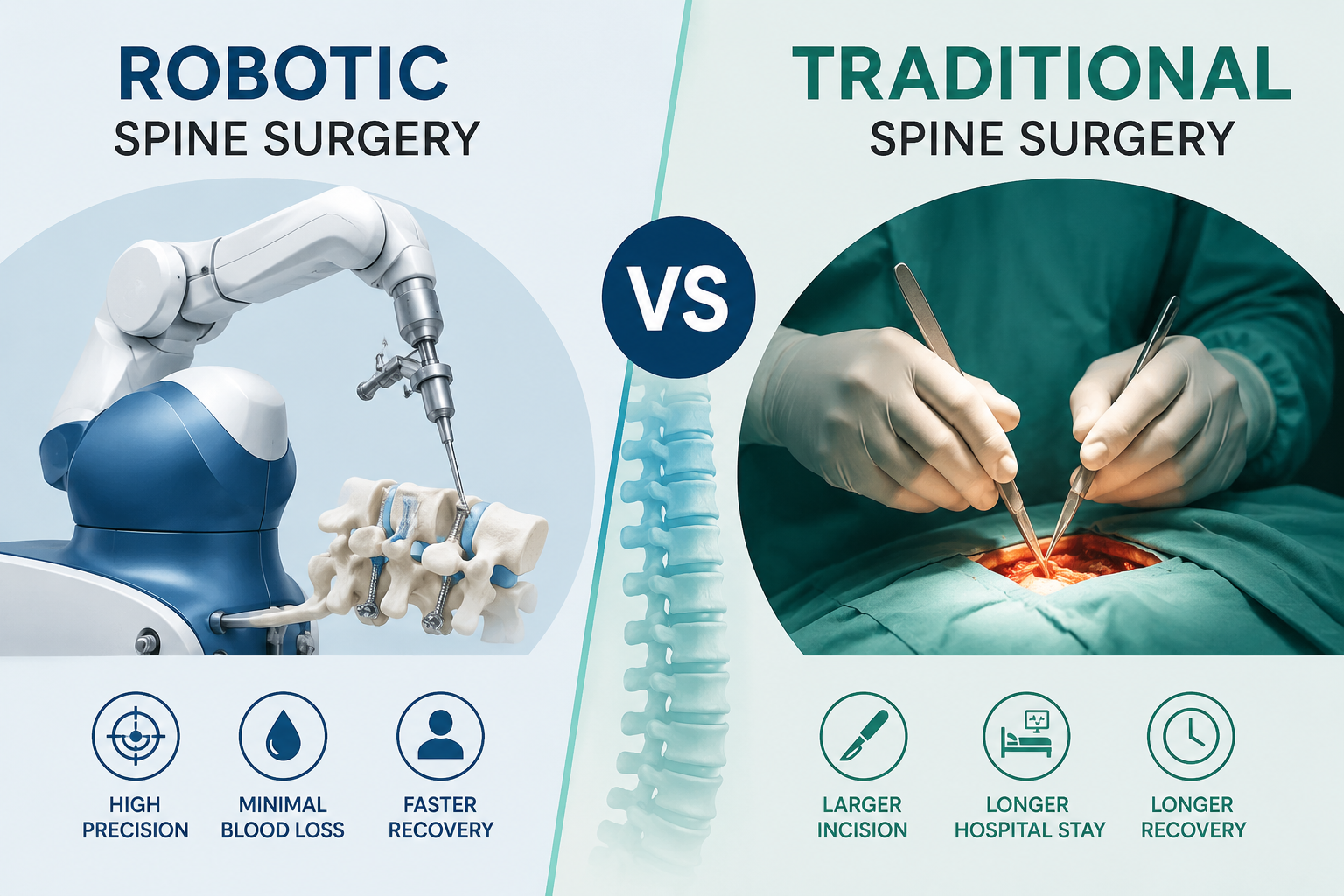
Spine surgery has come a long way from the large-incision, high-blood-loss procedures many patients still picture when they hear the word 'surgery.' Today, patients facing conditions like herniated discs, spinal stenosis, or degenerative disc disease often have a choice between traditional open spine surgery and robotic-assisted spine surgery. Understanding how these two approaches differ can help you have a more informed conversation with your surgeon about which path is right for you.
What Is Traditional Spine Surgery?
Traditional, or open, spine surgery involves a larger incision that gives the surgeon a direct visual and physical path to the spine. The surgeon relies on their own hands, standard surgical instruments, and years of trained experience to place hardware, remove damaged disc material, or decompress nerves. This approach has been refined over decades and remains a reliable, well-studied option, particularly for complex spinal deformities or revision surgeries where a wider field of access is genuinely necessary.
The tradeoff is that a larger incision typically means more disruption to the surrounding muscle and soft tissue, which can translate to more post-operative pain, a longer hospital stay, and a slower return to daily activities.
What Is Robotic Spine Surgery?
Robotic spine surgery uses advanced imaging and a robotic guidance system to help the surgeon plan and execute the procedure with sub-millimeter precision. Before the operation even begins, the surgical team builds a 3D map of the patient's spine, allowing the placement of screws, rods, or implants to be planned down to the exact trajectory and depth. During surgery, the robotic arm acts as a highly precise guide, while the surgeon remains fully in control of every movement and decision throughout the procedure.
Because this technology works hand-in-hand with minimally invasive techniques, robotic spine surgery is typically performed through much smaller incisions than traditional surgery. You can read more about how this technology is applied at Atlantic Brain and Spine on the Robotic Spine Surgery page.
Key Differences Patients Should Know
Precision and accuracy
Robotic systems use pre-operative imaging and real-time guidance to place implants with a level of accuracy that is difficult to replicate by hand alone, which can reduce the risk of hardware misplacement.
Incision size and tissue disruption
Traditional surgery generally requires a larger incision to give the surgeon direct visibility. Robotic-assisted procedures are usually paired with minimally invasive approaches, meaning smaller incisions and less disruption to muscle and soft tissue.
Recovery time
Less tissue disruption often translates into less post-operative pain, a shorter hospital stay, and a faster return to normal activities for robotic-assisted patients, though individual recovery still depends on the specific condition being treated.
Radiation exposure
Robotic platforms typically rely more on pre-operative 3D imaging and less on repeated intraoperative X-rays, which can mean reduced radiation exposure for both the patient and the surgical team compared to some traditional fluoroscopy-guided techniques.
Candidacy
Not every patient or every condition is suited to a robotic approach. Complex deformities, certain revision surgeries, or cases involving significant anatomical distortion may still call for a traditional open approach. A thorough evaluation, including imaging and a review of your surgical history, is the only reliable way to determine which technique fits your situation.
Which Approach Is Right for You?
Neither approach is universally 'better' the right choice depends on your diagnosis, anatomy, overall health, and the specific goals of your surgery. Many patients find it helpful to first understand the full range of surgical options available to them before narrowing down a technique. The Spine Surgery Guide from Atlantic Brain and Spine walks through what to expect at each stage, from diagnosis to recovery, and can be a useful starting point before your consultation.
Ultimately, the most important factor isn't the technology itself but the experience of the surgical team using it. A skilled spine surgeon will recommend the approach, robotic or traditional, that gives you the best chance at a safe procedure and a full recovery, rather than defaulting to one method for every patient.
- Managerial Effectiveness!
- Future and Predictions
- Motivatinal / Inspiring
- Fitness and Wellness
- Medical & Health
- Manufacturing
- Education
- Real-Estate
- Food Industry
- Hospitality
- Online Games
- Sports
- Home Services
- Civil Engineering
- Safety and Protection
- Software Products & Services
- Fashion and Jewellery
- Artificial Intelligence
- Entrepreneurship
- Mentoring & Guidance
- Marketing
- Networking
- HR & Recruiting
- Literature
- Shopping
- Career Management & Advancement