

 SkillClick
10 Reasons Businesses Hire CRM Developers in 2026
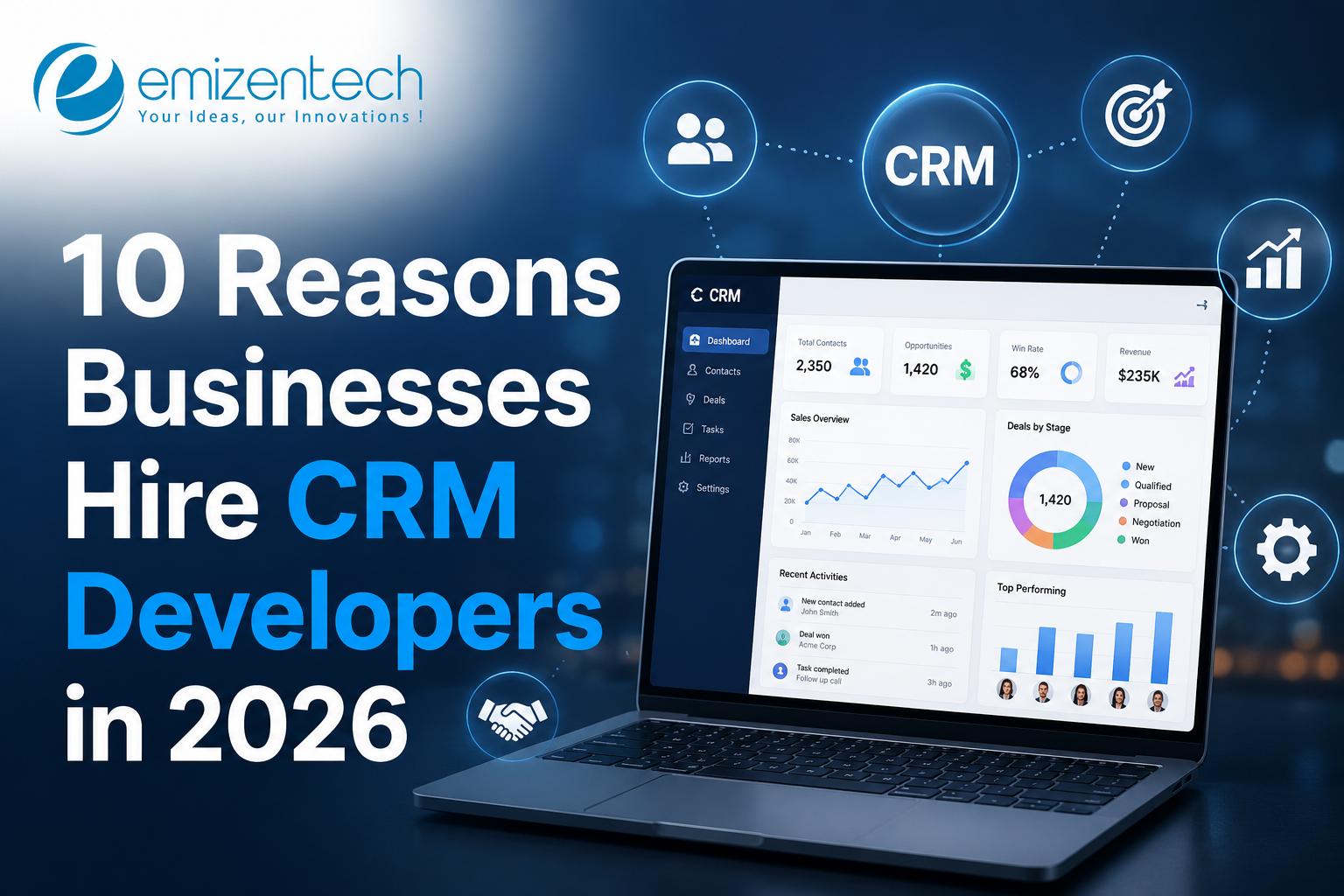
Customer expectations continue to rise, and businesses are under constant pressure to deliver faster responses, personalized experiences, and seamless communication across multiple channels. While CRM platforms have become essential tools for managing customer relationships, simply installing a CRM system is rarely enough to achieve these goals.
Modern organizations often require customized workflows, integrations, automation, and data management capabilities that go beyond standard CRM features. This is one of the main reasons businesses continue to hire CRM developers in 2026. These professionals help companies adapt CRM platforms to their unique operational needs, making them more effective and easier to use.
Let's explore the key reasons why CRM developers remain in high demand and how they contribute to business success.
1. To Customize CRM Systems Around Business Processes
Every business operates differently. A CRM platform may offer hundreds of features, but not all of them align perfectly with a company's workflow.
This is where CRM developers become valuable. They customize dashboards, reports, workflows, and customer records to match how teams actually work. Instead of forcing employees to adapt to generic software, developers tailor the system to fit existing business processes.
For example, a real estate agency may need a lead-tracking process that differs significantly from a manufacturing company. A CRM developer can build custom workflows that support those specific requirements.
This flexibility is one reason many organizations choose to hire CRM developers rather than relying solely on out-of-the-box solutions.
2. To Integrate Multiple Business Applications
Modern businesses use numerous software tools every day. Sales teams use CRM platforms, marketing teams rely on automation tools, finance departments use accounting systems, and support teams work with ticketing software.
Without proper integration, valuable customer information can become scattered across different systems.
CRM developers help connect these applications so data flows automatically between them. For example, customer information collected through a website can instantly appear in the CRM without manual entry.
These integrations improve efficiency, reduce errors, and ensure everyone works with accurate information.
3. To Automate Repetitive Tasks
One of the biggest productivity challenges for many organizations is manual work.
Employees often spend hours updating records, assigning leads, sending follow-up emails, and generating reports. These tasks are necessary but can consume valuable time that could be spent on more strategic activities.
CRM developers create automation rules that eliminate repetitive processes.
For instance, when a new lead enters the system, the CRM can automatically assign it to a sales representative, create follow-up tasks, and send a welcome email. Small improvements like these can save countless hours over time.
Businesses that hire CRM developers often see significant efficiency gains through automation alone.
4. To Improve Data Accuracy and Organization
Customer data is one of the most valuable assets a company owns. Unfortunately, inaccurate or incomplete data remains a common problem across industries.
Duplicate records, outdated contact information, and inconsistent data entry can create confusion and affect decision-making.
CRM developers help organizations establish better data management practices. They build validation rules, automate updates, and create systems that reduce human error.
For example, a CRM can automatically prevent duplicate customer entries or require mandatory information before records are saved.
Cleaner data leads to more reliable reporting and stronger customer insights.
5. To Support Business Growth
As businesses grow, their operational requirements become more complex.
A CRM system that works well for a small team may struggle when customer volumes increase, additional departments begin using the platform, or new sales channels are introduced.
CRM developers help organizations scale their systems without disrupting operations.
They design flexible solutions that can accommodate future growth, whether that involves additional users, advanced reporting requirements, or expanded automation capabilities.
Many organizations hire CRM developers because they want systems that can grow alongside the business rather than requiring constant replacement.
6. To Enhance Customer Experience
Customer experience has become a major competitive factor in nearly every industry.
Businesses need quick access to customer information, communication history, service requests, and purchasing behavior. When this information is difficult to access, customer interactions often suffer.
CRM developers help create centralized systems that give employees a complete view of each customer.
For example, a support representative can immediately see previous interactions, recent purchases, and open service tickets without switching between multiple systems.
This leads to faster responses, more personalized communication, and better overall customer experiences.
7. To Strengthen Reporting and Decision-Making
Good decisions depend on accurate information.
Many organizations collect large amounts of customer data but struggle to turn that information into useful insights. Standard CRM reports may not always provide the level of detail decision-makers need.
CRM developers create customized reporting solutions tailored to business goals.
These reports can help organizations track:
-
Sales performance
-
Customer retention
-
Marketing effectiveness
-
Lead conversion rates
-
Service response times
When businesses hire CRM developers, they often gain better visibility into performance metrics that support smarter planning and decision-making.
8. To Manage Complex Data Migrations
Many companies eventually outgrow spreadsheets, outdated CRM systems, or legacy databases.
Moving years of customer information into a new platform can be challenging. Data may be incomplete, duplicated, or stored in incompatible formats.
CRM developers play a critical role during migration projects.
They help clean, organize, validate, and transfer data while minimizing disruptions to daily operations.
For example, a company moving from an older CRM platform to a modern cloud-based solution may need to migrate thousands of customer records. Proper planning and technical expertise help ensure valuable information isn't lost during the transition.
9. To Improve Security and Compliance
Data security remains a growing concern in 2026.
Businesses handle increasing amounts of sensitive customer information, making proper security controls more important than ever. Depending on the industry, organizations may also need to comply with various regulations regarding data protection and privacy.
CRM developers help strengthen security by implementing:
-
User access controls
-
Role-based permissions
-
Data encryption measures
-
Audit tracking features
-
Secure integrations
These safeguards help reduce risks while ensuring employees have access only to the information necessary for their roles.
Organizations often hire CRM developers to ensure their systems support both operational efficiency and responsible data management.
10. To Prepare for Future Technology Changes
Technology evolves quickly, and CRM systems are no exception.
Businesses increasingly adopt advanced technologies such as AI-powered analytics, predictive forecasting, conversational interfaces, and customer self-service tools. Organizations that fail to adapt may struggle to remain competitive.
CRM developers help businesses prepare for future requirements by building flexible, scalable systems.
Rather than focusing only on immediate needs, experienced developers consider how the CRM can support future enhancements and integrations.
Companies that hire CRM developers with a long-term mindset are often better positioned to adapt as customer expectations and technologies continue to change.
Conclusion
CRM platforms have become central to how businesses manage customer relationships, streamline operations, and support growth. However, the true value of a CRM system often depends on how well it aligns with the organization's specific needs.
From customization and automation to integrations, reporting, and security, there are many reasons businesses continue to hire CRM developers in 2026. These professionals help transform standard CRM platforms into practical tools that support day-to-day operations and long-term business goals.
As organizations face growing customer expectations and increasingly complex technology environments, skilled CRM development continues to play an important role in helping businesses adapt and operate more effectively. Businesses exploring CRM solutions often work with technology partners like EmizenTech to better understand implementation approaches, customization options, and long-term scalability considerations.
FAQs
Why do businesses hire CRM developers?
Businesses hire CRM developers to customize CRM platforms, automate workflows, integrate software systems, and improve customer data management.
Can CRM developers help with existing CRM systems?
Yes. CRM developers can enhance, customize, and optimize existing CRM platforms without requiring a complete replacement.
What industries benefit from CRM development?
Retail, healthcare, finance, real estate, manufacturing, education, and many other industries use CRM development services.
Do small businesses need CRM developers?
Small businesses may benefit from CRM developers when they require customization, automation, integrations, or support for future growth.
What is the biggest benefit of hiring a CRM developer?
One of the biggest benefits is creating a CRM system that aligns closely with business processes, improving efficiency and user adoption.
- Managerial Effectiveness!
- Future and Predictions
- Motivatinal / Inspiring
- Fitness and Wellness
- Medical & Health
- Manufacturing
- Education
- Real-Estate
- Food Industry
- Hospitality
- Online Games
- Sports
- Home Services
- Civil Engineering
- Safety and Protection
- Software Products & Services
- Fashion and Jewellery
- Artificial Intelligence
- Entrepreneurship
- Mentoring & Guidance
- Marketing
- Networking
- HR & Recruiting
- Literature
- Shopping
- Career Management & Advancement