

 SkillClick
Digital T-Shirt Printing: The Smart Choice for Custom Apparel
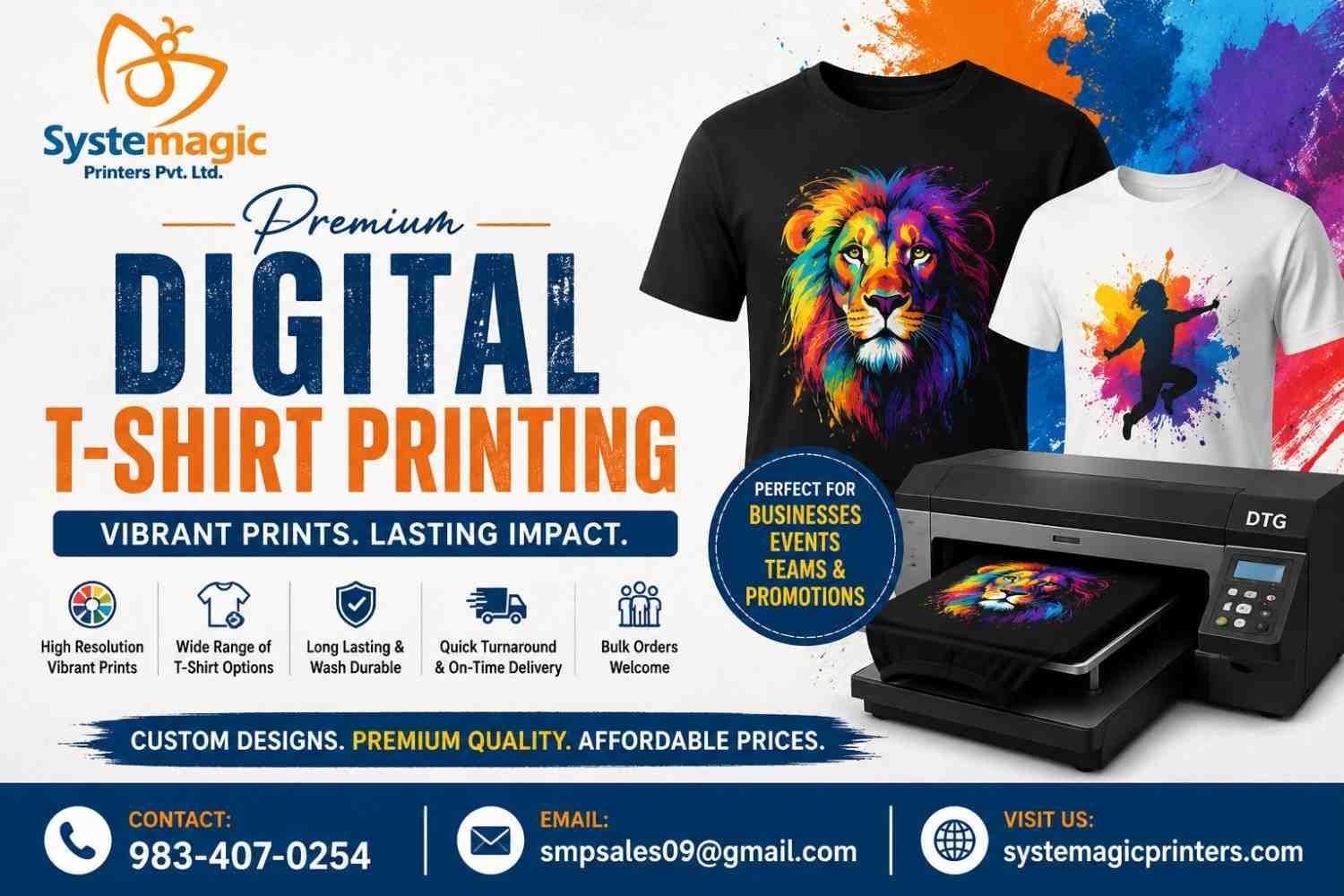
A college fest committee in Pune once needed 60 shirts with a design that had eleven colors and a photo-realistic gradient, ordered nine days before the event. Screen printing that design would have meant eleven separate screens, a setup cost that didn't make sense for 60 pieces, and a timeline that didn't fit nine days at all. Digital T-Shirt Printing solved it in an afternoon, because that's specifically the gap this technology exists to fill — complex, colorful, small-to-medium batch work that traditional methods handle badly or not at all.
Most buyers still default to screen printing out of habit, without checking whether their actual order — complexity, quantity, timeline — even fits that method anymore.
What's Actually Happening Inside a Digital Print Job
Digital printing skips the screen-and-stencil process entirely, transferring a design directly from a digital file onto fabric using either direct-to-garment inkjet technology or a printed film transfer method, depending on the fabric and design complexity involved.
Core Digital Printing Methods
-
DTG (Direct-to-Garment) Printing directly onto a fabric made of pure Cotton or a blend of Cotton with another material using an inkjet. Excellent for rendering photo-realistic images and gradients
-
DTF Direct-to-Film design printed on a film first, then heat transferred onto fabric, works on cotton, polyester and blends whereas DTG doesn‘t
-
Sublimation, dye that sublimates when ironed directly into the polyester fiber gives brilliant, permanently dyed color to synthetic fabric. Specifically
-
White ink underbase needs dark fabrics require an underbase for colors to register properly, increased cost and print hand.
-
Resolution and file standards most digital methods require a minimum of 300 DPI source files, and low-res logo‘s pulled off a website will print visibly blurry.
The Specification Detail That Trips Up Most First-Time Buyers
File resolution is the detail almost every first-time digital printing client gets wrong, and it's entirely preventable if someone catches it before production. A logo pulled from a website or social media profile is usually 72 DPI — fine for a screen, completely inadequate for print, where it renders pixelated and soft at any size larger than a business card. A good printer checks file resolution before running production and flags it if the source file won't hold up. A printer who runs it anyway without saying anything is setting the client up for a delivery-day disappointment.
Five Questions to Ask Before Choosing a Digital Printing Partner
Buyers often compare digital printers purely on price per shirt. These five questions matter more for whether the final product actually looks professional.
-
"Will you check my file resolution before production and tell me if it's inadequate?" A responsible printer flags low-resolution files proactively. One who prints whatever's submitted without comment is prioritizing speed over the client's actual outcome.
-
"Which method — DTG, DTF, or sublimation — do you recommend for my specific fabric and design, and why?" A knowledgeable printer explains the tradeoff clearly. A generic "we can do any method" answer without a fabric-specific recommendation suggests they haven't thought it through for your particular order.
-
"What's your color accuracy process — do you calibrate against a physical proof or just trust the screen preview?" Screen colors and printed colors don't always match. A printer offering a physical proof before full production protects you from a batch-wide color surprise.
-
"How does pricing scale between a batch of 20 and a batch of 200 with digital methods?" Digital printing has a different cost curve than screen printing — understanding where the economics shift helps you choose the right method for your actual quantity.
-
"What's your policy if the delivered print doesn't match the approved proof?" A specific remake or refund policy, stated upfront, beats a vague "we'll look into it" response after the batch already shipped.
What Digital Printing Actually Protects for Buyers
Ditch the generic “high-quality prints” pitch this is exactly what is different when digital printing is the best choice for an order.
Multicolour, complex or photo-realistic style artwork becomes affordable in small-medium number runs without the screen costs which make traditional screen printing unviable at small numbers, thus preserving budget for detailed artwork not needing the 500-piece minimum to make it financially feasible. Quicker turnarounds on tight deadline jobs saves event dates specifically, since digital lacks the time-consuming screen-production stage of traditional print.
Less waste on shorter runs protects the client from ordering more than they need, just to push the design over the minimum order that makes the screen printing cost effective, but exceeds their real requirements. Accurate color registration on gradients, or photographic quality images, protects the integrity of more complex logos or artwork otherwise impossible to reproduce to scale, cost effectively.
Off-Road Design allows slight design variations different names and numbers, or minor color adjustments per item ensuring that buyers commissioning the curved embosser for a batch of team uniforms or a glut of artist- and client-identified event shirts are not committed to identical apparel that Lee or Cibeles, ‘slim fit,’ as presented at the beginning of the process. And The Off-Road Design minimums help smaller clients and new or one-off events get the apparel they need without having to purchase in bulk.
Finding Digital Printing Capacity in Pune
When they need Digital T-Shirt Printing in Pune, buyers must understand that although a printer may provide all three services, they may not necessarily run all three. For example, some printers who have invested in equipment to do water based DTG printing for cotton production might only accept outsourcing or reject sublimation and DTF commissions if your fabric choice, design complexity or production volume isn‘t what they are experts at. The expansion of Pune‘s event and corporate clothing markets has created a need for faster turnaround of increasingly smaller, more complex orders digital methods are much better suited to this than bulk screen printing.
If you‘re a business trying to distinguish amongst various options for Digital T Shirt Printing Services in Pune, inquire which processes are being handled internally by the printer and which are subcontracted out, as outsourced jobs tend to be more expensive and take longer while this information is often not transparently provided.
If youre just comparing T Shirt Digital Printing in Pune for a large, intricate, multi-colored order with tight deadlines, focus on a printer that can show you some down- and- dirty from similar types of jobs rather than a history of basic single-color logos.
About Us
We're Systemagic, running DTG, DTF, and sublimation printing in-house out of Pune since 2015, specifically so we're not subcontracting a client's order to a third party and adding a hidden markup or delay. We check every submitted file's resolution before production runs, regardless of how rushed the timeline is.
Here's something we don't put in our brochure: we once ran a client's low-resolution logo through DTG production without flagging it clearly enough, delivered a visibly soft, slightly pixelated print, and had to reprint the entire batch once they pointed it out. We built a mandatory resolution check into our production workflow after that, one that stops a job automatically if the file falls below our minimum DPI threshold, regardless of how close the deadline is. That's cost us a few uncomfortable conversations with rushed clients since. It's also meant we haven't repeated that specific mistake.
Get a Quote From Systemagic
Send us your design file, your quantity, and your fabric preference, and we'll recommend the right digital method for your specific combination rather than defaulting to whichever one is easiest for us to run. We respond within 24 business hours with pricing and a resolution check on your file. Minimum order quantity is 10 pieces for digital printing, considerably lower than our bulk screen printing minimum. Reach us through www.systemagicprinters.com and mention "Digital Printing Inquiry" so it reaches our production team directly.
Conclusion
Digital T-Shirt Printing exists specifically for the orders traditional screen printing handles poorly — complex designs, small batches, and tight timelines that don't justify screen setup costs or the wait that comes with them. Buyers who understand which method actually fits their design and fabric end up with prints that look sharp instead of learning about resolution and color accuracy issues after a batch has already shipped. Getting that match right upfront is considerably easier than fixing it after the fact.
Frequently Asked Questions
How is Digital T-Shirt Printing different from traditional screen printing?
Digital methods transfer a design directly from a file onto fabric without screens or stencils, making them better suited to complex, multi-color, or photo-realistic designs at smaller quantities where screen setup costs don't make economic sense.
What should I check with Digital T-Shirt Printing Services before submitting my design?
Confirm they check file resolution before production and ask which method — DTG, DTF, or sublimation — they recommend for your specific fabric, since not every printer runs all three in-house or gives a fabric-specific recommendation without prompting.
Is T-Shirt Digital Printing more expensive than screen printing for bulk orders?
For very large quantities, traditional screen printing often becomes more cost-effective per piece, though digital methods remain competitive and sometimes cheaper for smaller-to-medium batches where screen setup costs would otherwise dominate the total price.
Can Digital T-Shirt Printing handle dark-colored fabric well?
Yes, though it typically requires a white ink underbase layer first for accurate color reproduction, which adds a small amount to the cost and print feel — a detail worth discussing upfront if you're printing on navy, black, or other dark garments.
How many colors can a digital print actually include without extra cost?
Unlike screen printing, where each color adds a separate screen and cost, digital methods handle unlimited colors and gradients at essentially the same base cost — this is one of the clearest advantages for complex, colorful designs specifically.
- Managerial Effectiveness!
- Future and Predictions
- Motivatinal / Inspiring
- Fitness and Wellness
- Medical & Health
- Manufacturing
- Education
- Real-Estate
- Food Industry
- Hospitality
- Online Games
- Sports
- Home Services
- Civil Engineering
- Safety and Protection
- Software Products & Services
- Fashion and Jewellery
- Artificial Intelligence
- Entrepreneurship
- Mentoring & Guidance
- Marketing
- Networking
- HR & Recruiting
- Literature
- Shopping
- Career Management & Advancement