

 SkillClick
The Future of Full-Court Practice: Mobile AI Training Robots
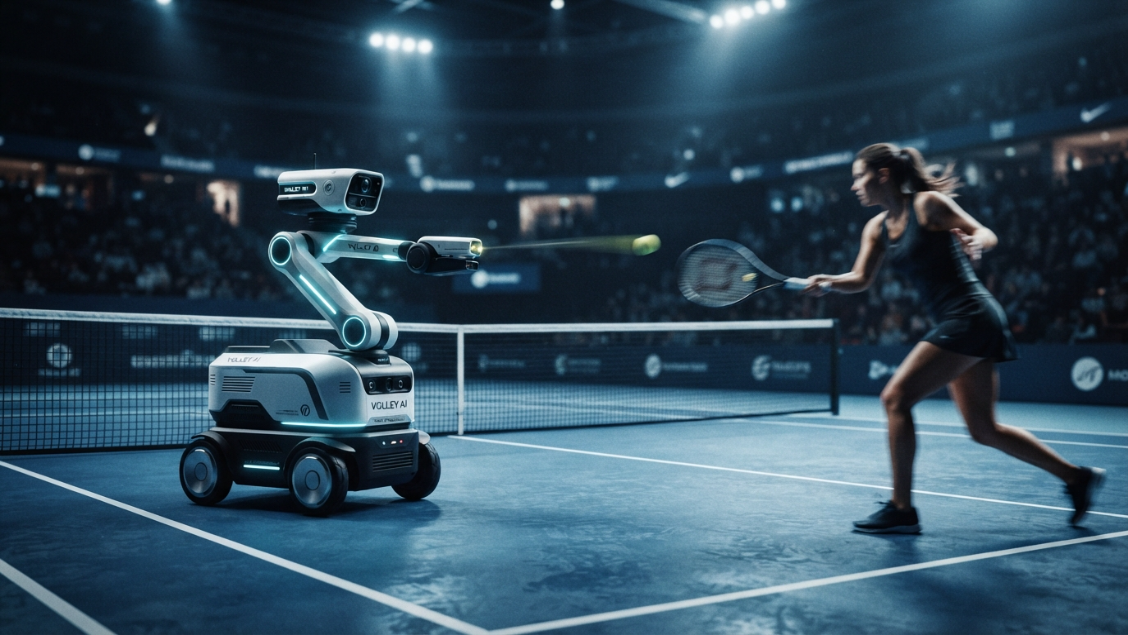
Standing in one spot and hitting fed balls has always been the core limitation of traditional ball machines. A mobile AI tennis robot changes that equation by adding physical mobility to the system itself, allowing the machine to move sideways, backward, and diagonally rather than staying fixed at the baseline.
This kind of omnidirectional movement matters because real tennis points rarely happen from a single fixed position. Players move constantly — recovering to center, covering the alley, closing on a short ball — and practicing exclusively from a stationary feed position only develops part of the skill set needed during actual match play. A mobile system can create varied court angles that more closely resemble game conditions than any stationary feeder possibly could.
AI vision is what makes this mobility useful rather than random. Rather than moving on a fixed pattern, a vision-equipped mobile machine can track a player's shot and reposition based on what's actually happening during the drill, functioning more like a responsive opponent than a static feeding device. This is a meaningfully different category from earlier ball machines, which is why it's worth understanding the distinction before assuming all "AI tennis" products offer the same capability.
Opponent simulation is the specific use case this technology is built around. Rather than simply feeding balls, a mobile system can create drills that resemble rally patterns against a moving player, which is far closer to actual match dynamics than repetition-based baseline drilling. For players deciding whether this level of technology fits their training goals, comparing it against simpler models in the broader Tenniix lineup helps clarify whether mobility and full opponent simulation are actually needed, versus a more basic feeding system.
Full-court training also benefits players working on specific tactical patterns — approach shots followed by volleys, deep baseline rallies transitioning to short balls, and similar sequences that simply can't be replicated by a machine fixed in one location. This is where the gap between older ball machines and current-generation training robots becomes most apparent in practice, not just on a spec sheet.
Advanced and competitive players in particular tend to get the most value from this category, since match-level tactical drilling depends heavily on realistic court coverage demands that a stationary machine simply cannot recreate, no matter how sophisticated its feeding pattern is otherwise.
As this category matures, it's likely that mobility becomes a more standard expectation among serious training equipment, following the same trajectory that vision tracking has over recent years.
Court space requirements are worth considering before investing in a mobile system, since a machine designed to move across the width and depth of a court needs enough clearance to do so safely, particularly on shared or multi-use courts where other players or equipment might be nearby during a session.
Cost is naturally a larger consideration in this category than with simpler machines, given the added mechanical and sensor complexity involved in reliable, responsive mobility. For most players, it makes sense to have already outgrown the benefits of a stationary vision-equipped machine before committing to the added expense of a fully mobile system, rather than starting at the top of the category by default.
FAQ
What does "omnidirectional" mean for a training robot? It means the machine can move in multiple directions — sideways, backward, diagonally — rather than staying fixed in one position.
Is a mobile training robot necessary for casual players? Not necessarily. Casual players focused on basic consistency may be well served by a stationary machine; mobility benefits players working on advanced, game-like drills.
Does mobility affect setup complexity? Mobile systems generally involve more calibration than stationary machines, though most are still designed for straightforward home or club setup.
Who benefits most from full-court mobile training? Competitive and advanced players working on tactical, match-realistic drills tend to see the greatest benefit from this category of equipment.
- Managerial Effectiveness!
- Future and Predictions
- Motivatinal / Inspiring
- Fitness and Wellness
- Medical & Health
- Manufacturing
- Education
- Real-Estate
- Food Industry
- Hospitality
- Online Games
- Sports
- Home Services
- Civil Engineering
- Safety and Protection
- Software Products & Services
- Fashion and Jewellery
- Artificial Intelligence
- Entrepreneurship
- Mentoring & Guidance
- Marketing
- Networking
- HR & Recruiting
- Literature
- Shopping
- Career Management & Advancement