

 SkillClick
Generative AI Training Data: What "High Quality" Actually Means and How to Build It
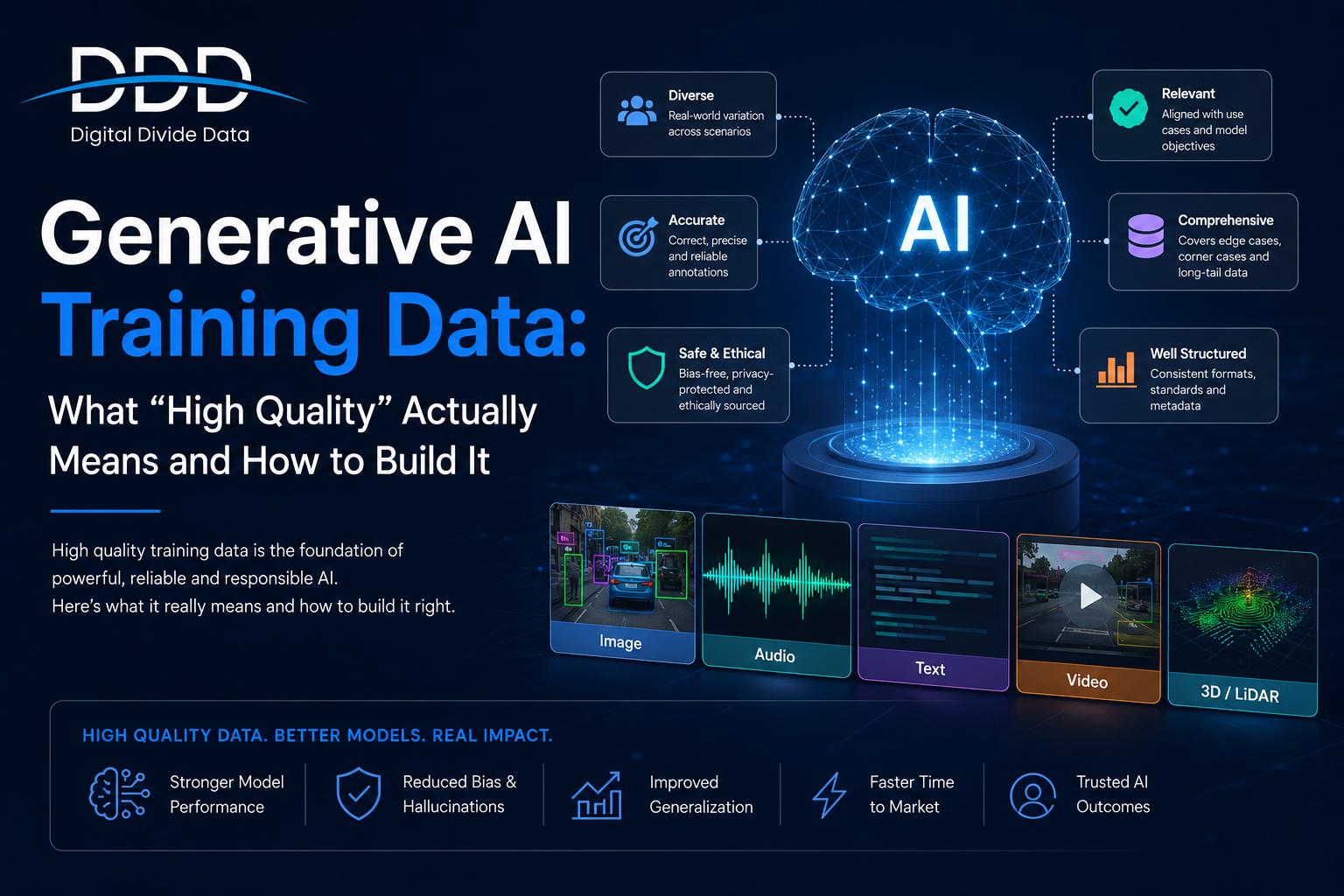
The phrase "high-quality training data" appears in every discussion of generative AI development. It functions as a consensus goal everyone agrees data quality matters, quality gets cited as the root cause when models underperform, and quality improvement is proposed as the solution when outputs disappoint. What the phrase rarely includes is a specific, operational definition of what high-quality generative AI training data actually looks like.
That vagueness is consequential. Organizations that agree quality matters but haven't defined what quality means for their specific models and use cases build data pipelines that optimize for the wrong things, evaluate data against metrics that don't predict model performance, and discover the quality problem only when the trained model fails in deployment.
This blog defines quality for generative AI training data across the specific dimensions that actually determine how a model behaves and explains what producing quality across each dimension operationally requires.
Why Generic Quality Definitions Fail GenAI
Traditional ML training data quality is defined primarily by label accuracy: the proportion of annotations that match the ground truth. For classification tasks, this definition works. The correct label exists, and quality is the percentage of examples where that correct label was applied.
Generative AI training data doesn't have a single correct label. A prompt asking a model to "explain quantum entanglement for a high school student" has no single correct response. There are better and worse responses across multiple dimensions accuracy, accessibility, appropriate scope, appropriate tone, appropriate length but there is no binary ground truth against which a response can be scored as simply correct or incorrect.
This means quality for generative AI training data is multidimensional and contextual. It requires defining what "better" means across each relevant dimension for the specific model and deployment context, and evaluating training data against those dimension-specific criteria rather than a single accuracy metric.
The Six Dimensions of Quality in GenAI Training Data
Dimension 1: Factual Accuracy and Verifiability
The most fundamental quality dimension: do the factual claims in the training data reflect reality? For generative models that will produce factual outputs summaries, answers to factual questions, explanations of technical concepts training data with factual errors teaches the model to reproduce those errors with the same confidence it reproduces correct facts.
The challenge is that factual accuracy cannot be verified automatically at scale. Automated fact-checking tools can catch claims that contradict each other within a document, but they cannot verify claims against external ground truth. Domain expert review of sampled training data checking factual claims against authoritative sources in the relevant domain is the only reliable quality control for factual accuracy.
Domain expert review is resource-intensive but not optional for training data used to build domain-specific generative AI. A legal AI trained on data containing legal errors learns to produce legal errors. A clinical AI trained on data containing clinical inaccuracies learns to produce clinical inaccuracies. The cost of expert review at the training data stage is lower than the cost of identifying and remediating the factual errors the model learns to propagate at scale in deployment.
Operational standard: Stratified domain expert review of a statistically sampled subset of each data category, with factual error rates tracked by category and error types documented for feedback into data collection and annotation guidelines.
Dimension 2: Relevance and Task Alignment
Training data is relevant when it contains the kinds of inputs and outputs the model will encounter and produce in deployment. Data that looks high quality in general terms but doesn't reflect the specific task distribution the model is being built for produces a model that handles general cases well and the actual deployment use case poorly.
For a customer service generative AI, relevant training data includes the kinds of customer queries, tones, information needs, and problem types that actual customers submit not idealized, polished versions of those queries. Real customer queries contain typos, vague phrasing, implicit context, emotional loading, and the specific domain vocabulary of the product category. Training data assembled from clean, well-formed example queries that a product team writes to illustrate the kinds of questions customers ask produces a model that handles those clean examples and degrades on real customer inputs.
Task alignment extends to output format and length. If the deployment use case requires concise summaries of a specific length, training data with responses of a different length distribution teaches the model length norms that don't match the deployment requirement. If the deployment context requires a specific response structure, training data with varied unstructured responses teaches structural inconsistency.
Operational standard: Training data collection and generation guided by analysis of actual deployment inputs where available, or by structured elicitation from domain experts who can produce realistic examples of the actual task distribution, not idealized proxies for it.
Dimension 3: Linguistic Diversity and Style Coverage
Generative models trained on linguistically homogeneous data develop brittle generation behavior: they perform well on inputs that match the style, register, and phrasing of the training data, and degrade on inputs that differ. For models intended to handle diverse user populations, linguistic diversity in the training data is a technical performance requirement.
Linguistic diversity for generative AI training data includes:
- Register variation: Formal and informal, technical and lay, professional and conversational. A model trained only on formal text will produce formal responses to informal queries; a model trained only on technical text will produce responses inaccessible to lay users.
- Dialect and accent coverage: For models processing spoken language or informal text, coverage of dialect-specific vocabulary, grammar, and expression patterns ensures the model handles the actual diversity of user expression rather than only the standardized written form of the language.
- Tone and sentiment variation: Training data that covers the range of emotional tones users express frustrated, enthusiastic, uncertain, urgent, curious teaches the model to recognize and respond appropriately to that variation.
Operational standard: Deliberate diversity planning in data collection that specifies targets for register, topic domain, and demographic representation, with coverage monitoring throughout the data assembly process to verify targets are being met rather than discovered to be unmet after data collection is complete.
Dimension 4: Calibrated Uncertainty and Appropriate Qualification
Generative models learn from their training data how confident to be in their outputs. Training data where responses are uniformly confident where every answer is stated with equal assurance regardless of the underlying certainty of the information teaches the model to be uniformly confident. Deployed, this produces a model that states uncertain or contested claims with the same confidence as established facts: the overconfidence failure mode that makes generative AI outputs dangerous in high-stakes contexts.
High-quality generative AI training data explicitly models appropriate uncertainty: responses that qualify claims where the underlying knowledge is incomplete or contested, that acknowledge alternative interpretations where they exist, that signal when a question falls outside the model's competent scope, and that decline to answer authoritatively when authoritative answer isn't possible.
Building this qualification behavior into training data requires annotation guidelines that specify how to handle different levels of claim certainty not just what to say, but how to frame it relative to the confidence warranted by the underlying evidence. This is annotation work that requires annotators with sufficient domain expertise to know when a claim is well-established versus contested versus uncertain.
Operational standard: Explicit guidelines for how different certainty levels should be expressed in training responses, with domain expert review specifically checking whether uncertainty is expressed at the appropriate level in sampled training examples.
Dimension 5: Safety and Harm Avoidance Coverage
Safety training for generative AI is only as good as the safety training data. A model aligned to avoid harmful outputs learns that alignment from preference data examples of outputs rated as safe and unsafe, with the model trained to produce the former and avoid the latter. The coverage of that preference data determines what the model has learned to avoid.
Safety training data that only covers obvious harmful content explicit violence, unambiguous hate speech leaves the model with undefined behavior on the more numerous ambiguous cases: content that is potentially harmful in some contexts but not others, content that contains harmful information embedded in otherwise legitimate text, and content where the harm depends on who receives it rather than the content itself.
Comprehensive safety training data covers:
- Boundary cases: Content that is clearly harmful, clearly safe, and the wide range of cases in between where context determines harm
- Refusal behavior: Examples of the model correctly declining to produce harmful content across diverse request framings, including adversarial framings designed to elicit harmful outputs indirectly
- Context-dependent harm: Cases where the same content is appropriate in one context and harmful in another, teaching the model to attend to context rather than applying blanket rules to content types
Operational standard: Adversarial red-teaming of the model to identify categories where safety training data coverage is insufficient, followed by targeted additional data collection and annotation for those categories. Red-teaming cycles run before each major model release rather than once at the initial training stage.
Dimension 6: Representation and Demographic Balance
Generative models trained on data that overrepresents some demographic groups and underrepresents others develop implicit biases that appear in their outputs: language that reflects the dominant group's perspective as default, representation of underrepresented groups through the lens of the overrepresented group's assumptions, and systematic differences in output quality for questions about different demographic groups.
Representation balance in generative AI training data is not only an ethical requirement it is a performance requirement. A model that performs differently for different demographic groups has a measurable performance gap that affects the users disadvantaged by it. Closing that gap requires training data that is genuinely representative of the user population's diversity, not just technically inclusive at the level of token presence.
Operational standard: Demographic analysis of training data sources and annotation outputs, with specific targets for representation across the demographic dimensions relevant to the deployment population. Representation auditing at the data assembly stage rather than discovered through model evaluation after training.
The Data Curation Pipeline That Produces These Quality Dimensions
Building training data that achieves quality across all six dimensions requires a curation pipeline with specific steps not a general data quality process, but a generative-AI-specific process designed for the multidimensional quality requirements of generative models.
Source assessment before collection: Evaluating candidate data sources against the six quality dimensions before collecting from them. A web crawl of news sites may produce factually accurate, linguistically diverse content that is weak on uncertainty calibration because news writing typically expresses claims more confidently than the underlying evidence warrants. An academic corpus may be factually strong and well-calibrated but weak on linguistic diversity because academic writing uses a narrow register. Understanding the quality profile of each source type before collection allows the pipeline to compensate through complementary sourcing rather than discovering the profile after collection.
Multi-stage filtering with quality-dimension-specific rules: Automated filtering rules designed for each quality dimension rather than generic text quality rules. A relevance filter removes content that doesn't match the task distribution. A calibration filter identifies and flags content where claims are asserted without appropriate qualification. A representation filter monitors demographic balance. Running these filters at the corpus level before annotation begins removes the worst examples of each quality failure before expensive annotation resources are applied to them.
Human annotation with dimension-specific rubrics: Annotation guidelines that specify quality criteria for each of the six dimensions not just what to include in a response but how to express uncertainty, how to handle boundary safety cases, how to balance detail level for different audiences. Different annotation tasks may require different expertise: factual accuracy review requires domain expertise, safety boundary annotation requires red-team training, calibration annotation requires understanding of epistemic standards in the relevant domain.
Continuous quality monitoring against model performance: Connecting training data quality metrics to model performance evaluation results, so that when the model underperforms on specific tasks or for specific user groups, the failure can be traced back to the training data quality dimension responsible. This feedback connection turns training data quality into an ongoing improvement discipline rather than a one-time construction effort.
Final Thought
High-quality generative AI training data is not a property that can be achieved through a single approach or measured through a single metric. It is the simultaneous achievement of factual accuracy, task relevance, linguistic diversity, calibrated uncertainty, safety coverage, and demographic representation each requiring specific operational processes and specific quality controls.
Organizations that define quality in these specific terms, build data pipelines that produce quality across each dimension, and monitor quality with dimension-specific metrics produce generative AI training data that supports models capable of reliable, appropriate, and trustworthy behavior in deployment.
Organizations that define quality generically and measure it through proxies that don't predict the behavior they care about discover the quality gaps when the model fails in the ways the proxies didn't anticipate.
- Managerial Effectiveness!
- Future and Predictions
- Motivatinal / Inspiring
- Fitness and Wellness
- Medical & Health
- Manufacturing
- Educación
- Real-Estate
- Food Industry
- Hospitality
- Online Games
- Sports
- Home Services
- Civil Engineering
- Safety and Protection
- Software Products & Services
- Fashion and Jewellery
- Artificial Intelligence
- Entrepreneurship
- Mentoring & Guidance
- Marketing
- Networking
- HR & Recruiting
- Literature
- Shopping
- Career Management & Advancement