

 SkillClick
Why OMR Founders Keep Learning Marketing the Hard Way
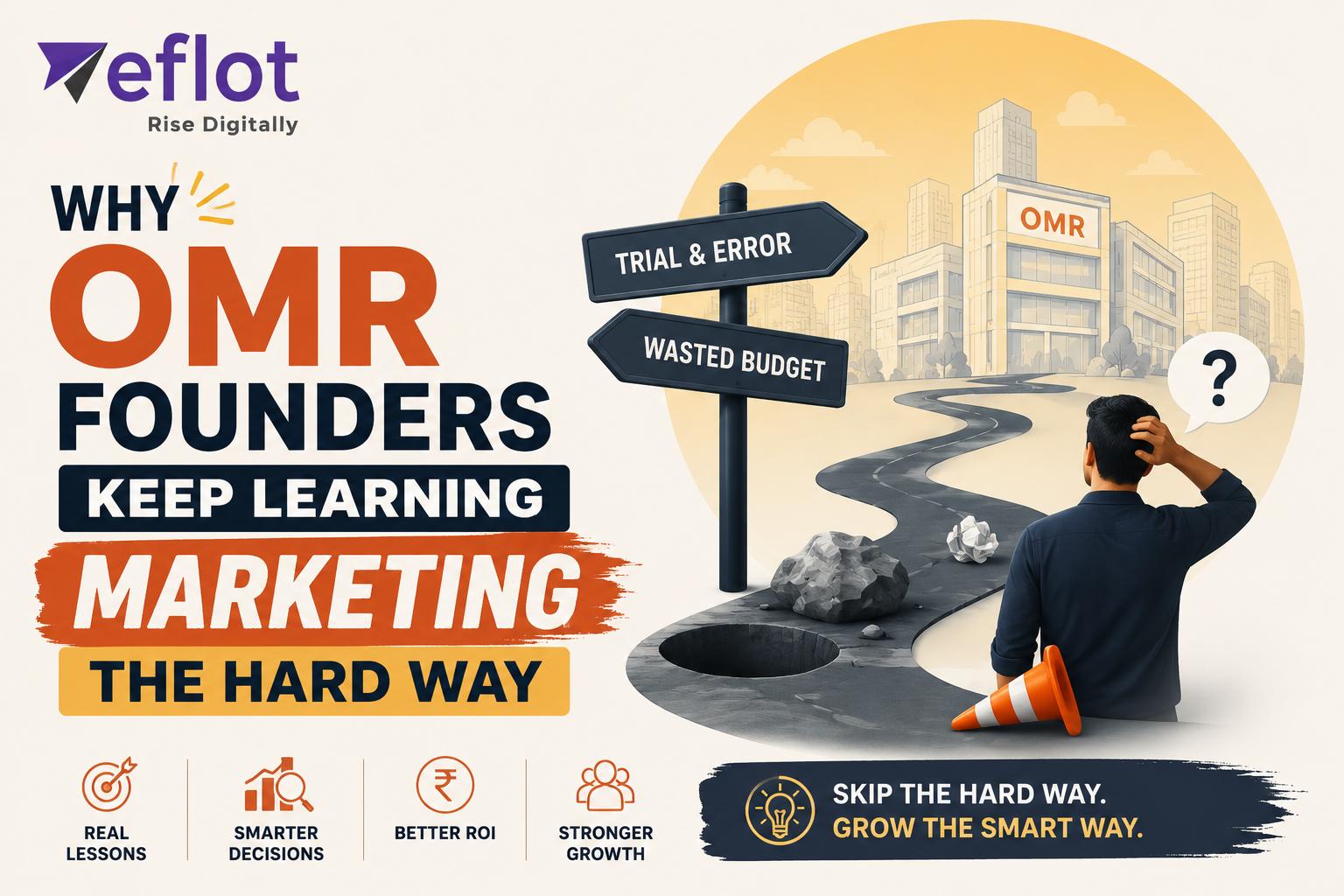
Every founder along the OMR stretch has a version of the same story. They built a product that actually works, hired a small team, and then treated marketing like an afterthought they would "figure out later." Later usually arrives after six months of burned ad spend and a website that nobody outside the founder's own network has visited.
OMR is home to a strange mix of businesses. You have SaaS startups tucked into coworking spaces near Sholinganallur, IT service companies with global clients but zero local visibility, and D2C brands trying to compete with players who have ten times their budget. Each of these founders eventually hits the same wall: they know how to build, but they don't know how to get found.
This piece looks at why that pattern repeats itself so often, what it actually costs a business, and what founders wish someone had told them before they spent their first marketing rupee. It also compares what a founder can realistically do alone versus what needs outside help, using OMR and T Nagar as two reference points since they represent very different business environments within the same city.
Why Do OMR Founders Struggle With Marketing in the First Place?
Most founders in this corridor come from a technical or operations background. They are excellent at building products, managing delivery timelines, or scaling engineering teams. Marketing sits outside that comfort zone entirely, and it shows up in a few predictable ways:
-
They treat marketing as a cost center instead of a growth lever, so it gets the leftover budget.
-
They assume a good product will sell itself through word of mouth alone.
-
They hire a junior generalist and expect agency-level results.
-
They chase every new platform (a new AI tool, a trending ad format) without a consistent base strategy.
-
They measure success by vanity metrics like follower count instead of leads or revenue.
None of these mistakes are unique to OMR. But because the area is so dense with tech talent, founders often assume marketing is a solvable engineering problem. It isn't. It's a discipline built on testing, patience, and understanding buyer behavior, which takes time most first time founders don't budget for.
What Does the "Hard Way" Actually Look Like?
Ask around any coworking space on OMR and you'll hear some version of this timeline:
-
Founder builds a landing page and runs a small Google Ads budget with no clear targeting.
-
Cost per lead looks fine for two weeks, then quietly climbs as the algorithm runs out of easy clicks.
-
Founder panics and doubles the budget hoping volume fixes the problem.
-
Three months in, the CAC (customer acquisition cost) is higher than the customer's lifetime value.
-
Founder finally brings in someone with actual marketing experience, usually after the damage is done.
This isn't a hypothetical. It's a pattern that shows up across dozens of early stage companies in this part of Chennai, and it's rarely the founder's fault in the way they think it is. The real issue is skipping strategy and jumping straight to execution.
DIY, Freelancer, or Agency: What Actually Fits an OMR Startup?
There's no single right answer here, but there is a right answer for each stage of a company. The table below breaks down what typically works at different points.
|
Approach |
Best For |
Typical Monthly Cost (INR) |
Common Pitfall |
|
Founder-led DIY |
Pre-seed, testing messaging |
10,000 to 25,000 |
No time to be consistent |
|
Freelancer |
Single-channel needs (SEO or ads only) |
20,000 to 50,000 |
Limited strategic oversight |
|
In-house hire |
Post product-market fit, steady budget |
40,000 to 80,000 |
Slow to build full-funnel skills |
|
Agency |
Multi-channel growth, limited internal bandwidth |
30,000 to 1,50,000+ |
Requires clear briefs and KPIs |
A founder working with a digital marketing agency in OMR, Chennai usually gets access to a full team (strategist, SEO specialist, ad manager, content writer) for less than the cost of hiring each of those roles individually. That's the trade-off worth understanding before writing off agencies as too expensive.
How Is Marketing Different for a T Nagar Business Compared to OMR?
This comparison matters more than most founders realize. T Nagar is a retail and footfall-driven market with decades of brand loyalty already baked in. OMR is younger, more digital-first, and heavily B2B or SaaS in nature.
-
A digital marketing agency in T Nagar, Chennai often focuses on local SEO, Google Maps visibility, and retail-driven campaigns because customers are searching with intent to visit a physical store.
-
An OMR-based business, by contrast, usually needs lead generation funnels, LinkedIn outreach, and content that builds trust with a B2B buyer who won't convert on the first visit.
Founders who copy a T Nagar playbook onto an OMR business (or vice versa) often wonder why their results don't match. The audience behavior is simply different, and the channels need to reflect that. It's worth talking to a digital marketing agency in T Nagar, Chennai if you're curious how differently they approach a campaign brief compared to an OMR-focused team, since the contrast makes the point clearer than any explanation can.
What Should a Founder Actually Ask Before Hiring Help?
Before signing on with anyone, whether that's a freelancer or a full agency, founders should be asking pointed questions rather than just checking a portfolio. A few worth asking:
-
Can you show a case study with numbers, not just screenshots of a nice looking website?
-
How do you report results, and how often?
-
What happens if a campaign underperforms in the first month?
-
Do you specialize in my industry, or is this a generalist retainer?
-
Who on your team will actually be working on my account?
Getting straight answers to these questions filters out a surprising number of vendors quickly.
What Does a Digital Marketing Service in OMR, Chennai Actually Include?
This is where a lot of confusion happens. Founders often think they're buying "marketing" as one single thing, when in reality a proper digital marketing service in OMR, Chennai is usually broken into distinct, measurable pieces:
-
SEO – technical fixes, content strategy, and local search visibility.
-
Paid media – Google Ads, LinkedIn Ads, and sometimes Meta depending on the audience.
-
Content marketing – blog posts, case studies, and email sequences that support the sales funnel.
-
Social media management – less about follower counts, more about credibility and consistency.
-
Analytics and reporting – tracking what's actually driving revenue, not just traffic.
A founder who understands this breakdown can push back when an agency tries to sell a vague "growth package" without specifics. Some agencies in the OMR ecosystem, including smaller ones like BrandLoom, have built their reputation around one narrow tactic (LinkedIn-led lead generation for SaaS founders, in BrandLoom's case) rather than trying to be everything to everyone, which tends to produce more consistent results for early stage companies.
Frequently Asked Questions
1. How long does it take to see results from digital marketing in OMR?
Most founders start seeing early signals like better website traffic or lead quality within 6 to 8 weeks. Meaningful revenue impact usually takes 3 to 6 months, depending on the industry and starting point.
2. Is SEO or paid advertising better for a new startup on OMR?
Paid advertising delivers faster initial traction, while SEO builds a more sustainable, lower-cost pipeline over time. Most founders benefit from running both together rather than choosing one exclusively.
3. How much should a small business budget for a digital marketing agency in OMR, Chennai? Budgets typically range from 30,000 to 1,50,000 rupees per month depending on the scope, industry, and number of channels involved. Smaller retainers focused on one channel cost less than full-funnel packages.
4. Do I need a different marketing strategy for T Nagar versus OMR?
Yes. T Nagar businesses usually rely on local, footfall-driven strategies, while OMR businesses need digital lead generation tailored to B2B or SaaS buyers who research before they commit.
5. Can a founder handle marketing alone before hiring anyone?
Yes, especially in the earliest stage, but it works best as a short-term approach for testing messaging. Once the business needs consistent, multi-channel execution, outside help usually becomes necessary.
Founders on OMR don't struggle with marketing because they lack intelligence or effort. They struggle because marketing rewards patience and structure, two things that don't come naturally when you're used to shipping code or closing operational gaps fast. The founders who eventually get this right are the ones who stop treating marketing as a side project and start treating it as its own discipline, worth the same rigor they apply to building their product.
Whether that means testing things solo for a few months, bringing in a freelancer for one channel, or working with a full digital marketing agency in OMR, Chennai, the goal is the same: stop guessing and start measuring. That shift alone saves most founders more money than any single campaign ever could.
- Managerial Effectiveness!
- Future and Predictions
- Motivatinal / Inspiring
- Fitness and Wellness
- Medical & Health
- Manufacturing
- Education
- Real-Estate
- Food Industry
- Hospitality
- Online Games
- Sports
- Home Services
- Civil Engineering
- Safety and Protection
- Software Products & Services
- Fashion and Jewellery
- Artificial Intelligence
- Entrepreneurship
- Mentoring & Guidance
- Marketing
- Networking
- HR & Recruiting
- Literature
- Shopping
- Career Management & Advancement