

 SkillClick
Top 5 AI Skills to Learn in 2026 to Stay Ahead in the Future of Work | UniAthena
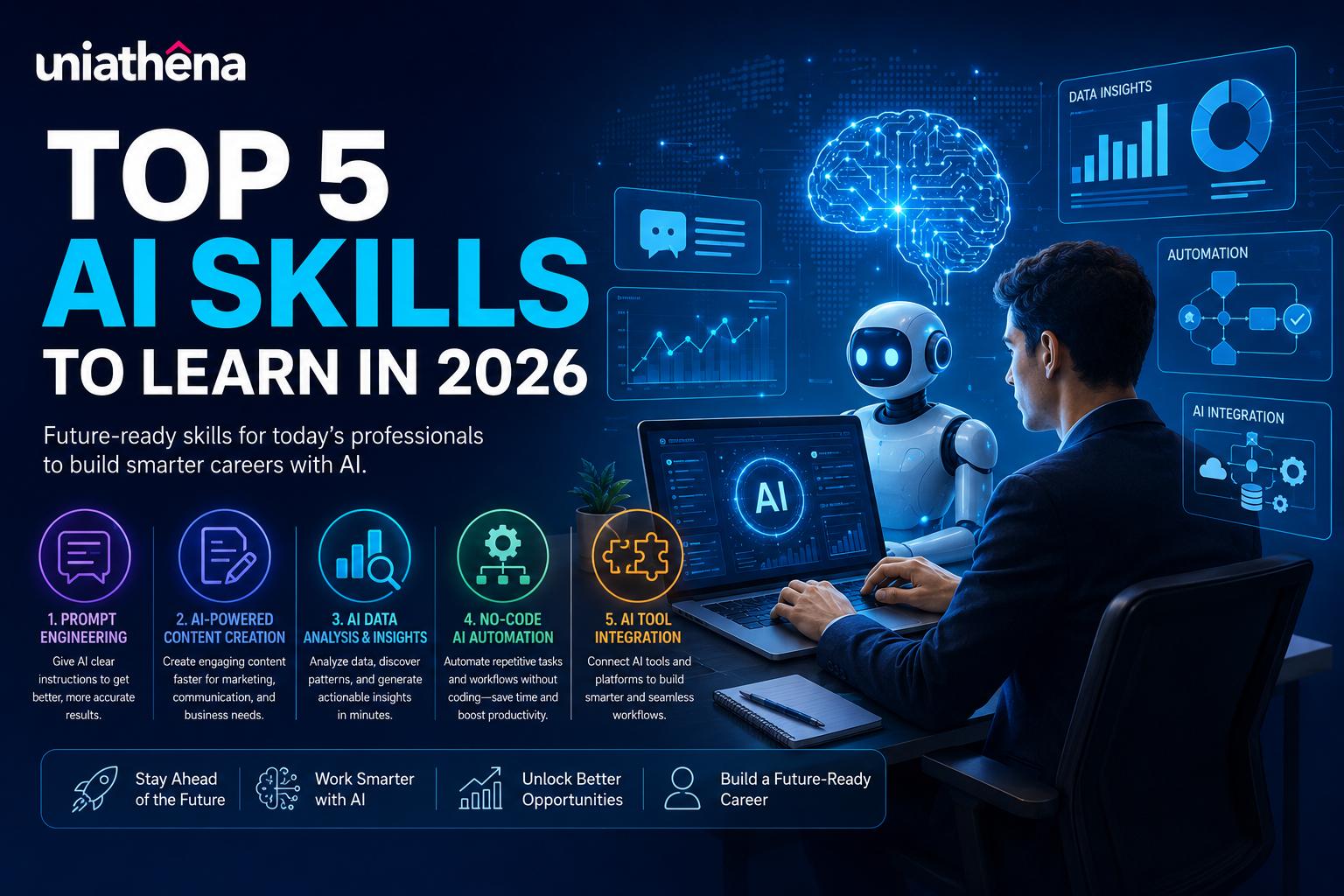
Introduction
Artificial intelligence is no longer a technology reserved for developers or data scientists. It has become an essential part of modern workplaces, helping professionals write reports, analyze data, automate repetitive tasks, and make smarter business decisions.
According to recent industry reports, AI adoption continues to accelerate worldwide, with organizations investing heavily in intelligent automation and AI-powered decision-making. As a result, employers increasingly value professionals with practical AI skills that improve productivity and innovation.
Whether you're a student, business professional, marketer, or manager, investing in AI learning today can open exciting opportunities tomorrow. This guide explores the five most valuable artificial intelligence skills to master in 2026, how they're used across industries, and how you can learn artificial intelligence without needing a technical background.
Key Takeaways
-
Practical artificial intelligence skills are becoming essential in almost every profession.
-
Learning AI can improve productivity, creativity, and decision-making.
-
No-code AI tools make it easier than ever to build valuable AI expertise.
-
Developing these skills can unlock diverse artificial intelligence career paths across industries.
-
Short online courses provide an excellent starting point for continuous AI learning.
Top 5 AI Skills You Need to Learn in 2026
1. Prompt Engineering
Prompt engineering has quickly become one of the most valuable AI skills. It involves giving AI systems clear, detailed instructions to generate accurate, useful, and high-quality outputs.
Instead of asking broad questions, professionals learn to provide:
-
Clear context
-
Specific objectives
-
Desired output formats
-
Rules and limitations
Strong prompt engineering improves results for writing, research, brainstorming, coding assistance, presentations, customer support, and business planning.
Also Read: The Future of Creativity: AI-Powered Design Tool
2. AI-Powered Content Creation
Businesses now rely on AI to produce high-quality content faster than ever. This includes:
-
Blog articles
-
Social media campaigns
-
Email marketing
-
Product descriptions
-
Customer support responses
-
Internal documentation
Rather than replacing creativity, AI helps professionals work faster while maintaining consistency and quality. Learning to combine human creativity with AI assistance is becoming one of today's most valuable artificial intelligence skills.
3. AI Data Analysis & Business Insights
Organizations collect enormous amounts of information every day. AI makes it possible to analyze this data in minutes instead of hours.
Professionals can use AI to:
-
Identify customer trends
-
Forecast sales
-
Detect unusual patterns
-
Generate visual reports
-
Recommend business strategies
Instead of manually sorting spreadsheets, AI provides meaningful insights that support faster and better decisions.
4. No-Code AI Automation
One of the fastest-growing areas of AI learning is no-code automation.
Without writing a single line of code, professionals can automate tasks like:
-
Report generation
-
Email workflows
-
Meeting summaries
-
Customer notifications
-
Data synchronization
-
Approval processes
These automations reduce repetitive work, minimize errors, and allow employees to focus on higher-value responsibilities.
Also Read: How Low-Code & No-Code is Empowering IT and Business Users
5. AI Tool Integration
Modern organizations rarely use just one AI platform. Businesses increasingly connect multiple tools into seamless workflows.
Examples include integrating:
-
AI chatbots with CRM systems
-
Analytics platforms with marketing software
-
Inventory management with customer service
-
Document processing with project management tools
Learning how different AI platforms work together prepares professionals for more advanced AI careers where efficiency and automation are key priorities.
Also Read: A Practical Guide to Designing Conversational Flows with AI Tools
Industries Driving AI Careers
AI has become an essential business technology across nearly every sector.
Finance
Banks use AI to detect fraud, evaluate financial risks, automate compliance, and process loan applications more efficiently.
Marketing
Marketing teams use AI for customer segmentation, campaign optimization, content personalization, and predictive analytics that improve engagement and conversions.
Healthcare
Healthcare organizations apply AI to analyze medical records, assist diagnosis, streamline administrative work, and improve patient care.
E-commerce
Retailers leverage AI for demand forecasting, product recommendations, inventory management, customer service, and logistics optimization.
Manufacturing
Manufacturers use AI for predictive maintenance, quality inspection, supply chain optimization, and smart production planning.
These industries continue creating exciting artificial intelligence career paths for professionals from both technical and non-technical backgrounds.
How to Start Learning AI Skills
You can start learning AI without leaving your job. Begin with short courses that teach both theory and practical applications. These courses give hands-on experience and help you understand how AI works in real-world tasks.
Short courses to try:
How to Learn Artificial Intelligence in 2026
You don't need to become a programmer before starting your AI journey.
A practical roadmap includes:
-
Learn AI fundamentals
-
Practice prompt engineering daily
-
Explore popular AI productivity tools
-
Understand data analysis using AI
-
Build simple no-code automation projects
-
Earn recognized certifications
-
Apply your knowledge to real workplace scenarios
Short online certification programs make AI learning flexible and accessible while helping learners develop job-ready skills.
AI Learning Opportunities in Namibia
Artificial intelligence is gaining momentum across Namibia as businesses, educational institutions, financial services, healthcare providers, and government organizations continue their digital transformation efforts. Professionals with strong AI skills are becoming increasingly valuable as companies adopt automation, data analytics, and intelligent business solutions.
For students and working professionals in Namibia, online learning offers an affordable way to learn artificial intelligence without relocating or leaving full-time employment. International certification programs, self-paced courses, and practical projects help learners build industry-relevant expertise that aligns with global workforce demands.
As Namibia expands its digital economy, investing in artificial intelligence skills today can prepare professionals for both local employment opportunities and remote global AI careers.
Conclusion
Artificial intelligence is reshaping how organizations operate across every major industry. From prompt engineering and content creation to automation, data analysis, and AI integration, these practical skills are becoming essential for modern professionals.
The best approach is to begin with foundational courses, gain hands-on experience using AI tools, and gradually build advanced expertise through structured learning. As organizations continue embracing AI, professionals who invest in continuous AI learning will be better positioned to secure rewarding artificial intelligence career paths and thrive in the future workplace.
FAQs
1. Which AI skill should beginners learn first?
Prompt engineering is one of the easiest and most practical starting points. It requires no programming experience and improves your ability to work effectively with AI tools.
2. Do I need coding skills to learn artificial intelligence?
No. Many modern AI platforms offer no-code or low-code solutions that allow anyone to automate tasks, analyze data, and create AI-powered workflows.
3. What industries offer the best AI careers?
Finance, healthcare, education, marketing, retail, manufacturing, logistics, and technology all offer growing opportunities for professionals with AI expertise.
4. How long does it take to develop practical AI skills?
Most learners can build foundational artificial intelligence skills within a few weeks through consistent practice and structured online courses. Advanced expertise develops through continued learning and real-world application.
5. Why is AI learning important for future careers?
AI is transforming nearly every profession. Developing practical AI knowledge helps professionals improve efficiency, adapt to changing technologies, and qualify for a wider range of high-demand roles in the evolving digital economy.
- Managerial Effectiveness!
- Future and Predictions
- Motivatinal / Inspiring
- Fitness and Wellness
- Medical & Health
- Manufacturing
- Education
- Real-Estate
- Food Industry
- Hospitality
- Online Games
- Sports
- Home Services
- Civil Engineering
- Safety and Protection
- Software Products & Services
- Fashion and Jewellery
- Artificial Intelligence
- Entrepreneurship
- Mentoring & Guidance
- Marketing
- Networking
- HR & Recruiting
- Literature
- Shopping
- Career Management & Advancement