

 SkillClick
The Emergency Lighting Inspection Most Building Owners Forget About
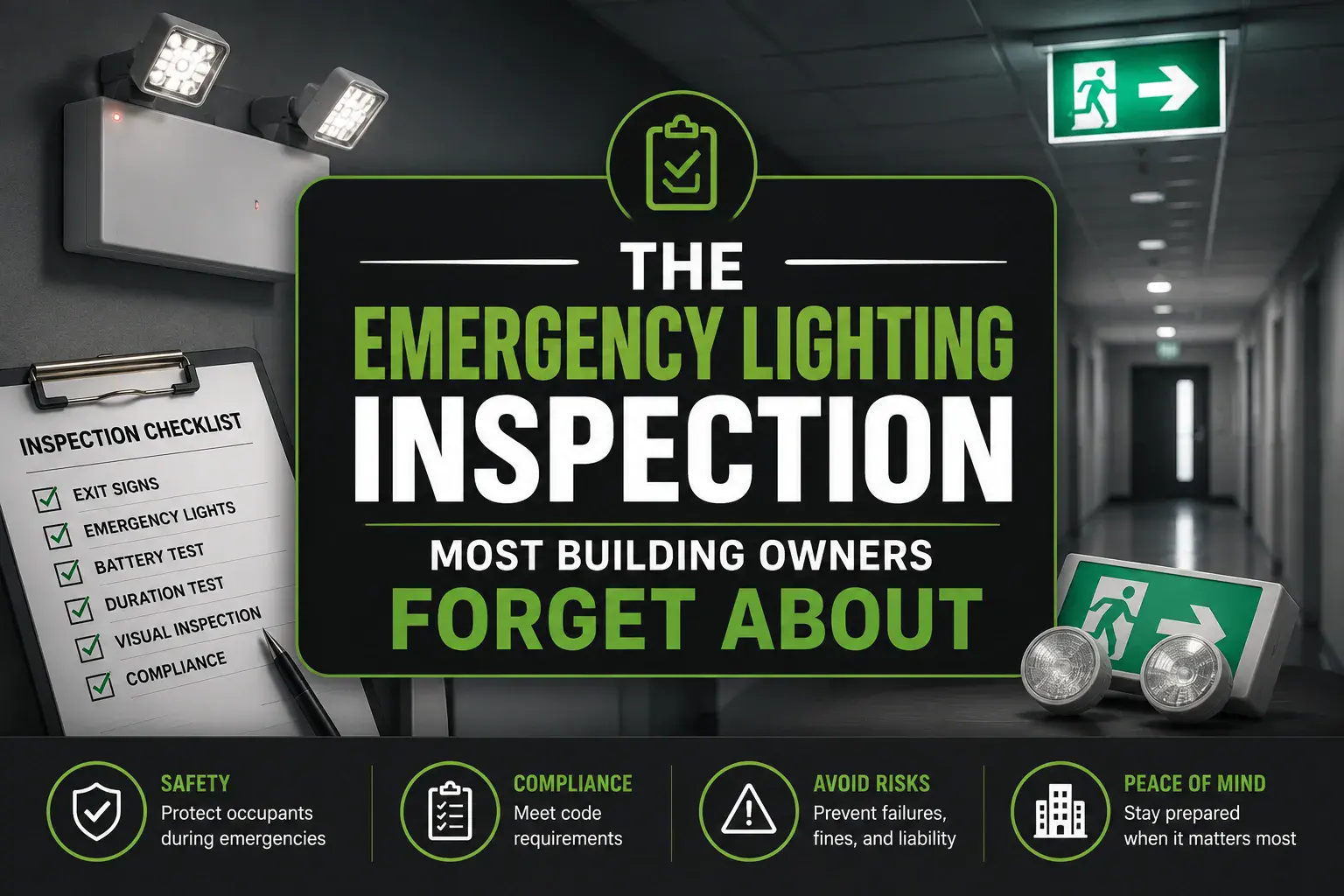
Fire extinguishers get checked every year without fail. Smoke detectors get tested, batteries get swapped, everyone remembers. But there's another life-safety system in most commercial buildings that quietly gets ignored until it fails an inspection or, worse, fails during an actual power outage: emergency lighting and exit signage. It's easy to forget about because it does nothing, visibly, day to day. The lights just sit there dark until the power drops, which is exactly the problem. Nobody notices a dead battery in an emergency fixture until the one moment it actually matters.
Why this system gets overlooked
Most life-safety equipment gives you some kind of daily feedback. A fire extinguisher's pressure gauge is visible at a glance. A smoke detector chirps when its battery is low. Emergency lighting units, by contrast, sit completely inert under normal power, doing their actual job only during a failure. That means a fixture with a dead or degraded battery can look completely normal for months, or years, right up until the building loses power and the emergency lights simply don't come on.
This isn't a hypothetical. Battery-powered emergency lighting units typically rely on sealed lead-acid or nickel-cadmium batteries that degrade over time regardless of use, and a battery that's been silently failing for a year won't announce itself until it's asked to actually perform.
What code actually requires
Emergency lighting isn't optional in commercial spaces, it's governed by building and fire codes, most commonly referencing UL 924 for the equipment itself and NFPA 101 (the Life Safety Code) for testing and maintenance requirements. The core testing obligations most jurisdictions require look roughly like this:
-
Monthly functional test. A brief test, often just 30 seconds, confirming each unit activates and illuminates when normal power is interrupted.
-
Annual full-duration test. A longer test, typically 90 minutes, confirming the battery can sustain the required illumination for the full duration mandated by code, not just flicker on briefly.
-
Written documentation. Most jurisdictions require a maintained log of these tests, with dates and results, available for inspection.
The gap between what's required and what actually happens is usually a documentation problem as much as a maintenance one. A building might genuinely be testing its units, but if there's no log to show an inspector, that's still a compliance failure on paper.
Self-testing units solve the part humans keep forgetting
This is where a lot of buildings have shifted their approach in recent years. Rather than relying on facilities staff to remember monthly and annual manual tests, which realistically get missed or delayed once a facilities team is stretched thin, self-testing emergency units run their own diagnostics automatically on a schedule and flag failures with a visible indicator light, removing the human memory problem from the equation entirely. It doesn't eliminate the need for a maintenance program, someone still has to notice the failure indicator and act on it, but it closes the much more common gap, which is testing simply not happening at all because nobody remembered or had time.
If you're responsible for a commercial space and unsure whether your current emergency lighting setup meets current code, particularly around battery runtime and self-testing capability, it's worth reviewing what's actually available now rather than assuming units installed years ago still meet current standards. A collection like Circ Lighting's emergency lighting lineup is a useful reference point, since it's built specifically around the requirements that trip buildings up most often: UL-listed construction, 90-minute battery backup, and self-testing functionality that handles the monthly and annual diagnostic burden automatically instead of relying on someone remembering to do it by hand.
A short checklist for building owners and facilities managers
-
Confirm your units are actually being tested, not just installed. Ask to see the log, not just the fixtures.
-
Check battery age. Sealed batteries in emergency units typically need replacement every 4 to 7 years regardless of apparent performance, since capacity degrades gradually and invisibly.
-
Consider self-testing units for any building where testing has historically been inconsistent. The automation solves a real, common failure mode rather than just adding a feature.
-
Verified exit signage and emergency lights are covered by the same maintenance plan, since they're often treated as separate systems even though code typically governs them together.
-
Walk the building during a planned power interruption if one's ever scheduled, and actually watch which units come on. It's the only true real-world test.
Emergency lighting is one of those systems that's cheap to maintain properly and genuinely dangerous to neglect, and the neglect is almost always invisible until the exact moment it isn't. A five-minute monthly check, or a self-testing unit that removes the need for that check entirely, is a small habit that closes a real gap in most buildings' safety planning.
- Managerial Effectiveness!
- Future and Predictions
- Motivatinal / Inspiring
- Fitness and Wellness
- Medical & Health
- Manufacturing
- Ausbildung
- Real-Estate
- Food Industry
- Hospitality
- Online Games
- Sports
- Home Services
- Civil Engineering
- Safety and Protection
- Software Products & Services
- Fashion and Jewellery
- Artificial Intelligence
- Entrepreneurship
- Mentoring & Guidance
- Marketing
- Networking
- HR & Recruiting
- Literature
- Shopping
- Career Management & Advancement