

 SkillClick
Why Choosing the Wrong Drywall Is a Mistake That Shows Up Later
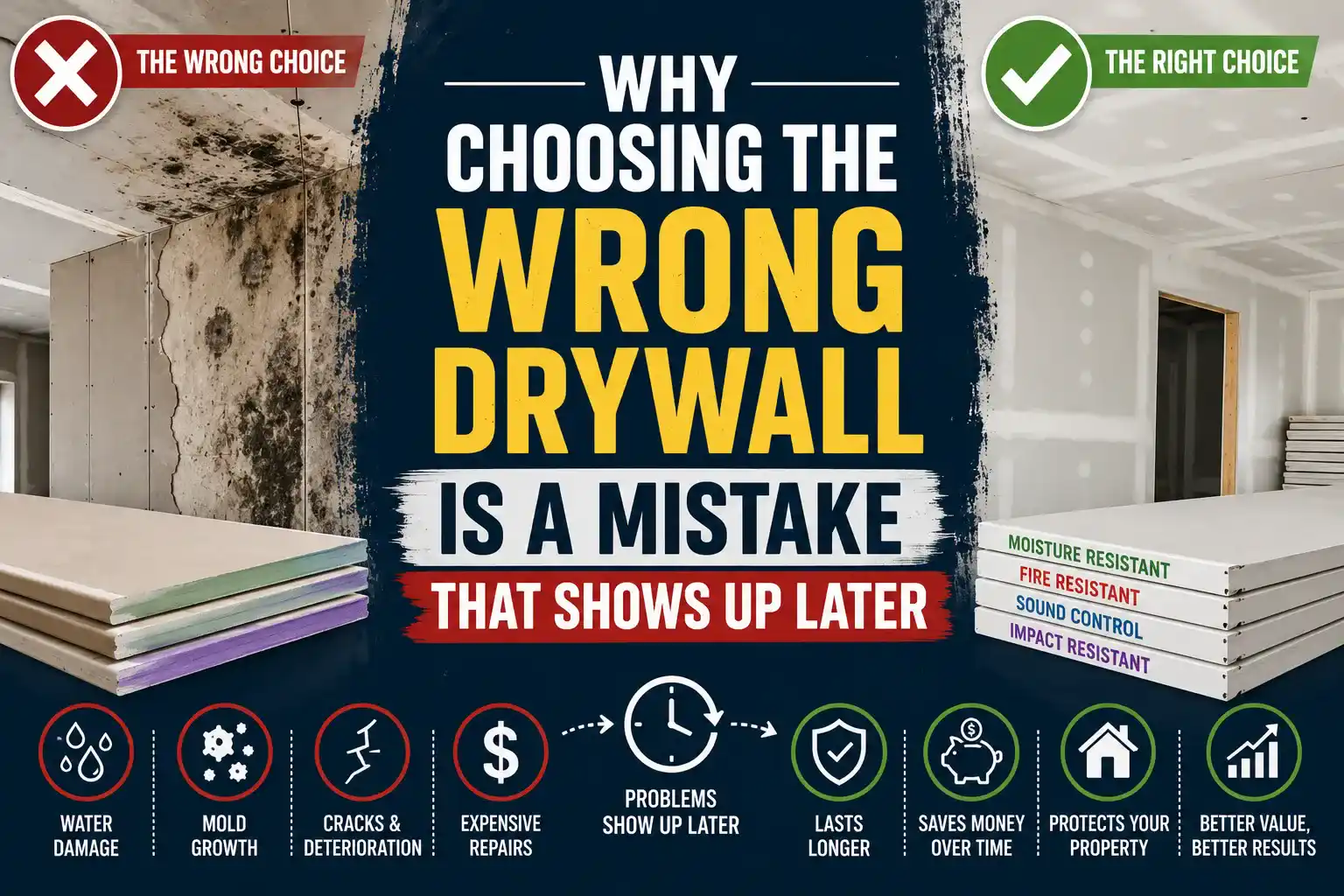
Most decisions in construction reveal themselves quickly. A bad concrete mix shows up in the pour. Incorrect framing dimensions get caught during inspection. Poor electrical work fails testing before the project closes out.
Drywall is different. The wrong choice does not always announce itself immediately. It waits. It waits for the first humid summer in a bathroom that has a standard white board instead of a moisture-resistant panel. It waits for the garage wall that never got Type X and now creates a fire code problem during a home sale inspection. It waits for the music studio owner who specified regular drywall and now cannot understand why sound bleeds through every wall.
The material looks the same going up. The problems only surface once the building is occupied and in use. That gap between installation and consequence is exactly why drywall selection deserves more attention than it typically gets on residential and commercial projects.
The Mistake Most People Make
The most common drywall mistake is not choosing the wrong product on purpose, it is not thinking about the choice at all.
Standard white drywall is cheap, easy to work with, and perfectly appropriate for many applications. That makes it the default. And defaults have a way of getting applied broadly, even in places where a different product would clearly serve better.
A contractor pricing a whole-house renovation might specify standard drywall throughout without stopping to consider that the basement has humidity issues, the master bath shares a wall with a bedroom, or the garage-to-living-room wall has a fire separation requirement. None of those are unusual situations. All of them call for something other than the standard product.
The cost difference between choosing correctly from the start and fixing a drywall problem after the fact is significant. Tearing out installed drywall, disposing of it, and reinstalling the correct product means paying twice for labor and materials. In moisture damage situations, there is often mold remediation on top of that. The upgrade at specification time costs almost nothing by comparison.
What the Room Actually Tells You
Every room in a building communicates what it needs from its wall material if you know what to listen for.
Water is the first question. Any space that sees regular moisture bathrooms, kitchens, laundry rooms, basements needs drywall that is formulated to resist it. Standard paper-faced gypsum boards absorb moisture and eventually deteriorate. Moisture-resistant options like green board, blue board, and purple drywall exist precisely for these environments, and each has its own level of resistance that suits different applications.
Fire separation is the second question. Building codes are specific about where fire-rated drywall is required. Garage walls and ceilings that share space with living areas, stairwells, and certain commercial partitions all carry fire rating requirements. Type X drywall, with its fiberglass-reinforced gypsum core, provides the one-hour and three-quarter-hour ratings that codes call for in these locations. Installing standard drywall where Type X is required is a code violation that creates real liability.
Sound is the third question. It gets overlooked most often because it is not a safety issue, but it has a direct impact on how livable or workable a space is. Home theaters, music rooms, master bedrooms above living areas, multi-family unit separations all of these benefit from drywall engineered to dampen sound transmission rather than simply fill the space between studs.
Thickness Matters Too
Beyond product type, thickness is a separate decision that carries real consequences.
Half-inch drywall is the standard for most interior walls. Five-eighths inch is required for fire-rated assemblies and performs better on ceilings where sag resistance matters. Quarter-inch panels exist for curved applications. Using the wrong thickness in the wrong location creates problems that are either structural, aesthetic, or code-related.
For a full breakdown of each drywall type including specific applications, pricing ranges, and the key factors that should drive your selection this detailed guide covering the types of drywall and how to choose one walks through every option from standard white board to soundproof drywall so you can make the right call before material goes on the truck.
The Specification Decision Is a Cost Decision
Here is the practical reality for contractors and project managers. Drywall specification happens at estimated time, which means the material selection directly affects what gets priced and what gets ordered.
Getting it right at that stage costs nothing extra. A well-specified drywall takeoff that matches the right product to the right room in the right thickness produces an accurate material list, an accurate cost estimate, and a finished project that performs the way it should.
Getting it wrong at that stage creates a cascade of corrections that costs real money. The rooms that need moisture resistance develop problems. The walls that needed fire ratings failed inspection. The spaces that needed sound control disappoint the people who use them.
Drywall is not a glamorous specification decision. But it is one that matters and the right choice made early is almost always easier and cheaper than the right choice made later.
- Managerial Effectiveness!
- Future and Predictions
- Motivatinal / Inspiring
- Fitness and Wellness
- Medical & Health
- Manufacturing
- Образование
- Real-Estate
- Food Industry
- Hospitality
- Online Games
- Sports
- Home Services
- Civil Engineering
- Safety and Protection
- Software Products & Services
- Fashion and Jewellery
- Artificial Intelligence
- Entrepreneurship
- Mentoring & Guidance
- Marketing
- Networking
- HR & Recruiting
- Literature
- Shopping
- Career Management & Advancement