

 SkillClick
How to Build an AI-Powered Fitness App in 2026?
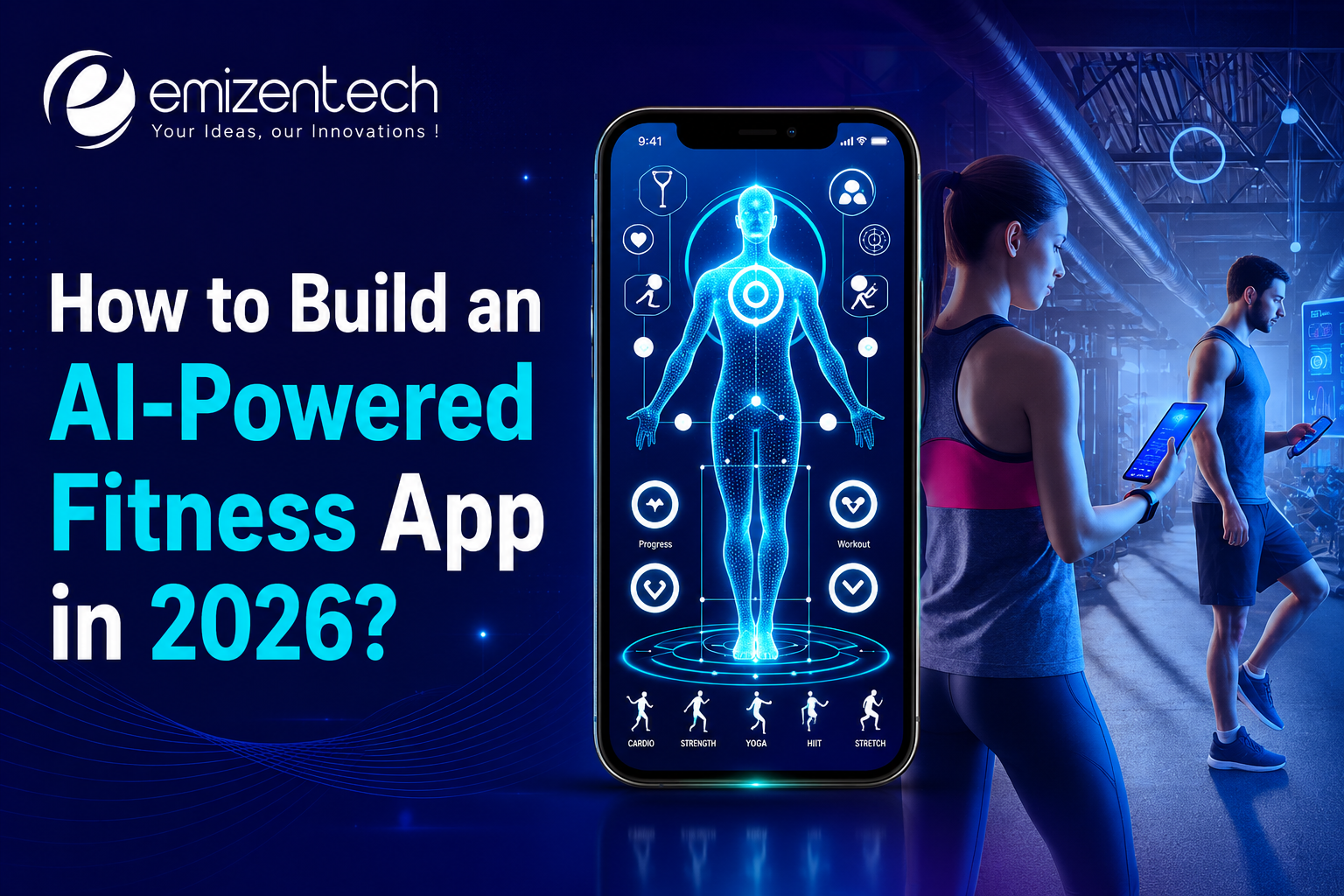
Fitness apps have been around for over a decade, but what's actually inside them has changed dramatically. The early ones counted steps and logged runs. Then came calorie counters and workout libraries. Now we're in a different era entirely - apps that watch your form through the camera, adjust your training plan based on how well you slept, and flag recovery problems before you feel them. That's not an incremental improvement. That's a different category of product.
The timing for building in this space is genuinely good right now. Fitness mobile app development has matured to the point where powerful AI tools are accessible without a research lab budget, but the market hasn't saturated to where differentiation is impossible. If you have a clear problem to solve and the right team to build it, 2026 is a real window. This guide walks through the full picture - what an AI fitness app actually is, what to build into it, how the development process works, what it costs, and how you make money from it.
What Is an AI-Powered Fitness App?
An AI-powered fitness app is a mobile application that uses artificial intelligence to make health and fitness guidance genuinely personal rather than one-size-fits-all. The core idea is simple: instead of giving every user the same static workout plan, the app learns from their individual data - training history, sleep quality, nutrition, biometrics, and progress over time - and adapts accordingly.
The technologies underneath this aren't as exotic as they sound. Machine learning powers personalization, building and continuously adjusting recommendations based on what works for a specific user. Computer vision enables real-time movement analysis, using the phone camera to evaluate exercise form and flag problems mid-rep. Natural language processing makes in-app coaching feel like a conversation rather than a lookup table. Put these together and you have something that responds to the person using it - not to a generic average user the developer imagined. That responsiveness is the defining characteristic of modern fitness mobile app development at the AI tier, and it's what separates apps that retain users from ones that get deleted after two weeks.
Why Invest in AI-Powered Fitness App Development in 2026?
The fitness app market is big and still growing. Global revenue is projected to cross $15 billion in 2026, driven by a combination of rising health awareness, the proliferation of wearable devices, and a lasting behavioral shift toward digital health management that accelerated during the pandemic and hasn't reversed. The average person now carries a health-tracking device on their wrist and expects the apps connected to it to do something meaningful with the data it generates.
Beyond market size, there's a structural problem worth solving. Most fitness apps have genuinely terrible user retention. The typical pattern is a wave of downloads in January, a steep drop-off by February, and an app that sits unused on most phones within six weeks. Generic plans with no feedback loop can't hold attention. AI changes that dynamic because the app becomes more relevant over time rather than less. It knows your patterns, catches your plateaus, and adjusts before you give up. That stickiness has real business value — apps with strong AI personalization report dramatically higher long-term retention rates than their static counterparts. Companies investing in fitness mobile app development with AI built in from day one aren't chasing a trend. They're building something with durable utility, and that's a fundamentally different business proposition.
Key Features of an AI-Powered Fitness App
The features you build determine whether your app becomes part of someone's daily routine or sits forgotten on their phone. Here is a breakdown of the features that matter most — and why each one actually earns its place:
AI-Personalized Workout Plans
This is the foundation. Rather than handing every user the same 12-week program, the app builds plans based on individual fitness level, stated goals, performance data, and recovery signals. Critically, the plan keeps adjusting. If a user consistently skips certain workouts or shows signs of fatigue, the AI adapts instead of repeating the same prescription. That responsiveness is what makes the app feel personal rather than like a PDF in an interface.
Real-Time Form Feedback
Using the phone camera and computer vision models, the app evaluates movement during exercises and provides immediate corrections — knees caving on a squat, back rounding on a deadlift, inconsistent range of motion on a press. For beginners especially, this feature reduces injury risk significantly. It isn't a replacement for a skilled human coach, but it's a lot better than training alone with no feedback at all, and it's available at 10pm when no coach is around.
Smart Nutrition Tracking
Manual calorie logging is the thing most users abandon first because it's tedious. The better approach is photo recognition — the user snaps a meal, the AI estimates macros from the image — combined with a saved meals library and a smart search. What separates good nutrition tracking from basic is that targets should adjust based on training load. A heavy strength session and a rest day don't have the same nutritional demands, and an app that treats them identically is leaving real value on the table.
In-App AI Coaching
A well-built coaching feature does more than answer FAQs. It walks users through sessions set by set, responds to questions in natural language ("can I swap the Romanian deadlift for something else?", "why is my heart rate so high today?"), and notices when a user's engagement is dropping and adjusts accordingly. NLP quality has improved enough that these interactions feel genuinely useful rather than frustratingly robotic, which wasn't reliably true even two years ago.
Wearable Device Integration
Apple Watch, Garmin, Fitbit, WHOOP, Samsung Galaxy Watch — these devices generate a continuous stream of biometric data: heart rate, HRV, resting pulse, sleep stages, active calories, blood oxygen. If your app isn't pulling this in, it's working with a partial picture. Full wearable sync is what allows the AI to make recommendations grounded in how the user's body is actually responding to training, not just what they manually log.
Progress Analytics and Trend Visualization
Numbers alone don't sustain motivation — context does. A dashboard showing that a user's one-rep max increased 15% over eight weeks, or that their resting heart rate dropped five beats per minute since starting the program, gives them something to point to. Good analytics surfaces these milestones automatically rather than making users dig for them. Weekly summaries, personal records, and visual trend lines all contribute to the sense that the app is working, which keeps people around.
Gamification and Social Challenges
Streaks, leaderboards, completion badges, weekly group challenges — these feel lightweight but they drive real retention. The design principle that works best is tying rewards to meaningful workout actions rather than arbitrary points. Challenges that pit users against friends or community members outperform solo challenges because the social accountability element adds a layer of commitment that self-directed goals often lack.
Sleep and Recovery Monitoring
Sleep quality directly affects training performance, hormone balance, and injury susceptibility. An app that reads sleep data from a wearable and automatically reduces training intensity after three consecutive nights of poor sleep — or flags that a planned hard session should be swapped for active recovery — is acting like a smart coach. Most basic fitness apps completely ignore this dimension, which is exactly why it's a clear opportunity for differentiation.
Push Notifications and Behavioral Reminders
A static reminder that fires at the same time every day regardless of behavior becomes noise within a week. Behavioral triggers are different: a notification that fires because the user usually trains Tuesday evenings but hasn't opened the app yet, or one that notices a three-day gap in activity and sends a specific re-engagement prompt. This kind of context-aware nudge is a minor technical detail that has an outsized impact on daily active use.
Together, these are the features that make fitness mobile app development in the AI era worthwhile — a product that serves users better the longer they use it.
Step-by-Step Process to Build an AI-Powered Fitness App
Building well takes time and discipline. Cutting corners in early stages reliably creates expensive problems later. Here is how the process should actually unfold:
Step 1 — Deep User Research
Before writing a line of code or designing a single screen, spend serious time understanding the people you're building for. Read the one and two-star reviews of competing apps — they are an unfiltered brief on what to fix. Talk to potential users directly. Figure out whether you're targeting fitness beginners who need guided structure, intermediate users who've outgrown basic trackers, or a defined niche like post-rehabilitation fitness, sports-specific conditioning, or corporate wellness. The sharper your user definition, the better every subsequent decision gets.
Step 2 — Define a Realistic MVP Scope
Scope creep is how projects run out of budget before they launch. Choose two or three core AI features — personalization and workout tracking are almost always the right starting point — and build those properly. Wearable integrations, community features, advanced nutrition analysis, and corporate wellness dashboards can all come in subsequent versions once you have real users giving you feedback on what actually matters to them. A focused app that does a few things extremely well will outperform a bloated app that does many things poorly.
Step 3 — Design for the Real Use Environment
Fitness app UX has a specific set of constraints that generic design thinking doesn't account for. Users are often operating with sweaty hands, in noisy gym environments, glancing at a screen while mid-exercise. Onboarding needs to be fast — ask only what the AI genuinely needs to personalize the experience, nothing more. Workout interfaces need large tap targets and glanceable layouts. Navigation should be intuitive on first use, not after a learning curve. How the app performs in a real gym matters more than how it looks in a Figma presentation.
Step 4 — Select a Proven Technology Stack
Flutter and React Native are both solid for cross-platform mobile development and cover the vast majority of use cases. For AI, TensorFlow Lite is worth knowing specifically — it runs inference on-device, which makes form feedback faster and reduces the server calls that would otherwise add latency during a live workout. PyTorch is strong for model development and training. Firebase handles real-time backend needs well for early-stage apps. AWS and Google Cloud are both reliable infrastructure choices. The goal is a stack your development team knows well, not whatever happens to be newest.
Step 5 — Build and Validate Your AI Models
This phase takes the most time and carries the most technical risk. You can start with pre-trained models and fine-tune them on fitness-specific datasets, which is faster and more cost-effective than training from scratch. For pose estimation, MediaPipe is a strong starting point. For recommendation engines, collaborative filtering and reinforcement learning are both viable approaches depending on the use case. The non-negotiable here is training data quality. Models trained on noisy, poorly labeled data give confident but wrong recommendations, which is worse for user trust than giving no recommendations at all.
Step 6 — Build the Backend and Integrate Third Parties
The backend handles user authentication, data storage, subscription and payment processing, and all the API connections that make the app work with the wider ecosystem. Apple HealthKit and Google Fit are essential for health data on their respective platforms. Wearable device APIs add another integration layer. RevenueCat or Stripe handles subscription infrastructure. Budget more time for this phase than you think you need — third-party integrations consistently surface edge cases that weren't in the original plan.
Step 7 — Beta Test with Real Users
Internal QA catches bugs. Real-user testing catches the things that are technically functional but experientially broken — onboarding steps that confuse people, AI recommendations that feel off or irrelevant, features that nobody can find. Run a closed beta with at least 50–100 real users, record sessions, and track where people drop off. The fixes you make based on this feedback cost a fraction of what post-launch corrections cost, and they prevent the reputation damage that comes from a rough public launch.
Step 8 — Launch and Iterate Continuously
Launch is the beginning, not the conclusion. In the first weeks post-launch, focus on watching behavioral data — where users drop off, which features drive daily active use, where the AI is performing well and where it's missing. AI models improve as they accumulate more real-world data, so the product genuinely gets better over time if you're paying attention and shipping updates. Apps that go quiet after launch lose user trust quickly; a consistent update cadence signals that the product is alive and improving.
Monetization Strategies for AI-Powered Fitness Apps
The revenue model is not something to figure out after launch. It needs to be designed into the product from the start because it shapes which features you build, how you structure the free experience, and what you optimize for. Here are the models that work:
Freemium Model
The free tier should be genuinely useful, not crippled. Lock the AI-powered features — adaptive plans, form feedback, real-time coaching — behind the premium tier. Users who see real value in the free version are far more likely to convert than those who feel gated from the moment they sign up. The goal is to make the free tier good enough to build habit, and the paid tier good enough to be obvious once that habit is established.
Subscription Tiers
Monthly and annual plans at two or three price points work well. Annual subscriptions improve cash flow and reduce churn significantly. Structuring tiers around AI capability depth — basic personalization at the entry level, full adaptive coaching and form feedback at the top tier — gives users a clear, tangible reason to upgrade rather than a vague "more features" pitch.
One-Time Content Purchases
Specific programs, specialized training plans, or premium challenge bundles sold individually. This works well as a supplemental revenue stream alongside subscriptions, especially for users who want a specific outcome (a 12-week race prep plan, a postpartum fitness program) without committing to a recurring charge.
Corporate Wellness Contracts
B2B deals with employers to provide employee wellness programs. Deal values are higher, sales cycles are longer, but the revenue is stable and churn rates are far lower than consumer subscriptions. Companies in this space often find that one mid-size corporate client generates as much revenue as hundreds of individual subscribers, with a fraction of the support overhead.
Affiliate Revenue
Recommending equipment, supplements, or recovery tools within the app and earning commission when users buy. This only works well when the recommendations feel genuinely relevant and contextually appropriate — triggered by what the user is actually doing in the app, not serving as banner ads. Done well, it adds income without degrading the user experience. Done poorly, it damages trust fast.
White-Label Licensing
Licensing the platform to gyms, physiotherapy clinics, sports teams, or corporate wellness providers who want a branded app without building one. Less visible than consumer product revenue, but often more profitable. The sales cycle is longer but the contracts tend to be larger and more stable.
Deciding on your primary and secondary revenue models during the fitness mobile app development planning phase — not after you've already built the product — prevents a lot of painful structural rework later.
Cost to Build an AI-Powered Fitness App in 2026
There's no honest single number because the variables matter enormously. Complexity, platform, AI model approach, and team location all shift the range significantly. Here's a realistic breakdown:
|
App Type |
Estimated Cost |
Timeline |
|
Basic Fitness App (MVP) |
$15,000 – $30,000 |
3–4 months |
|
Mid-Level AI Fitness App |
$30,000 – $70,000 |
5–7 months |
|
Advanced AI-Powered App |
$70,000 – $150,000+ |
8–12 months |
Key Factors That Affect Cost
-
Custom AI model development is the biggest single cost driver. Building and training models from scratch is significantly more expensive than fine-tuning pre-trained ones — and for most apps, starting with pre-trained models is the right call anyway.
-
Number of platforms at launch matters more than people expect. Building for iOS and Android simultaneously doesn't double the cost, but it adds 30–40% compared to launching on one platform first.
-
Wearable and third-party API integrations each add development and testing time. One or two integrations are manageable in an MVP; building out a full ecosystem of connections is a later-stage investment.
-
Development team location is the most controllable variable. US and UK development rates typically run 3–4x higher than comparable teams in India. Working with an experienced fitness mobile app development team based in India is the most common cost-optimization decision startups make in this space, and the savings - often 40–60% against Western rates - make a meaningful difference to how far a seed or Series A budget stretches without sacrificing output quality.
How to Choose the Right Fitness App Development Company?
The development partner decision matters more than most founders realize until they've made the wrong one and are six months in with a product that doesn't work. Here's what to actually evaluate:
Domain-Specific Portfolio
Generic mobile app experience is not the same as fitness or health app experience. Ask to see previous work in the health and wellness space specifically. The domain knowledge gap shows up in product decisions - feature prioritization, UX assumptions, compliance awareness — not just in code quality.
Demonstrated AI Capability
Ask specifically about their hands-on experience with TensorFlow, PyTorch, computer vision, and NLP in production applications - not just proof-of-concept projects. Agencies that can only speak in vague terms about "AI integration" are typically wrapping third-party APIs rather than building real models. That distinction matters a lot for an AI-first product.
Verified Client Reviews
Clutch and GoodFirms both host client-verified reviews. Read the critical ones carefully - how a company handles problems, delays, and scope disagreements is far more revealing than how they perform when everything goes smoothly. One or two detailed negative reviews tell you more than ten generic five-stars.
Detailed Scoping and Transparent Pricing
Any agency that gives you a fixed quote in the first conversation without fully understanding your spec is either guessing or padding heavily. A reliable partner produces a detailed scope document, asks hard questions about your requirements, and commits to numbers only after they understand what they're building.
Post-Launch Support Structure
AI models require retraining as real-world data accumulates and user behavior evolves. Make sure ongoing maintenance, model updates, and bug fixes are explicitly covered in the contract - not left as a vague "we'll figure it out later" arrangement. This is one of the areas where contracts matter.
IP Ownership and NDA
You should own your codebase outright from day one. Get a non-disclosure agreement and full intellectual property transfer confirmed in writing before development begins. This is non-negotiable regardless of how much you trust the team you're working with.
Conclusion
AI fitness apps aren't appealing because they're technically interesting. They're appealing because they solve a problem that simpler tools have consistently failed to solve - keeping people consistent with their health goals over the long term. That's a real problem with real commercial value attached to it.
If you're building in this space, the fundamentals are clear: pick a specific user, solve their actual problem, build an MVP with strong AI at its core, get it in front of real users fast, and keep shipping. Whether your starting point is a standalone Fitness Tracker App Development product, an AI coaching platform, or a corporate wellness tool, the approach is the same. Companies like EmizenTech bring the technical depth to handle the AI layer properly without it becoming a year-long research detour. Serious fitness mobile app development requires a serious build partner - find one, and then focus on building something that people actually come back to.
Frequently Asked Questions (FAQs)
How much does it cost to build an AI-powered fitness app?
Roughly $15,000–$30,000 for a lean MVP, $30,000–$70,000 for a mid-level app with solid AI features, and $70,000–$150,000+ for a fully built platform with custom models and wearable integrations. The location of your development team is the single biggest variable - India-based teams cost 40–60% less than US or UK equivalents with comparable output quality.
What AI technologies are used in fitness apps?
The core stack is machine learning for personalization, computer vision for form analysis, and NLP for in-app coaching - typically built on TensorFlow, PyTorch, or MediaPipe. More advanced apps also use predictive models for recovery tracking and injury risk assessment.
How long does it take to develop an AI fitness app?
A focused MVP takes 3–4 months. A more complete app with multiple AI features typically runs 5–7 months. A fully featured platform with custom AI models, wearable integrations, and community features can take 8–12 months - the AI training and integration phases are where most of that time is spent.
Can AI-powered fitness apps integrate with wearables?
Yes - Apple Watch, Fitbit, Garmin, WHOOP, and Samsung Galaxy Watch all expose APIs for this, and Apple HealthKit and Google Fit handle the platform-level data connections. Most serious fitness mobile app development projects include at least foundational wearable support from the start.
What are the benefits of AI in fitness app development?
The core benefit is an app that gets more relevant over time - personalized plans, real-time coaching, adaptive recovery recommendations - rather than staying static like a basic tracker does. That improving utility is what drives long-term retention, which is the metric that most fitness apps fail on.
- Managerial Effectiveness!
- Future and Predictions
- Motivatinal / Inspiring
- Fitness and Wellness
- Medical & Health
- Manufacturing
- Education
- Real-Estate
- Food Industry
- Hospitality
- Online Games
- Sports
- Home Services
- Civil Engineering
- Safety and Protection
- Software Products & Services
- Fashion and Jewellery
- Artificial Intelligence
- Entrepreneurship
- Mentoring & Guidance
- Marketing
- Networking
- HR & Recruiting
- Literature
- Shopping
- Career Management & Advancement