

 SkillClick
How AI Systems Learn: Understanding Artificial Intelligence Models
We are living in the middle of one of the biggest technological shifts in human history. In 2026, understanding artificial intelligence is no longer optional for computer science and engineering students, it is essential. AI is reshaping software development, healthcare, finance, transportation, and virtually every field you might work in after graduation.
But here is the thing: most explanations of how AI works are either too shallow ("it learns from data!") or too academic (buried in mathematical notation before you even understand the basics). This guide aims to be different.
By the end of this post, you will have a clear, grounded understanding of how AI systems learn from the core principles all the way through to how real AI models are trained, refined, and deployed in the world. No unnecessary jargon. No filler. Just the concepts that actually matter.
What Is Artificial Intelligence?
Artificial intelligence, at its core, is the ability of a computer system to perform tasks that would normally require human intelligence. Things like recognizing a face in a photo, understanding a spoken sentence, playing a game of chess, or recommending what video to watch next.
But here is what separates modern AI from old-school computer programs: traditional programs follow explicit rules written by programmers. AI systems, by contrast, learn their own rules from data.
Think of it this way. If you wanted to write a program to recognize a cat in a photo the traditional way, you would have to define every possible feature of a cat: pointy ears, whiskers, fur patterns, and so on. It would take years and still fail constantly.
With AI, you simply show the system thousands of labeled photos "cat" and "not cat" and it figures out the relevant patterns on its own. That is the fundamental shift. AI learns; traditional programs execute.
Why Understanding Artificial Intelligence Matters Right Now in 2026?
The pace of AI development has accelerated dramatically. Large language models now power writing assistants, coding tools, and customer service platforms. Computer vision systems guide autonomous vehicles. Recommendation algorithms shape what billions of people read, watch, and buy.
For CS students specifically, understanding how these systems work is no longer a specialization; it is part of the baseline. Employers increasingly expect software engineers to have at least a working understanding of machine learning concepts, even if they are not building models themselves.
Beyond the job market, AI literacy helps you ask better questions, spot hype versus reality, and engage meaningfully with the technology that will define your career.
How AI Systems Learn: The Core Mechanism?
At the heart of every AI system is a simple idea: learn from examples. Let us walk through exactly how that works.
Step 1: Training Data - The Raw Material
Every AI model starts with data. Lots of it. This training data is the set of examples the model learns from. It might be millions of labeled images, thousands of hours of transcribed speech, or billions of words of text scraped from the internet.
The quality and quantity of this data matters enormously. An AI model is only as good as the data it is trained on. Garbage in, garbage out — this is one of the most important principles in all of machine learning.
Step 2: The Model — A Mathematical Function
The AI model itself is essentially a mathematical function. It takes an input (say, a photo) and produces an output (say, "this is a dog"). The model has thousands or millions of internal parameters, think of them as knobs and dials that control how it processes information.
Initially, these parameters are set randomly. The model knows nothing. What happens next is where the magic of machine learning comes in.
Step 3: Learning — Adjusting the Knobs
The model makes a prediction on a training example. It will almost certainly be wrong at first. The system then calculates how wrong it was — this is called the loss or error. It then uses an algorithm called backpropagation (for neural networks) to figure out how to adjust each parameter to reduce that error, just a little.
This process repeats millions of times across the entire training dataset. Gradually, the model's parameters are adjusted to a point where it produces accurate predictions. This iterative process is what we mean when we say a model is "trained."
A useful analogy: imagine learning to shoot a basketball. You throw, you miss, you adjust your angle slightly based on how far off you were. You repeat this thousands of times until muscle memory kicks in. AI training is the same concept, just happening mathematically.
The Three Major Types of Machine Learning
Not all AI learning works the same way. There are three main approaches, each suited to different types of problems.
1) Supervised Learning
This is the most common approach. The model is trained on labeled examples data where the correct answer is already provided. For example, a dataset of emails labeled "spam" or "not spam." The model learns to map inputs to outputs based on these labeled pairs.
Use cases: email filtering, image classification, fraud detection, medical diagnosis, and most predictive models you encounter in practice.
2) Unsupervised Learning
Here, the model receives data without any labels. Its job is to find structure, patterns, or groupings on its own. There are no "right answers" provided — the algorithm must discover them.
Use cases: customer segmentation, anomaly detection, recommendation systems, and data compression. If a company wants to group its customers by behavior without knowing in advance what those groups are, unsupervised learning is the tool.
3) Reinforcement Learning
This one is different from both of the above. Instead of learning from a fixed dataset, the AI agent learns by interacting with an environment. It takes actions, receives rewards or penalties based on outcomes, and gradually learns a strategy (called a policy) that maximizes reward over time.
The most famous demonstration: AlphaGo, developed by DeepMind, learned to play the board game Go at a superhuman level through reinforcement learning. It played millions of games against itself and discovered strategies no human had ever conceived.
Use cases: game playing, robotics, autonomous vehicles, and resource optimization.
Neural Networks and Deep Learning: How AI Achieves Complex Reasoning
When people talk about modern AI breakthroughs, image recognition, language models, voice assistants they are almost always talking about neural networks, specifically deep neural networks.
What Is a Neural Network?
A neural network is a type of AI model loosely inspired by the structure of the human brain. It consists of layers of interconnected nodes called neurons. Each neuron receives inputs, applies a mathematical transformation, and passes the result to the next layer.
The network has three types of layers: an input layer (receives raw data), one or more hidden layers (where the actual learning happens), and an output layer (produces the final prediction).
"Deep" learning simply means the network has many hidden layers, sometimes dozens or hundreds. The depth is what allows deep learning models to learn increasingly abstract representations of data.
How Neural Networks Learn to See, Read, and Listen?
Consider how a deep neural network learns to recognize a handwritten digit. The first layers learn to detect simple patterns like edges and curves. The middle layers combine these into shapes and structures. The final layers combine those into recognizable characters.
No one explicitly programmed the network to look for edges first. It discovered this hierarchical structure on its own, just by processing enough examples and adjusting its parameters to minimize error.
This ability to learn hierarchical features automatically is what makes deep learning so powerful and so broadly applicable across vision, language, and audio.
Natural Language Processing: Teaching AI to Understand Human Language
Natural Language Processing, or NLP, is the branch of AI focused on enabling computers to understand, interpret, and generate human language. It is what powers chatbots, translation tools, voice assistants, and large language models like the ones you interact with daily.
Language is extraordinarily difficult for computers. Words can be ambiguous. Context matters. Sarcasm, metaphor, and nuance are everywhere. Early NLP systems relied on hand-crafted rules and struggled constantly.
Modern NLP uses transformer-based neural networks trained on massive text datasets. These models learn statistical relationships between words, phrases, and contexts at an enormous scale, which allows them to generate coherent, contextually appropriate language and understand user intent with remarkable accuracy.
Key NLP applications you likely use already: autocomplete on your phone, spam detection in your email, grammar checking tools, and AI writing assistants.
How AI Models Improve Through Training and Feedback?
Training is not a one-shot process. AI models improve through continuous cycles of evaluation and refinement.
After initial training, a model is tested on data it has never seen before called the validation set. This tells developers how well the model generalizes beyond its training examples. If it performs well on training data but poorly on validation data, it has overfit in memorizing the training examples rather than learning underlying patterns.
Developers then tune the model: adjusting architecture, training more data, changing how the model is regularized, or modifying the learning process. In production, real-world feedback can further improve models through techniques like reinforcement learning from human feedback (RLHF), which is how many large language models are fine-tuned to be more helpful and accurate.
The key insight: AI systems are not static. They are continuously evolving, shaped by the data they process and the feedback they receive.
Your Step-by-Step Roadmap to Understanding AI
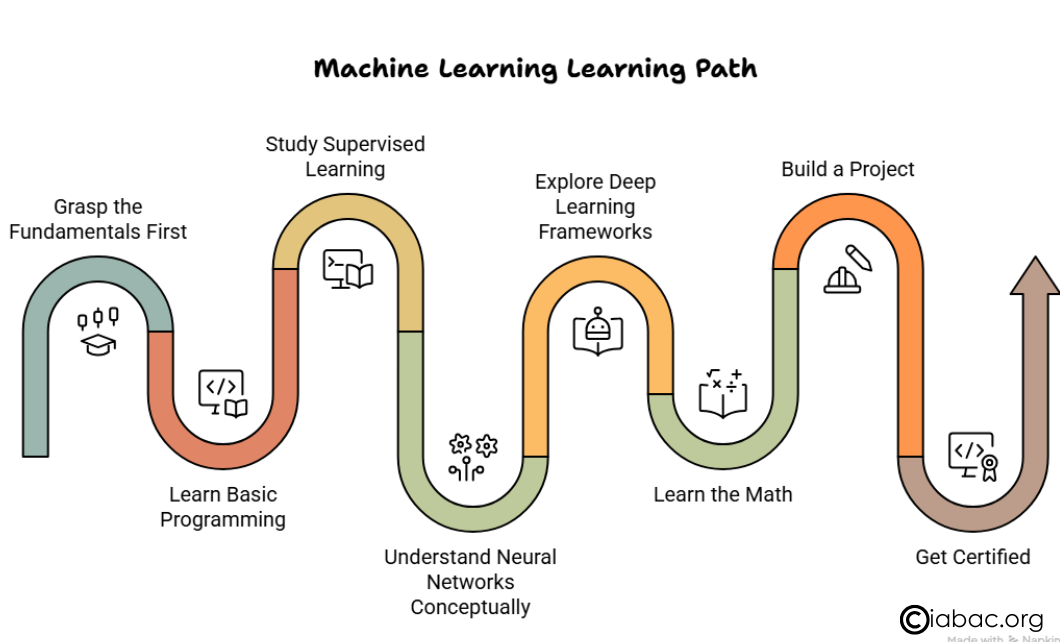
Here is a practical learning path if you are starting from zero and want to build real understanding:
-
Grasp the fundamentals first: Understand what AI is, what machine learning means, and why neural networks are central to modern AI. This article is your starting point.
-
Learn basic programming: Python is the language of AI. If you are not already comfortable with it, spend a few weeks on Python fundamentals before diving into ML libraries.
-
Study supervised learning: Start with linear regression and classification problems. Scikit-learn (a Python library) is the best place to begin practically.
-
Understand neural networks conceptually: Before touching code, make sure you understand what layers, neurons, weights, and activation functions are and why they matter.
-
Explore deep learning frameworks: TensorFlow and PyTorch are the two dominant frameworks for building neural networks. Pick one and work through beginner tutorials.
-
Learn the math (enough of it): You do not need a PhD, but a working understanding of linear algebra, probability, and calculus will help you understand what your models are actually doing.
-
Build a project: Apply what you have learned to a real problem. Classify images, predict prices, or build a simple text classifier. Learning by building beats reading alone every time.
-
Get certified: Validate your knowledge with a recognized credential. See the section below.
Top AI Certifications to Validate Your Understanding of Artificial Intelligence
Certifications serve two purposes: they force you to learn systematically, and they signal your knowledge to employers and academic programs. For students early in their AI journey, IABAC certifications offer a focused, practical path.
Certification Table:
|
Certification |
Issuer |
Focus Area |
Best For |
Level |
|
CAIE Top Pick |
IABAC |
AI Fundamentals, ML, DL, NLP |
CS students, AI beginners |
Beginner–Inter. |
|
CMLE |
IABAC |
Machine Learning algorithms & models |
Data & ML enthusiasts |
Intermediate |
|
CDLE |
IABAC |
Deep Learning & Neural Networks |
DL/research track |
Intermediate |
|
Gen AI Expert |
IABAC |
Generative AI, LLMs, Prompt Engineering |
Modern AI applications |
Intermediate |
|
CDS |
IABAC |
Data Science, Statistics, AI pipelines |
Data-focused learners |
Beginner–Inter. |
Other IABAC Certifications Worth Exploring
-
Certified Machine Learning Expert (CMLE) — IABAC: Deep focus on ML algorithms, model evaluation, and applied machine learning. Ideal once you have the AI foundations from CAIE.
-
Certified Deep Learning Expert (CDLE) — IABAC: Specialized in neural network architectures, computer vision, and advanced deep learning concepts.
-
Certified Generative AI Expert — IABAC: Covers large language models, prompt engineering, and generative AI applications at the cutting edge of the field in 2026.
-
Certified Data Scientist (CDS) — IABAC: Broader credential covering the full data science pipeline, including statistics, data engineering, and AI model deployment.
AI Algorithms, Models, and Intelligent Automation: The Bigger Picture
As AI models mature, they increasingly power what is called intelligent automation systems that can perform complex tasks with minimal human intervention. Robotic process automation combined with AI judgment is transforming industries from manufacturing to legal services.
The AI algorithms driving this range from classical techniques like decision trees and support vector machines to modern deep learning architectures. Understanding which algorithm fits which problem is a core skill for any AI practitioner.
The field of AI is not a single thing, it is a toolkit. Learning to understand artificial intelligence means learning to recognize which tools exist, how they work, and when to apply them. The concepts covered in this article are your entry point to that toolkit.
Conclusion: Understanding Artificial Intelligence Is a Skill, Not a Mystery
AI systems learn by doing what humans do they look at examples, identify patterns, and gradually refine their understanding through feedback. The mechanisms behind this are elegant and knowable. Machine learning, deep learning, neural networks, and natural language processing are not black boxes reserved for elite researchers. They are teachable, learnable, and increasingly essential.
Understanding artificial intelligence in 2026 gives you an enormous advantage. It lets you engage meaningfully with the technology powering the world, make better decisions in your career, and contribute to systems that matter.
Start with the concepts. Build the foundations. Then validate your learning with a certification that signals your commitment to the field.
Reference Links
-
IABAC Certified Artificial Intelligence Expert (CAIE): https://iabac.org/artificial-intelligence-certification
-
IABAC Certification Programs Overview: https://iabac.org
- Managerial Effectiveness!
- Future and Predictions
- Motivatinal / Inspiring
- Fitness and Wellness
- Medical & Health
- Manufacturing
- EĞİTİM BİLGİLERİ
- Real-Estate
- Food Industry
- Hospitality
- Online Games
- Sports
- Home Services
- Civil Engineering
- Safety and Protection
- Software Products & Services
- Fashion and Jewellery
- Artificial Intelligence
- Entrepreneurship
- Mentoring & Guidance
- Marketing
- Networking
- HR & Recruiting
- Literature
- Shopping
- Career Management & Advancement