

 SkillClick
How to Choose a Packaging Supplier That Truly Delivers
Introduction
You spent three months comparing prices, chasing samples, negotiating terms. You settled on a supplier. The first batch arrived on time. You opened the container. The bags were 2mm too narrow. They wouldn't run on your line.
You emailed your contact. Three days later: "I will check with production." Another week passed. "We can send a replacement in 45 days."
Your line was idle. Customers were waiting. And your purchasing manager wanted to know why you picked this supplier.
If you've done cross-border packaging procurement long enough, you've lived some version of this story. The numbers change. The frustration doesn't.
A Copenhagen Business School study tracked a Danish smartphone maker, Lumigon, through the same pattern. Miscommunication over a gold paint finish led to wasted batches, failed shipments, and cumulative financial pressure that contributed to the company's bankruptcy. The researcher's conclusion: "Bad communication leads to conflict, inefficiency, and loss." In their case, those words weren't abstract. They were the obituary.
Most procurement beginners screen suppliers on two things: price and samples. A low quote catches the eye. A polished sample feels reassuring. Neither tells you how the supplier will perform on order 47.
This article breaks down three hidden dimensions that separate real suppliers from the rest, backed by case studies and industry data:

Dimension 1: Communication competence. Your requirements travel from email → work order → workshop instruction. Each handoff loses fidelity. The contact person's language fluency, logical clarity, and cultural awareness determine how much survives. Studies show 40% of first-sample failures trace back to subjective language—"standard," "normal," and "heavy duty" mean different things to buyers and factory teams.
Dimension 2: Quality and delivery discipline. Samples are handcrafted with premium materials. Bulk runs on the regular line with regular workers. The gap between them is where a supplier's real capability shows. We walk through the five hidden causes of late delivery and the Golden Sample system that prevents "first-batch-perfect, fifth-batch-broken."
Dimension 3: Responsiveness. Response speed is not a personality trait. It is the best leading indicator of internal management quality. Anvyl's study of thousands of suppliers found the average response time is 2.9 days. Highly engaged suppliers respond in 1.9 days. Poor ones take over 4 days. A factory that needs 24 hours to reply to an RFQ will not solve your emergency in 2 hours.
This article will not teach you "how to get the lowest price." Price negotiation is the easiest part. It gives you a structured three-dimensional scoring framework to see a supplier's true capability before you sign—because choosing a supplier is like choosing a business partner. Don't expect to change them after the deal is done.
Dimension 1: Your Contact Person Is Your Supply Chain's Translator
Core argument: 40% of first-sample failures in custom packaging stem from subjective language. The person on the other end of your email bridges two languages, two cultures, and two sets of assumptions. Their translation accuracy determines your supply chain's loss rate.
Three Cases That Prove the Point
Case 1: The €220,000 label
A European food company switched label suppliers to save 4%—roughly €35,000 a year. The new labels were "equivalent." On the line, they shifted 2-3mm off-center. The reject rate crept from 1.8% to 3.9%. Three months of "normal variance."
Then retailer compliance audits flagged misaligned branding. Chargebacks hit €42,000. The true cost: over €220,000. Scrap: €38,000. Rework labor: €19,000. Returned pallets: €67,000. Lost production: €31,000. Penalties: €42,000.
The annual savings from the switch? €35,000. The loss from one undetected spec variance: six times that. All because "same structure, same finish" meant different things to the buyer and the factory floor.
Case 2: When communication kills a company
The Lumigon case is worth reading in full. A Danish smartphone maker sourced from Chinese suppliers. A request for "gold paint finish" was technically challenging. The supplier knew it but didn't say no—saving face mattered more than clarity. Production went ahead with the wrong finish. Entire batches scrapped. Shipping costs doubled. The antenna signal degraded from the wrong coating.
Payment delays created distrust. Production delays compounded. The cumulative financial burden contributed to the company's bankruptcy. The academic verdict: "Bad communication leads to conflict, inefficiency, and loss." In this case, the loss was total.
Case 3: €80,000 worth of bucket hats
Berlin streetwear brand Kopfgeist ordered custom hats from a Chinese factory. The spec said "standard curve" for the brim. The factory had its own definition of "standard." €80,000 of inventory was unsellable.
Post-mortem: 40% of first-sample failures across the factory's entire client base traced back to subjective language. Words that sounded precise meant different things on different continents.
The fix was simple and brutal: replace subjective words with physical measurements, Pantone codes, curvature radii, and sealed samples. After structured tech packs, sampling costs dropped 30-40%. Communication overhead fell by ~€21,000 per year.
Why "Yes" Never Means "Yes"
If you source from Asia, you've seen this pattern:
| What they say | What it often means |
|---|---|
| "This is a bit difficult" | No. We cannot do this. |
| "I will try my best" | Probably can't, but won't say no. |
| "Maybe" | Almost certainly no. |
| "We need to study this" | This is a problem; we hope you don't ask again. |
| "OK, no problem" (no follow-up) | Heard you. May not have understood. |
This is not dishonesty. Direct refusal causes "loss of face" for both parties, so indirect language becomes the norm. The Lumigon buyer never realized the supplier's indirect "no's" were actual rejections. Months wasted on a path the supplier knew was wrong from the start.
The golden rule of cross-border procurement: After every verbal discussion—call, video meeting, voice message—send a written confirmation summarizing what you understood. Ask for confirmation. This single habit eliminates 80% of communication-driven rework.
Berlin Packaging's global sourcing team puts it directly: "Follow up discussions with written confirmations. Use templates for consistency. Professionally translate important documents and send both the original and the translation."
Three Tests to Evaluate Communication Competence Before You Commit
Test 1: RFQ response quality
Send a detailed RFQ: product type, dimensions, material preference, quantity, target market.
Weak response: Standard quote template, no questions, arrives in 24+ hours.
Strong response: Quote within 4 hours, plus 3-5 targeted questions. "What product are you filling? Moisture sensitivity? Storage conditions? Food-grade cert needed for EU or FDA for US?"
What this tells you: the contact person is already translating your inquiry into a production spec. They are thinking about your application, not just their price list.
Test 2: The technical follow-up probe
After the first exchange, send a minor spec change: "Can we reduce film thickness from 80 to 75 microns?"
Weak response: "OK, no problem." This person does not understand that thickness affects barrier properties, seal temperature, and mechanical strength. They are a message passer, not a partner.
Strong response: "Reducing thickness will lower moisture and oxygen barrier. What shelf life do you need? We may need to adjust the material structure or laminate to maintain performance."
This person has technical literacy. They evaluate trade-offs. They are protecting you from a bad decision.
Test 3: Trial order information loss
Place a small trial order (10-20% of planned volume). Track the chain: your email → contact's understanding → work order → production → delivery.
Compare what you asked for against what arrived on 5-10 critical parameters.
-
Loss rate > 20%: this contact is a bottleneck
-
Loss rate 5-20%: typical, improvable with better documentation
-
Loss rate < 5%: keeper. They understand you. The factory executes faithfully.
Beyond the Individual: Does the Supplier Have Information Infrastructure?
A skilled contact can compensate for a lot. But they cannot overcome a factory running on verbal handoffs and WeChat messages.
During evaluation, ask: "Can you pull up our last order's production records and QC reports?"
If the answer is "Yes, here is the batch number and reports with photos," they have a traceable quality system.
If it's "I need to ask production," information is siloed. No system links sales to production to QC.
If it's "We don't keep those records," walk away. No traceability = no accountability.
Leading packaging suppliers now assign unique serial numbers to every batch, linked to material certificates, in-process inspection data, and final QC reports. This is not a luxury. It is infrastructure that prevents communication breakdowns from becoming production disasters.
Dimension 2: On-Time, On-Spec — The Twin Pillars of Supplier Reliability
Core argument: Samples are handcrafted. Bulk production runs on autopilot. The gap reveals a supplier's true capability. Late delivery and quality drift are the #1 and #2 complaints in packaging procurement globally. Both are preventable.
The Five Hidden Causes of Late Delivery
1. Raw material lead time is underestimated.
Factory quotes 25 days. Hidden inside: 20 days for material procurement. If the material is out of stock or fails incoming QC, the schedule collapses.
Detect it: Ask "Is this material stocked or made to order? Who supplies it? What is their lead time?" If the contact hesitates, they haven't mapped their own supply chain.
2. Big-client queue-jumping.
Capacity utilization above 90% means small buyers get pushed aside when a major client needs urgent production. Always happens. Never admitted.
Detect it: Ask "What is your current utilization rate?" Ideal: 70-80%. Above 90%: your order gets delayed first. Below 60%: quality or financial concerns.
3. Quality rework eats the schedule.
Most factories schedule production without a rework buffer. If the first print run fails, everything breaks. First-pass yield is the number that matters.
Detect it: Ask "What is your first-pass yield on this product type?" If the contact doesn't know the term, their process control is weak.
4. Logistics is an afterthought.
Many factories quote delivery as the date goods leave their factory (EXW/FOB). They don't account for container booking, consolidation, or vessel schedules. When the shipping window is missed, it's suddenly "the freight forwarder's fault."
Detect it: Ask "Is your delivery EXW, FOB, or CIF? Does it include shipping buffer?" A professional supplier knows exactly where their responsibility ends under Incoterms.
5. Overpromising to win the order.
Industry average for a given product is 35 days. Supplier quotes 25. Not because they are faster—because they want the order.
Detect it: Cross-check quoted lead time against industry average. If it's 30% below, ask directly: "How do you achieve this when most factories need 35 days?" The answer reveals whether they have a real advantage or are making a promise they can't keep.
On-Time Delivery Rate: The Metric That Predicts Everything
| Rating | OTD Rate | Action |
|---|---|---|
| Excellent | ≥ 98% | Preferred supplier |
| Good | 95-97% | Monitor regularly |
| Caution | 90-94% | Use with backup plan |
| High Risk | < 90% | Replace or dual-source |
A UK manufacturer featured in a Colton Packaging case study achieved 100% OTIF after switching suppliers. The result: safety stock reduced by 30%, working capital freed up.
How to verify: Ask for 12 months of shipping records. Not "our OTD is 98%"—actual data. If they can't provide it, commission a third-party audit (SGS, TÜV, Intertek) that includes delivery metrics.
Contract leverage: Include tiered penalties—first delay: written warning. Second in 12 months: 2% deduction. Third: 5% price reduction or triggers backup supplier clause. The point is not the penalty. It is filtering out suppliers who treat delivery dates as suggestions.
Golden Sample Management: Why Perfect Samples Don't Mean Perfect Production
The "Golden Sample" is not a nice-looking prototype. It is a legally binding physical standard that both parties sign. Every bulk unit must match it.
Here is how most factories actually operate:
-
Samples use premium materials, not bulk-grade
-
Samples are made by the most skilled workers, not the regular line
-
Samples get extra supervision from the production manager
-
The best sample is hand-picked and sent to you
This is the Golden Sample Trap. It causes 80% of the quality gap between sample and mass production.
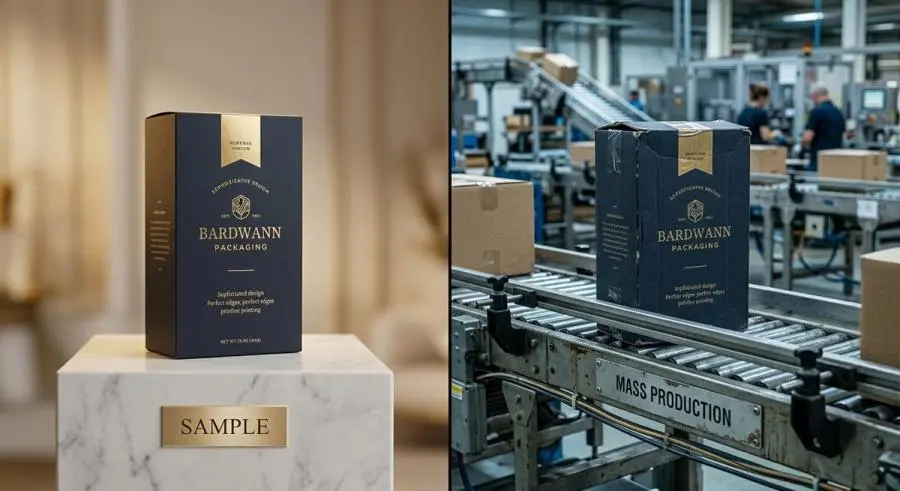
The 4-step system that closes the gap:
Step 1: Lock materials on the Golden Sample. Tag it with every spec: material grade, thickness, Pantone code, adhesive type, supplier. Add: "No substitution without written approval."
Step 2: Create Limit Samples. The Golden Sample is the perfect standard. Limit samples set the acceptable range:
-
Upper limit: slightly darker/thicker—the most acceptable
-
Lower limit: slightly lighter/thinner—below this is rejection
Any unit outside the limits is automatically rejected. This removes subjectivity from QC.
Step 3: Demand a Pre-Production (PP) Sample. Made on the actual production line, with production tooling, production materials, and regular workers. Not in the sample workshop. Only approve production when the PP sample matches the Golden Sample.
Step 4: Third-party AQL inspection against the physical Golden Sample. The inspector compares production units side-by-side with the Golden Sample. Not against a photo. Not against a spec sheet. The physical sample travels to the inspection site.
The Three-Stage QC System
Many suppliers claim QC. Few have all three stages.
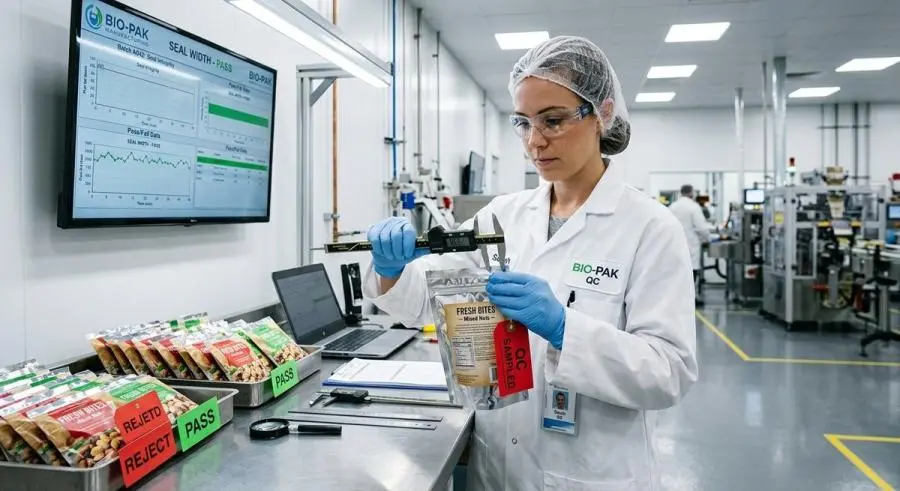
IQC (Incoming Quality Control) — Before production starts.
Your packaging supplier also buys from upstream suppliers. Incoming material quality determines 70% of the final product.
Evaluate: Ask "What are your IQC inspection items and standards? What happened the last time incoming material failed?" A supplier without an answer has no real raw material control.
IPQC (In-Process Quality Control) — During production.
This separates professional factories from workshops. Professional IPQC follows a staged schedule:
-
First-piece inspection: approve before production continues
-
30% checkpoint: random sampling for consistency
-
60% checkpoint: mid-production audit
-
90% checkpoint: pre-final check
Technical benchmark: Cpk (Process Capability Index) > 1.33. If the QC team doesn't know this, they aren't doing statistical process control.
Evaluate: Ask "Do you do in-process sampling? At what intervals? What happens when a defect is found mid-production?" The answer reveals whether QC is proactive (catching early) or reactive (waiting for final inspection).
OQC (Outgoing Quality Control) — Before shipment.
Standard approach: AQL 2.5 sampling for major defects, 4.0 for minor defects. QC report with photo evidence, compared against Golden Sample.
Key leverage: Ask for the QC report and photos before the container is loaded. Your approval required before sealing. This single request filters effectively—suppliers with weak QC will resist or delay; strong ones send it promptly because they already have the data.
Quality Drift: Why the 50th Batch Differs from the 1st
"Quality drift" is gradual degradation over successive orders. First order: excellent. Second: 90%. Fifth: 80%. The factory quietly cuts costs.
Common tactics: switching to cheaper raw materials (undisclosed), reducing coating thickness, simplifying post-processing, relaxing inspection criteria.
How to defend:
-
Archive every batch sample. Compare against Golden Sample quarterly.
-
Build a supplier scorecard. Track 5 dimensions per shipment. Three consecutive months of decline triggers a mandatory audit.
-
Include a material change clause: "Any change in raw material supplier, material grade, or production process requires 30 days' written notice. Unauthorized change constitutes a material breach." Givaudan requires 6 months' notice for site changes—that is the gold standard.
Three Contract Clauses You Must Have
Clause 1: Non-conforming product procedure. Notification timeframe, return authorization, rework timeline, cost responsibility.
Clause 2: Production line impact liability. Most contracts cap liability at "replacement or refund." Negotiate a fixed percentage (e.g., 20% of order value) as liquidated damages for production disruption—high enough to matter, not so high no supplier agrees.
Clause 3: Third-party arbitration for quality disputes. Name an agency (SGS, Intertek, TÜV). Their inspection results are binding on both parties. This clause alone makes suppliers more careful.
Dimension 3: Responsiveness — The Leading Indicator
Core argument: Response time is not a personality trait. It is the best leading indicator of internal management quality. Fast responders are better suppliers—not by coincidence, by causation.
The Data
Anvyl's study of thousands of B2B supplier interactions:
| Rating | Avg Response Time | What It Suggests |
|---|---|---|
| Excellent | ≤ 1 day | Dedicated account management, organized workflow |
| Good | 1-2 days | Competent but stretched |
| Fair | 2-3 days | Understaffed or disorganized |
| Poor | 3-4 days | Systemic issues |
| Very Poor | 4+ days | No account management |
Overall average: 2.9 days. Highly engaged suppliers (≥90% reply rate): 1.9 days median. Only 3.9% of suppliers had stale rates—meaning most can respond, but the best are an order of magnitude faster.
The correlation is causal. A factory with a professional team, an ERP system, and clear role assignments responds faster. A factory where "who handles this order" is unclear will inevitably be slow. Response time is the visible symptom of invisible management.
The Four Layers
Layer 1: Inquiry response.
< 4 hours: dedicated team, mature workflow. 4-12 hours: competent but multitasking. 12-24 hours: small team.
24 hours: warning. If they can't reply to a sales inquiry in 24 hours, they won't solve your emergency in 2.
Speed alone isn't enough. Strong responses answer your questions, anticipate follow-ups, and include relevant documents. Weak responses are generic, vague, or "I will check" with no follow-through.
Layer 2: Abnormal situation response.
Inquiry response is "sales mode." Everyone puts their best foot forward. Abnormal response reveals reality.
Excellent timeline: - Within 2 hours: acknowledge - Within 4 hours: preliminary analysis - Within 24 hours: root cause + corrective plan
Weak timeline: - Days 1-2: silence or "we're checking" - Days 3-4: excuses and deflection - Day 5+: partial solutions that require you to compromise
Practical test: during the trial order, introduce a controlled "issue"—a small spec change after production starts, or flag a minor concern. Watch how they handle it. Proactive or defensive? Solutions or excuses?
Layer 3: After-sales response.
Before payment: potential customer. After payment: cost center. This is when service diverges most.
| Scenario | Weak | Strong |
|---|---|---|
| Quality complaint | Questions your method, blames logistics, grudging discount | Acknowledges, ships replacement, traces root cause, implements fix |
| Urgent reorder | "30 days, no exceptions" | "15 days expedited with air freight" |
| Tech question months later | "That person left" | Same contact, remembers your history |
Layer 4: Routine communication.
Do they reply without chasing? When they say "I'll send it tomorrow," do they? Do they proactively update order status, or only respond when asked?
A supplier with reliable routine communication will also deliver reliably. The same habits drive both.
SLA Language for Your Contract
"Supplier shall: (a) respond to all inquiries within 4 business hours on working days; (b) respond to quality complaints within 2 hours, with a corrective plan within 24 hours; (c) designate a primary and alternate contact, both available during business hours.
Five or more SLA failures in any quarter triggers a senior management review. Two consecutive quarters of failure entitles Buyer to a 2% price adjustment."
The Deeper Logic
A factory with a dedicated sales team, an ERP system, documented SOPs, and regular cross-department communication will respond faster. That same infrastructure produces better quality and more reliable delivery.
A factory where one person handles sales, procurement, and production coordination—where information lives in someone's head—will respond slowly. That same lack of infrastructure produces inconsistent quality and unreliable delivery.
Response speed is not a separate dimension. It is the visible symptom of everything else.
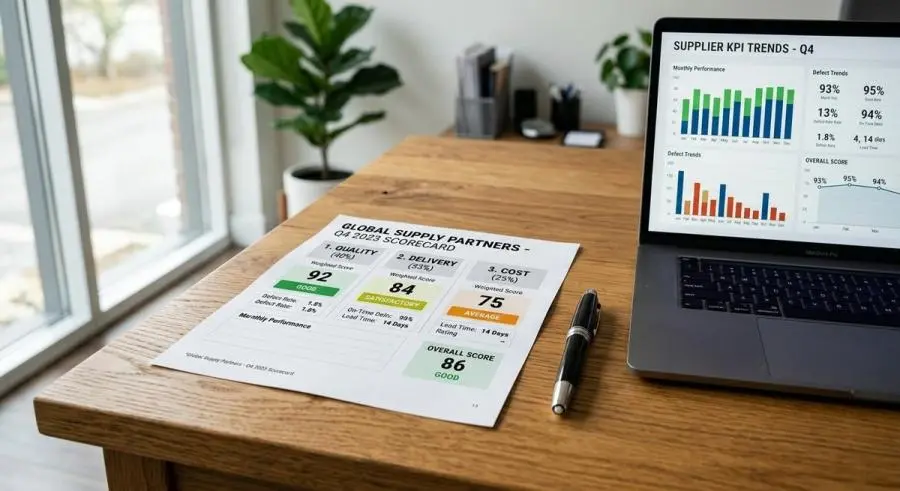
Putting It Together: The Three-Dimensional Supplier Scorecard
Scoring Framework
| Dimension | Weight | Metrics |
|---|---|---|
| Communication Competence | 30% | RFQ response quality (10%), Technical follow-up (10%), Trial order info loss (10%) |
| Delivery & Quality | 40% | OTD rate (15%), Defect PPM (10%), Golden Sample compliance (10%), 3-stage QC completeness (5%) |
| Responsiveness & Service | 30% | Avg response time (10%), Abnormal SLA achievement (10%), After-sales quality (10%) |
Score Interpretation
| Score | Classification | Action |
|---|---|---|
| 4.5 - 5.0 | Strategic partner | Increase share, prioritize projects |
| 4.0 - 4.49 | Approved supplier | Maintain, quarterly review |
| 3.5 - 3.99 | Watch list | Set improvement deadlines |
| < 3.5 | Replace / dual-source | Activate backup immediately |
How to Apply This Framework
Step 1: Shortlist by data. OTD records, average response time, online reputation.
Step 2: Run the three communication tests. Score the contact before evaluating the factory.
Step 3: Conduct a staged trial order. 10-20% volume. Validate OTD, quality, and abnormal handling before scaling.
Step 4: Score monthly. Review quarterly. A declining trend over three months triggers action before a crisis.
The Bottom Line
Price negotiates once. Samples can be optimized. But poor communication, unreliable delivery, and slow responsiveness are structural flaws. They cannot be fixed after the contract is signed.
A structured evaluation framework does not guarantee zero problems. But it ensures that when problems come—and they always do—you are working with a partner who communicates clearly, delivers consistently, and responds quickly.
Choose a supplier the way you choose a long-term business partner. Because that is exactly what they are.
- Managerial Effectiveness!
- Future and Predictions
- Motivatinal / Inspiring
- Fitness and Wellness
- Medical & Health
- Manufacturing
- Education
- Real-Estate
- Food Industry
- Hospitality
- Online Games
- Sports
- Home Services
- Civil Engineering
- Safety and Protection
- Software Products & Services
- Fashion and Jewellery
- Artificial Intelligence
- Entrepreneurship
- Mentoring & Guidance
- Marketing
- Networking
- HR & Recruiting
- Literature
- Shopping
- Career Management & Advancement