

 SkillClick
Why Your Business Still Does Not Have a Virtual Number Provider and What That Is Actually Costing You
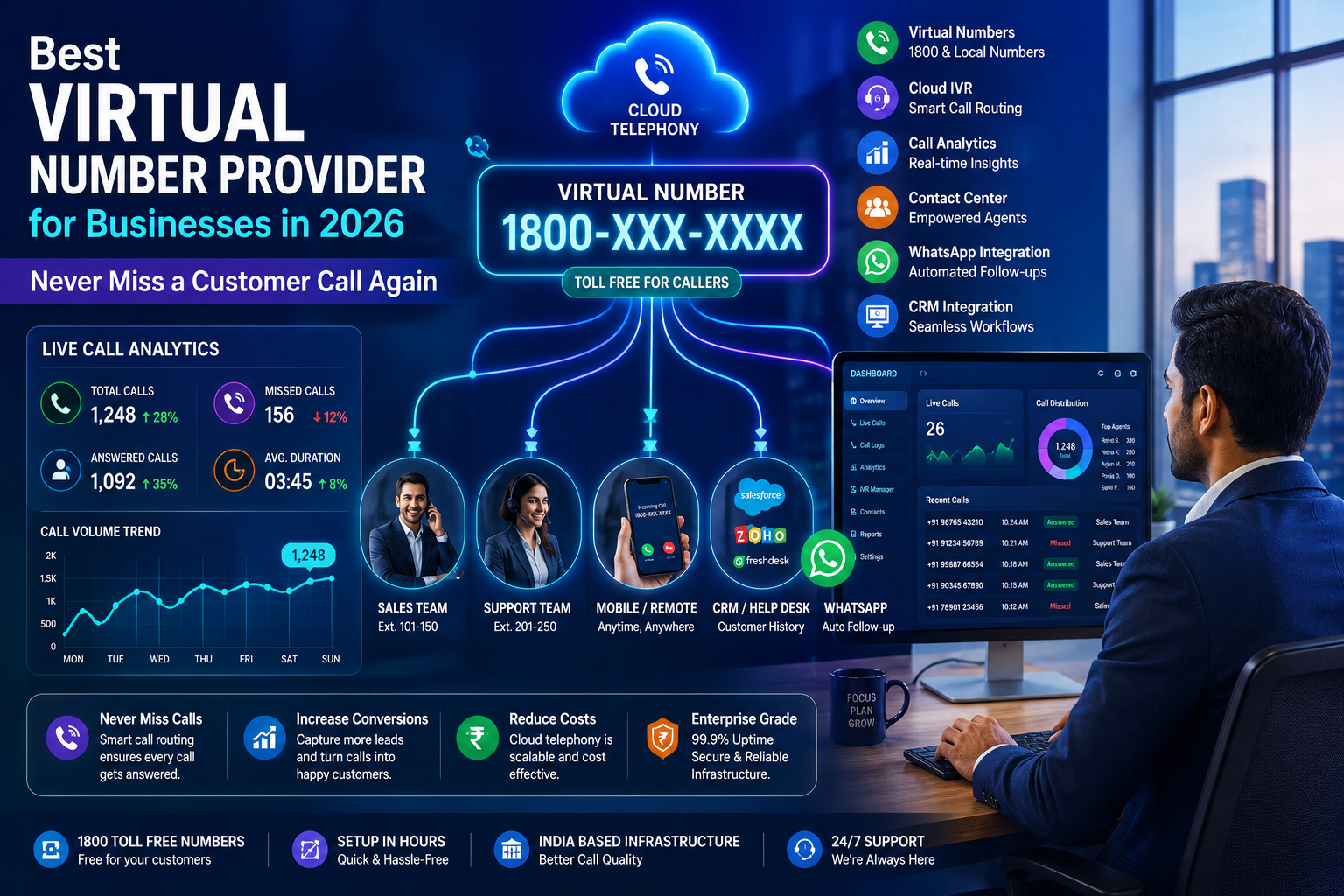
Let me be honest with you. Most articles about virtual numbers read like they were written by someone who has never actually run a business or dealt with a missed call at the worst possible moment. This one is different. I want to talk to you like a business owner, not a tech buyer going through a checklist.
If you ar running a sales team, a clinic, a real estate office, or any kind of operation where phone calls bring in money or keep customers happy, you already know the pain. Someone calls. Nobody picks up. They move on. You never even knew the call happened.
That is the problem a good virtual number provider solves. Not in theory. In practice, on the first day you go live.
What a Virtual Number Provider Actually Does
A virtual number provider gives your business a phone number that lives in the cloud. No physical SIM. No landline wire. No box sitting in a corner of your office. The number exists on servers, and calls to that number can be routed to any phone, any agent, any department, from anywhere.
When a customer dials your number, the system decides in real time where to send that call. Is it business hours? It goes to your sales team. After hours? It plays a message and sends a WhatsApp follow-up. Agent busy? It queues the call or routes it to the next available person.
None of this requires a technician to visit. None of it requires hardware upgrades. You change routing rules from a browser, and the change is live in minutes.
That is what a virtual number provider does at the most basic level. But the real value is in what happens after you go live.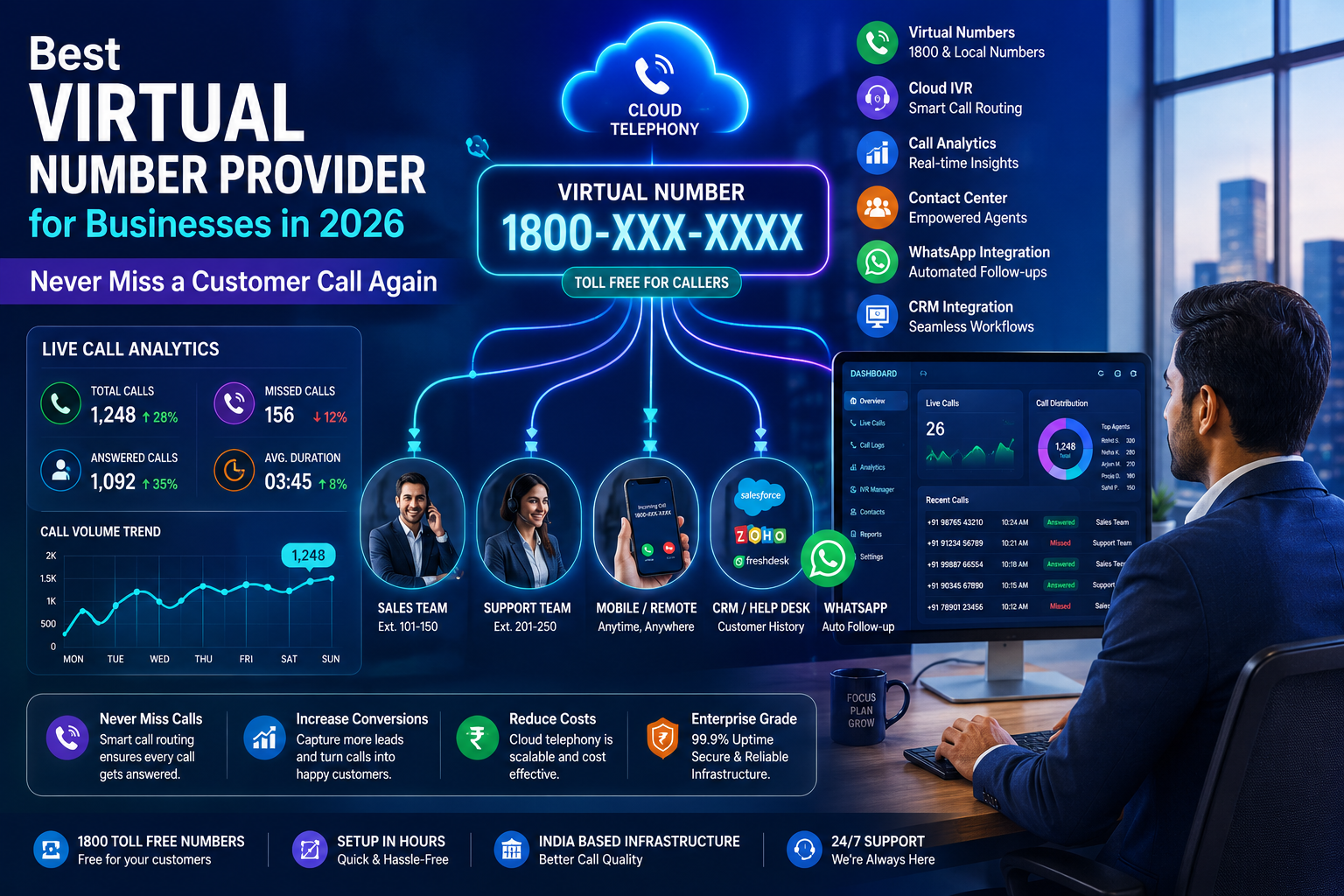
The First Week Changes Everything
Most businesses that switch to a virtual number setup report the same surprise in the first week. They discover how many calls they were missing before.
Your old setup probably had no visibility. If a call came in while your line was busy, it was gone. No record. No callback triggered. No way to know it happened unless the customer called back, which many of them do not.
With a virtual number and proper routing in place, every call is logged. The system records the time, the duration, the agent who answered, and the outcome. If nobody answered, that shows up too. You can see at the end of each day exactly how many opportunities came in and how many were handled correctly.
For a business that depends on inbound leads, this visibility alone is worth the switch.
The 1800 and 1600 Question That Many Providers Avoid
If you are looking at toll-free options in India, you will come across two formats. The 1800 number and the 1600 number. Most providers gloss over the difference. Here is why it matters.
A 1800 toll-free number is free for the caller. Your business absorbs the incoming call cost. But anyone can dial it, including every smartphone user in India.
A 1600 number works differently. The cost is shared between the caller and the business. But here is the critical part. A 1600 number cannot be dialed from a mobile phone.
Read that again. In a country where the overwhelming majority of your customers are calling from smartphones, a 1600 number is invisible to most of them. It does not ring. It does not even connect. Anyone on a mobile who tries to reach your 1600 number simply cannot.
The 1600 format was designed for government departments and utility companies that primarily received calls from landlines. If you are running a business in 2026, your customers are on mobile. The only sensible choice is 1800.
Yes, a 1800 number costs more because your business pays the incoming call rate. That cost is worth it. The alternative is advertising a number that half your market cannot reach.
What the Sales Process at Most Providers Does Not Tell You
I want to walk you through something that comes up consistently when businesses go shopping for virtual number services.
The headline price you see on a provider's pricing page is almost never the real number. It is the base subscription fee. What it often does not include is the per-minute rate on incoming toll-free calls, fees for call recording storage, the cost of CRM integration, and any overage charges if your call volume is higher than the plan covers.
By the time you add those together for a business handling a few hundred calls a month, the actual monthly cost can look quite different from what attracted you to the plan in the first place.
The right thing to ask any provider, before you agree to anything, is to give you a full cost estimate based on your actual expected monthly call volume. Not a plan overview. A real number, with every line item included.
The second thing providers do not always flag upfront is that setup takes longer than activation. Getting your number active can happen in a few hours. Getting your IVR menus recorded in the right languages, your routing logic configured, your CRM connected and tested, and your agents onboarded properly, that takes at least a full day for most businesses. Sometimes two.
Ask your provider whether onboarding support is included in your plan or whether you will be working through documentation on your own.
The third thing worth asking is whether the provider has infrastructure specifically built for Indian PSTN networks. Some international platforms route Indian calls through global infrastructure not optimized for domestic connections. The result is audio lag, call drops, and quality issues that are hard to pin down unless you know what to look for. Indian data centers matter for Indian call quality.
How This Connects to the Rest of Your Communication Stack
A virtual number is the front door. What you build behind that door determines how useful the whole setup is.
If you pair your number with a cloud IVR system, callers can self-route to the right department before any agent picks up. A customer calling about billing goes to billing. A customer with a service complaint goes to support. Nobody has to manually transfer anyone, and your agents are not starting every call by figuring out what the customer needs.
If you connect your virtual number to a cloud contact center platform, your agents get a full view of every customer interaction before the call begins. They see the call history, the account details, and any open issues. The customer does not have to repeat themselves.
If you add WhatsApp Business API integration, every missed call triggers an automatic WhatsApp message. In India, people respond to WhatsApp faster than they return a voicemail. That single automation recovers a significant portion of missed calls that would otherwise be lost.
When you bring these pieces together, the virtual number stops being a phone line and becomes the foundation of your entire customer communication operation.
What to Ask Before You Pick a Provider
Before you sign up with any virtual number provider, run through these questions.
First, how many concurrent calls can you handle at your busiest time of day? That number should match or exceed your peak volume.
Second, do you need regional language IVR menus? If your customers speak Hindi, Gujarati, Tamil, or any other language, your IVR should reflect that.
Third, does the provider integrate with the CRM or helpdesk tool your team already uses? Custom integrations add cost and delay.
Fourth, what is the provider's uptime history and how do they handle incidents? You need a real answer, not a marketing claim.
Fifth, what does onboarding actually look like? Is there a person assigned to help you get set up, or does it end at number activation?
Sixth, where are the provider's data centers? For Indian businesses, India-based infrastructure matters for call quality.
The Honest Bottom Line
A virtual number provider is not a complicated purchase. The technology is mature, the pricing is accessible, and implementation is faster than most businesses expect.
What slows businesses down is going in without asking the right questions and ending up with a plan that looked cheap until the overage charges arrived, or a setup that went live without the routing logic actually working the way the team needed.
If you are running any kind of operation where calls matter, the question is not whether to move to a virtual number setup. The question is which provider gives you the call quality, the support, and the integration depth your business actually needs.
Get that answer right, and the rest of the setup follows quickly.
- Managerial Effectiveness!
- Future and Predictions
- Motivatinal / Inspiring
- Fitness and Wellness
- Medical & Health
- Manufacturing
- Education
- Real-Estate
- Food Industry
- Hospitality
- Online Games
- Sports
- Home Services
- Civil Engineering
- Safety and Protection
- Software Products & Services
- Fashion and Jewellery
- Artificial Intelligence
- Entrepreneurship
- Mentoring & Guidance
- Marketing
- Networking
- HR & Recruiting
- Literature
- Shopping
- Career Management & Advancement