

 SkillClick
Trusted PSA Oxygen Plant Suppliers & Exporters
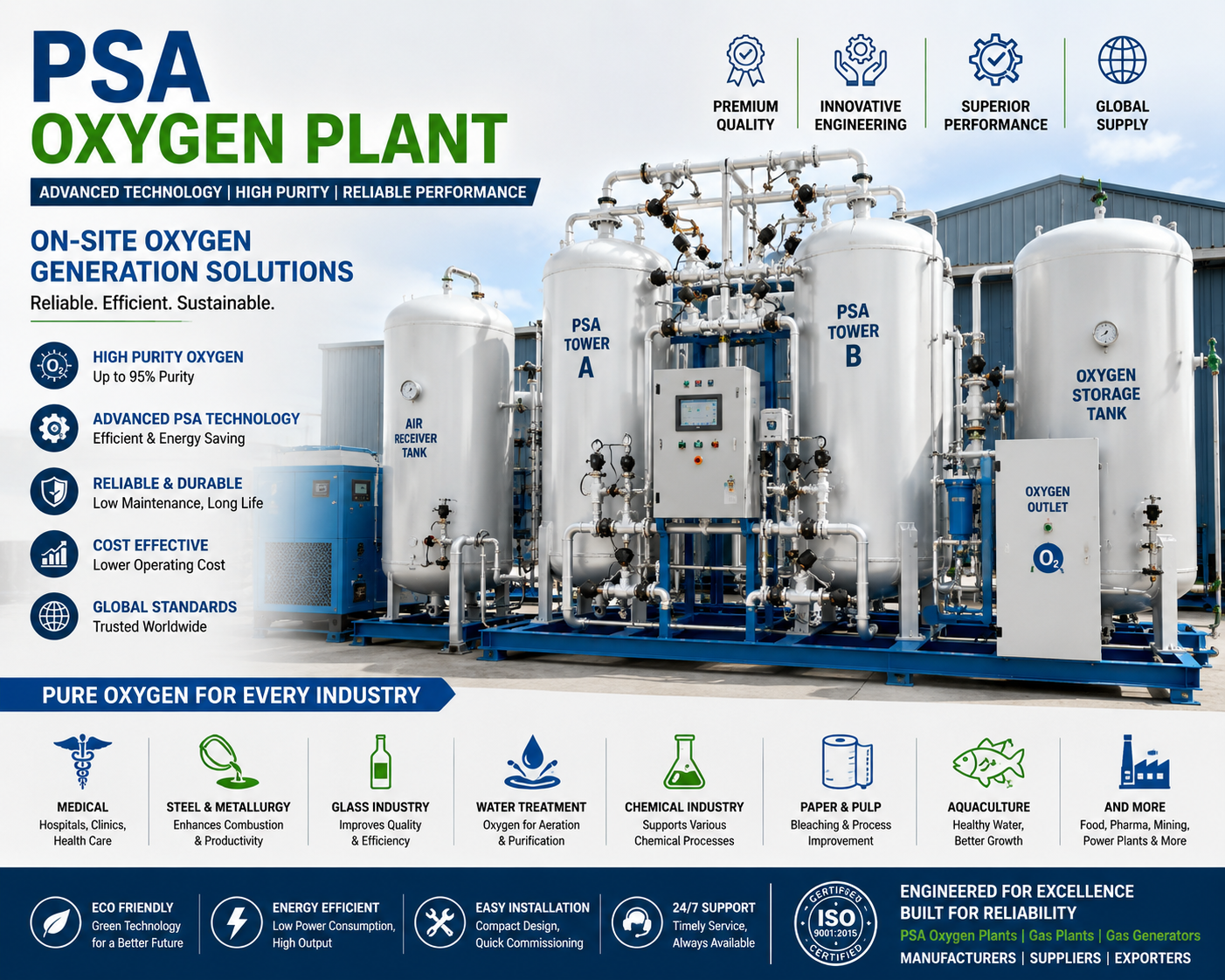
The Purchase Order Problem Usually Starts Before Dispatch
Half the problem shows up before the purchase order is even raised. A PSA Oxygen Plant is not a small catalogue item that can be compared only on price, photos, and delivery promise. Buyers need to check flow rate, oxygen purity, compressor load, filtration stages, installation space, certificate validity, and packing method before approving the order.
That is where many purchase orders go wrong.
For one listed configuration, the oxygen purity is 93 ± 3%, production capacity is 125 LPM / 7.5 Nm³/hr, and the system uses PSA technology with a 500-liter buffer tank. Those numbers matter because hospitals, wastewater plants, aquaculture units, metal fabrication units, and industrial users do not only need oxygen. They need steady oxygen under real site conditions.
And yet, most buyers still ask the weakest first question: “What is the price?”
Price matters. Nobody is denying that. But a low price with unclear specifications, weak packing, or missing documentation can become expensive once the plant reaches the site and commissioning gets delayed.
The Details Buyers Should Not Skip
Flow Rate, Purity, and Pressure Are Not Optional Lines
A PSA Oxygen Gas Plant must be reviewed from the specification sheet, not just from the sales quotation. For the listed Shelves Tech configuration, key details include 125 LPM / 7.5 Nm³/hr flow rate, oxygen purity of 93 ± 3%, operating pressure of 6–7.5 Barg, and outlet pressure of 5 Bar g.
Here’s the practical point. If your application needs continuous oxygen, the buyer should confirm whether the quoted flow rate is suitable for actual daily consumption, peak load, and future expansion. A plant may look sufficient on paper and still feel undersized if consumption peaks were not discussed before sampling approval or technical confirmation.
Compressor, Dryer, and Filtration Decide Long-Term Stability
The listed configuration includes an 11 kW lubricated screw air compressor, refrigerated type air dryer, and 3 filtration stages. These are not side details. In PSA systems, inlet air quality directly affects output stability, molecular sieve life, and maintenance frequency.
The missed detail is usually inlet air.
A supplier who avoids questions about compressor type, dryer performance, filter change intervals, and site temperature is not helping procurement. That is weak supplier behavior. It pushes risk onto the buyer after installation.
The Overlooked Specification: Site Conditions
The listed operating temperature range is 20°C to 45°C, with operating altitude up to 2000 meters above sea level. That matters for buyers sourcing from different regions of India or planning export dispatch.
A plant that performs properly in a factory demo may behave differently at a hot site, dusty site, or poorly ventilated utility room. Which means site readiness should be checked before dispatch, not after the machine arrives.
Technical Snapshot for Buyer Review
|
Specification Point |
Listed Detail |
|
Minimum Order Quantity |
1 Piece |
|
Production Capacity / Flow Rate |
125 LPM / 7.5 Nm³/hr |
|
Oxygen Purity |
93 ± 3% |
|
Technology |
PSA Pressure Swing Adsorption |
|
Air Compressor Power |
11 kW |
|
Dryer Type |
Refrigerated Type Air Dryer |
|
Filtration Stages |
3 Stages |
|
Automation Grade |
Fully Automatic, PLC Controlled |
|
Mounting |
Skid Mounted |
|
Buffer Tank Capacity |
500 Liters |
|
Operating Pressure |
6–7.5 Barg |
|
Outlet Pressure |
5 Bar g |
|
Power Supply |
220V / 50Hz / 1 Phase |
|
Operating Temperature |
20°C – 45°C |
|
Space Required |
190 × 53 × 175 cm |
How to Evaluate PSA Oxygen Plant Suppliers Before Ordering
1. Ask for the Exact Configuration, Not a General Quote
Good answer: “This quotation is for 125 LPM / 7.5 Nm³/hr, 93 ± 3% oxygen purity, 11 kW compressor, 3 filtration stages, PLC control, and 500-liter buffer tank.”
Bad answer: “Sir, standard plant hai, no issue.”
That kind of answer is not enough for a serious purchase order.
2. Check MOQ and Commercial Flexibility Early
The listed MOQ is 1 piece. That helps buyers who need one hospital unit, one industrial setup, or one trial order before larger procurement. Still, MOQ is only one part of the decision. Freight, installation support, taxes, documentation, and accessories can change the final landed cost.
Most buyers compare basic unit price and forget the cost of delayed commissioning.
3. Verify Certificate Validity Before Dispatch
Shelves Tech lists Udyam Registration Certificate, Import Export Certificate, and Quality Management Certificate. Buyers should ask for current copies before releasing payment, especially for institutional purchases and export orders.
A lapsed certificate creates avoidable friction. It can delay approval, vendor registration, finance clearance, or customs paperwork. A supplier who says “certificate baad mein bhej denge” is asking you to accept a risk that should have been closed before advance payment.
4. Ask About Packing Before Asking About Freight
PSA oxygen systems include sensitive components. The listed packing process includes pre-dispatch inspection, component verification, strapping, cushioning, moisture-resistant wrapping, anti-corrosion coating, palletization, and wooden crates for export shipments.
Some exporters treat packing as a transport problem. It is not. Packing is a quality control checkpoint.
5. Confirm Lead-Time Inputs Before Production Starts
Most delays do not begin on the production floor. They begin when specifications remain unclear until sampling, site inspection, or installation planning is already underway.
Before confirming with PSA Oxygen Plant Manufacturers, buyers should freeze flow requirement, site space, power availability, delivery address, unloading arrangement, certificate requirements, and installation responsibility.
What a Proper PSA Oxygen Plant Buying Process Protects
1. Lower Supply Dependency
An on-site PSA Oxygen Gas Generator reduces dependence on repeated oxygen cylinder movement or outside oxygen supply schedules. That protects operations when transport becomes slow, demand rises, or local availability becomes uncertain.
For buyers, the real benefit is control. Not just convenience.
2. Better Margin Protection
A correctly sized PSA Oxygen Gas Plant can reduce recurring oxygen purchase and handling pressure over time. The margin protection comes from fewer emergency purchases, fewer last-minute freight decisions, and lower dependence on unpredictable supplier availability.
But there is a trade-off. The upfront plant cost, installation planning, maintenance schedule, and operator discipline must be taken seriously. Ignoring those areas can eat into the savings later.
3. Stronger Operational Reliability
The listed PLC-controlled automatic operation, 3 filtration stages, and 500-liter buffer tank support stable operation when the system is matched correctly to site demand. Reliability does not come from one impressive feature. It comes from the full chain: compressor, dryer, filtration, adsorption system, buffer storage, inspection, and commissioning.
Nobody tells you this during rushed buying. A plant is only as reliable as the weakest ignored component.
4. Lower Risk of Specification Mismatch
Specification mismatch is one of the most common procurement failures. Buyers order one capacity, expect another output, and then discover the difference during commissioning.
A technical quotation with flow rate, purity, pressure, compressor rating, power supply, site dimensions, and operating temperature helps reduce that risk before the purchase order is issued.
5. Safer Dispatch and Lower Transit Damage Risk
Transit damage can ruin timelines. Scratches are visible. Internal movement damage is worse because it may appear only during commissioning.
Pre-dispatch inspection, moisture protection, strapping, cushioning, palletization, and reinforced export packing reduce that risk. Not remove it fully. Reduce it. That distinction matters because long road movement and port handling are never perfectly gentle.
6. Better Documentation for Institutional and Export Buyers
For procurement managers, documents are not paperwork afterthoughts. They are approval tools. IEC details, Udyam records, Quality Management Certificate copies, invoice, packing list, technical documentation, and compliance papers should be checked before dispatch.
That saves time when the buyer’s finance, hospital admin, project consultant, or customs agent asks for files.
Why Delhi Location Helps in Supply Chain Planning
Shelves Tech is located at Office No -110-111, 1st Floor, Gupta Arcade, Plot No-2, Inder Enclave, LSC Rohtak Road, Paschim Vihar, New Delhi-110087. For buyers looking for PSA Oxygen Plant Suppliers in India, this Delhi location gives a practical advantage for enquiry handling, documentation coordination, and North India freight planning.
Location is not just an address.
A buyer from Delhi NCR, Haryana, Punjab, Rajasthan, Uttar Pradesh, or nearby industrial belts can plan pre-dispatch discussions more easily than dealing with a distant supplier who is slow with technical clarification. Export buyers also need a team that understands IEC documentation, packing lists, crate marking, and shipment coordination.
For PSA Oxygen Plant Exporters, the hard part is often not selling the plant. It is aligning packing, documents, freight planning, and destination-side installation expectations before loading begins.
What We Check Before Dispatch Leaves Delhi
At Shelves Tech, we work with oxygen plants, medical equipment, hospital furniture, lab furniture, and healthcare solutions for hospitals, laboratories, and industrial facilities. We are ISO-certified since 2013, and our certification records include Udyam, Import Export Certificate, and Quality Management documentation.
We have learned one operational lesson the hard way: a technically correct product can still create buyer frustration if packing, site readiness, documents, and dispatch coordination are handled casually.
Our listed PSA oxygen plant configuration includes measurable details like 125 LPM / 7.5 Nm³/hr flow, 93 ± 3% purity, 11 kW compressor power, 3 filtration stages, and 500-liter buffer capacity. We prefer buyers to share actual usage details before quotation because a guess at the enquiry stage becomes a complaint at the commissioning stage.
Send the Details We Need Before We Quote
We can quote more responsibly when we receive the right information first. For a PSA Oxygen Plant, please send us your required oxygen flow rate, application, operating hours per day, site location, available space, power supply, expected delivery timeline, certificate requirements, and whether the order is for domestic use or export.
Our listed MOQ is 1 piece, so buyers can discuss a single-unit requirement without forcing a bulk order conversation too early.
We also need your expected response time. Tell us whether you need a same-day call, a 24-hour quotation review, or a scheduled technical discussion, and we will align our reply after checking the technical requirement. For export enquiries, share destination country, port preference, packing requirement, and documentation format at the first stage.
The Better Buyer Wins Before the Plant Ships
A purchase of a PSA oxygen gas generator should be approached as a technical sourcing decision as opposed to a quick machinery request. A sophisticated buyer evaluates a number of factors before granting an order, including: purity, flow, pressure, details on the compressor, site conditions, minimum order quantity, certificate validity, packaging, and freight. Shelves Tech is pleased to assist buyers with oxygen plant specifications. As the demand for oxygen grows in the healthcare and industrial sectors, the need for specialized procurement will be of increasing importance.
FAQs
1. What do you assess in a supplier of PSA oxygen plants?
Factors to consider include flow, purity, pressure, power of the compressor, type of dryer, number of filtration stages, and site automation. For instance, a listed configuration indicates a flow of 125 LPM, a purity of 93 ± 3%, a compressor of 11 kW, 3 filtration stages and a minimum order quantity of 1.
2. For buyers overseas, do PSA oxygen plant exporters take care of all documentation?
Export paperwork can be provided, but it is the buyers responsibility to ensure the correct documentation is provided for the shipment. For some countries, an IEC, invoice, packing list, and other technical documents, certified copies and packing crates may be required. This is a simple case of a known fact: customs requirements differ by country and buyers should ensure compliance with local import requirements.
3. What do PSA Oxygen Gas Plant Suppliers offer that basic equipment traders do not?
Competent PSA Oxygen Gas Plant Suppliers inquire on site conditions, oxygen purity, pressure, the type of compressor, filtration, and the commissioning process. A basic trader may only offer a catalogue and price, which is a very risky approach considering the technical matching required for oxygen systems as opposed to simple availability of the product.
4. What can I learn from PSA Oxygen Gas Plant Exporters regarding their packing?
You can learn if they typically perform a pre-dispatch inspection, if they use moisture resistant wrapping, cushioning, strapping, palletization, and reinforced wooden crates when necessary. Additionally, you can learn how they secure delicate components when the product is handled during transport by road, at the port, and during container loading. Good pricing combined with poor packing can turn a product into a bad purchase.
5. What do I need to tell the PSA Oxygen Gas Generator Suppliers?
You should tell them your application, how much oxygen you need them to supply, what purity you expect, how many hours they will operate, what the site conditions will be (temperature, possibly altitude), as well as the dimensions and the power supply to the site, the location, as well as how soon you expect them to deliver and install. Without this information, the PSA Oxygen Gas Generator Suppliers will be unable to serve you appropriately.
6. Are all PSA Oxygen Gas Generator Exporters climate neutral?
Not by default. PSA Oxygen Gas Generator Exporters will need to evaluate the operating temperature, site ventilation, altitude and humidity, as well as the conditions of the destination and the handling. The configuration referenced has an operating temperature of between 20°C and 45°C with an altitude of up to 2000 meters. If your site is outside of these conditions, you will need to talk to them before you place your order.
7. Why use PSA Oxygen Plant Manufacturers in India for your hospital and industrial oxygen requirements?
PSA Oxygen Plant Manufacturers in India can offer buyers that want to deal locally the opportunity for faster technical discussions and documentation support within India. Buyers also have the option to compare the offerings from PSA Oxygen Gas Plant Manufacturers in India and the PSA Oxygen Gas Generator Manufacturers in India based on their specifications, certification, and clarity in their dispatch and post-sales information, rather than basing their purchase purely on price.
- Managerial Effectiveness!
- Future and Predictions
- Motivatinal / Inspiring
- Fitness and Wellness
- Medical & Health
- Manufacturing
- Education
- Real-Estate
- Food Industry
- Hospitality
- Online Games
- Sports
- Home Services
- Civil Engineering
- Safety and Protection
- Software Products & Services
- Fashion and Jewellery
- Artificial Intelligence
- Entrepreneurship
- Mentoring & Guidance
- Marketing
- Networking
- HR & Recruiting
- Literature
- Shopping
- Career Management & Advancement