

 SkillClick
Surgical Instruments for Cardiac & Vascular Surgery
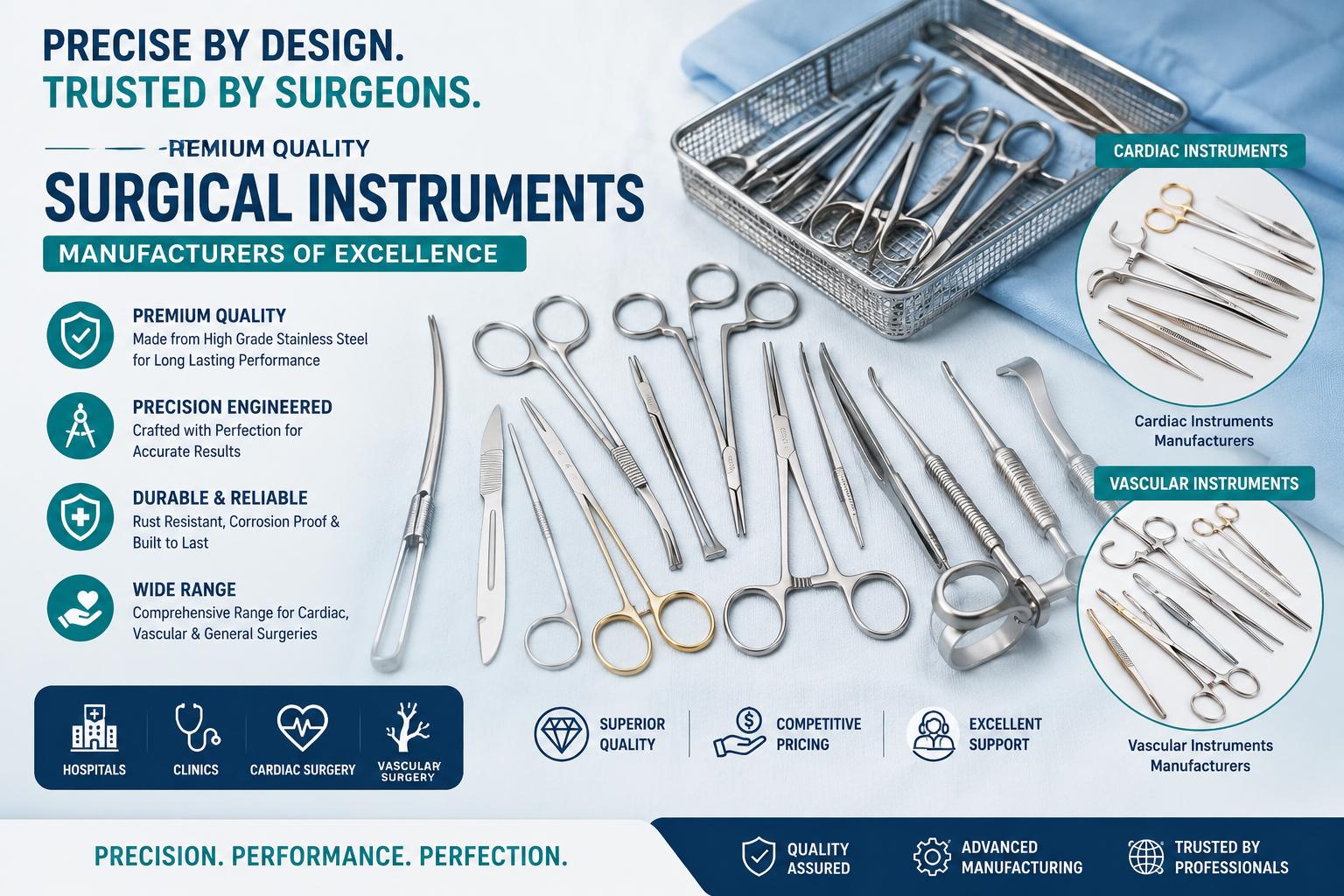
One weak clamp can ruin a clean procedure plan.
That’s the uncomfortable truth behind surgical instruments used in cardiac and vascular procedures. These are not ordinary tools sitting inside a tray. They control blood flow, hold delicate tissue, open access, support suturing, and sometimes decide how smoothly a surgeon can work under pressure.
WHO has reported that surgical complications can occur in up to 25% of inpatient surgical cases, and at least half of surgery-related harm is considered preventable. That number should make B2B buyers more careful, not more price-driven.
Most buyers still start with, “Rate kya hai?”
That’s the wrong opening. For cardiac and vascular products, the first question should be: does the supplier understand the procedure, the material, the finish, the packing, and the repeat-order pressure?
The Surgical Instruments Detail Buyers Usually Miss
Cardiac Instruments Are Built for Controlled Access and Fine Handling
Cardiac Instruments are used in procedures such as CABG, valve work, congenital defect correction, thoracic access, and heart-related surgical handling. Surgifact’s cardiac category mentions instruments such as tubing clamps, rib spreaders, duct dissectors, rib shears, retractors, aortic dilators, and periosteal elevators.
The important detail is not only the name of the tool.
It is how the tool behaves after repeated sterilization, handling, and packing. Surgifact’s cardiac page lists technical options such as stainless steel, titanium, tungsten carbide, 14 cm to 26 cm lengths, straight or curved tips, and ring, bayonet, ratchet, or spring handles.
Vascular Instruments Need Atraumatic Control
Vascular Instruments are used for artery and vein handling, bypass surgery, aneurysm repair, grafting, clamping, cutting, dilating, and suturing. Surgifact’s vascular page lists Potts-Smith scissors, bulldog clamps, vascular forceps, needle holders, dilators, Weber Aortic Clamp, Satinsky Tangential Occlusion Clamp, Debakey Vascular Clamp, and other vascular tools.
Here’s where buyers get careless. They check price and product photo, but they don’t ask about jaw type.
That’s risky. The vascular page mentions jaw options like atraumatic, serrated, DeBakey, Cooley, straight jaw, and curved jaw. In vascular work, the wrong jaw can mean poor grip or unnecessary pressure on delicate vessel walls.
5 Checks Before Choosing Surgical Instruments Manufacturers
1. Material and Finish Clarity
A good supplier explains material, polish, coating, and intended usage. ISO 13485:2016 is an internationally recognized quality management standard for medical devices, and ISO confirmed this version as current in 2025.
Bad answer: “Standard stainless steel hai, sir.”
That answer tells you nothing.
2. Product Range Depth
For Cardiac Instruments Manufacturers or Vascular Instruments Manufacturers, range depth matters. If one supplier has only 4–5 generic items, they may struggle with repeat orders or specialty demand.
Bad answer: “Photo bhej do, bana denge.”
Possible? Yes. Dependable for bulk? Not always.
3. Technical Documentation
A good supplier can share product names, sizes, material options, packing details, and certificate information. Surgifact’s website lists certifications and also carries dedicated product categories for cardiac and vascular instruments.
Bad answer: “Documents dispatch ke baad mil jayenge.”
That is how procurement teams get stuck after payment.
4. Sample-to-Bulk Consistency
Nobody tells you this early enough: sample quality is easier than bulk consistency.
Bad answer: “Sample same rahega, tension mat lo.”
A serious buyer should check finishing, alignment, grip, tip quality, and packing before repeating the order.
5. Defect and Replacement Policy
A supplier who says “case by case dekh lenge” does not have a policy.
That’s not flexibility. That’s weak after-sales planning.
How Better Instruments Protect Buyer Margin
Fewer Rejections After Hospital Inspection
Hospitals and surgical centers check feel, finish, grip, and confidence. Surgifact’s own website highlights precision engineering, durability, accuracy, and reliable performance for hospitals and clinics.
If the tool fails visual or functional inspection, your margin goes into replacement freight.
Better Repeat Orders for Dealers
Surgical Instruments Dealers don’t grow by selling once. They grow when the hospital asks for the same pattern again.
That only happens when the instrument behaves consistently.
Lower Risk in Cardiac and Vascular Supply
Cardiac and vascular tools are not forgiving categories. WHO’s safe surgery checklist pilot reduced major inpatient complications from 11% to 7% and deaths from 1.5% to 0.8%, showing how procedure discipline changes outcomes.
Tools are part of that discipline.
Stronger Brand Positioning for Wholesalers
If you are building a private label or distribution brand, poor finishing will damage trust faster than late marketing. Surgical instruments manufacturers in India with stable product control give wholesalers a better base for repeat selling.
Better Control Over Bulk Buying
Surgifact’s cardiac and vascular pages mention price bands, length options, handle types, and material choices. These details help buyers compare products beyond one-line quotations.
And honestly, that saves arguments later.
Why Jalandhar Matters for Cardiac and Vascular Supply
Surgifact / Vaishanav Surgical Co. lists its location at 1382/1046, Raja Garden, Basti Danishmandan, Near Vishal Tools, Jalandhar - 144002, Punjab, India. The website also lists contact numbers and email for surgical instrument enquiries.
For buyers searching Cardiac Instruments Manufacturers in India, Vascular Instruments Manufacturers in India, or surgical instruments manufacturers in India, the location is not just a Google Maps detail.
Jalandhar gives buyers practical supply-chain value: quicker sample movement within North India, easier courier coordination, and better follow-up for Punjab, Delhi NCR, Haryana, Rajasthan, UP, and export dispatch planning.
Most buyers underestimate geography until one urgent sample gets delayed.
Surgifact’s product categories include Cardiac Instruments, Vascular Instruments, Electrosurgery Instruments, ENT Instruments, General Surgery Instruments, Gynaecology Instruments, Neurology Instruments, Spine Instruments, and more. That category spread helps B2B buyers consolidate enquiries instead of dealing with 6 scattered vendors.
What We Watch Before We Dispatch
We are Surgifact, working from Jalandhar with a focus on surgical instruments, Cardiac Instruments, Vascular Instruments, and related medical tools for hospitals, dealers, wholesalers, and procurement-led buyers.
We’ve been connected with this field since 1967, and our website shows Vaishanav Surgical Co. copyright from 1967 to 2026.
Here’s one thing we’ve learned from real orders: buyers rarely reject an instrument because the catalogue looked bad; they reject it because the final piece doesn’t match the sample finish, size expectation, or handling feel.
That is why we pay attention to product clarity, model names, size options, packing, and communication before dispatch.
We don’t treat cardiac and vascular orders like general stock movement. The buyer usually has a procedure need, a dealer commitment, or a hospital deadline behind the enquiry.
Send These Details for a Clear Quote
Send us your requirement with product name, quantity, size, preferred material, finish, packing need, and delivery location.
We usually aim to reply within 1 working day after receiving clear details. For common surgical instruments, buyers can share enquiries starting from 5 pieces per item. For cardiac and vascular specialty tools, MOQ may vary because model, size, and availability need checking before we confirm.
To avoid back-and-forth, send us:
-
Product photo or model name
-
Required quantity
-
Size or length, if known
-
Material preference
-
Dealer, hospital, or brand requirement
-
Delivery city or export destination
-
Packing and certificate requirement
We will check the requirement properly and then quote. Wrong assumptions create wrong orders, and we prefer fixing the detail before billing.
Conclusion
Surgical instruments used in cardiac and vascular procedures demand more than a low quotation. They need material clarity, accurate finishing, proper jaw design, supplier discipline, and repeat-order consistency.
For buyers dealing with Cardiac Instruments and Vascular Instruments, supplier selection is not a small purchase decision. It is part of risk control.
The next serious buyer will compare proof, not promises.
FAQs
1. Which surgical instruments are commonly used in cardiac and vascular procedures?
Cardiac and vascular procedures commonly use clamps, forceps, scissors, retractors, needle holders, dilators, rib spreaders, and atraumatic vascular clamps. A good surgical instruments supplier should explain size, material, jaw type, and handling use clearly.
2. How should Surgical Instruments Dealers check quality before bulk buying?
Check sample finish, tip alignment, handle movement, jaw grip, polish, packing, and product documentation. Surgical Instruments Dealers should not approve bulk orders only from photos because finish and grip are difficult to judge on screen.
3. Do Cardiac Instruments Suppliers handle hospital and dealer requirements?
Yes, many Cardiac Instruments Suppliers handle both hospital and dealer requirements. But there is a caveat: specialty cardiac tools may need model-wise confirmation, so urgent buyers should not assume every pattern is ready stock.
4. What should Cardiac Instruments Dealers ask before placing repeat orders?
Cardiac Instruments Dealers should ask about material, size, product code, packing, dispatch timeline, and whether the bulk lot will match the approved sample. If the answer is vague, pause the order.
5. In what way do Vascular Instruments Suppliers stand apart from common suppliers?
Vascular Instruments Suppliers need deeper knowledge on atraumatic jaws, fine vessel management, as well as clamp pressure and design of tips. While general suppliers may have vascular instruments too, the technical clarity can be insufficient.
6. Are Vascular Instruments Dealers able to provide the needed customization?
Yes, for Vascular Instruments Dealers, the required length, jaw, and handle type, as well as their custom logos, can usually be accommodated. The most honest limitation is that the degree of customization will have an effect on lead time and MOQ, so this should all be agreed on before going ahead with the quotation.
7. What is the advantage for buyers when they focus on the established surgical instruments manufacturers?
The established surgical instruments manufacturers know the expectations around providing samples for approval, as well as the confirmations for bulk supply, the right packing and documentation, and the provision for replacements. Price will always be a consideration, but within cardiac and vascular supply, poor quality instruments which can be cheaper will most likely lead to the most expensive mistakes once a shipment is rejected.
- Managerial Effectiveness!
- Future and Predictions
- Motivatinal / Inspiring
- Fitness and Wellness
- Medical & Health
- Manufacturing
- Formazione
- Real-Estate
- Food Industry
- Hospitality
- Online Games
- Sports
- Home Services
- Civil Engineering
- Safety and Protection
- Software Products & Services
- Fashion and Jewellery
- Artificial Intelligence
- Entrepreneurship
- Mentoring & Guidance
- Marketing
- Networking
- HR & Recruiting
- Literature
- Shopping
- Career Management & Advancement