

 SkillClick
Contract Alcohol Manufacturing India: Key Benefits
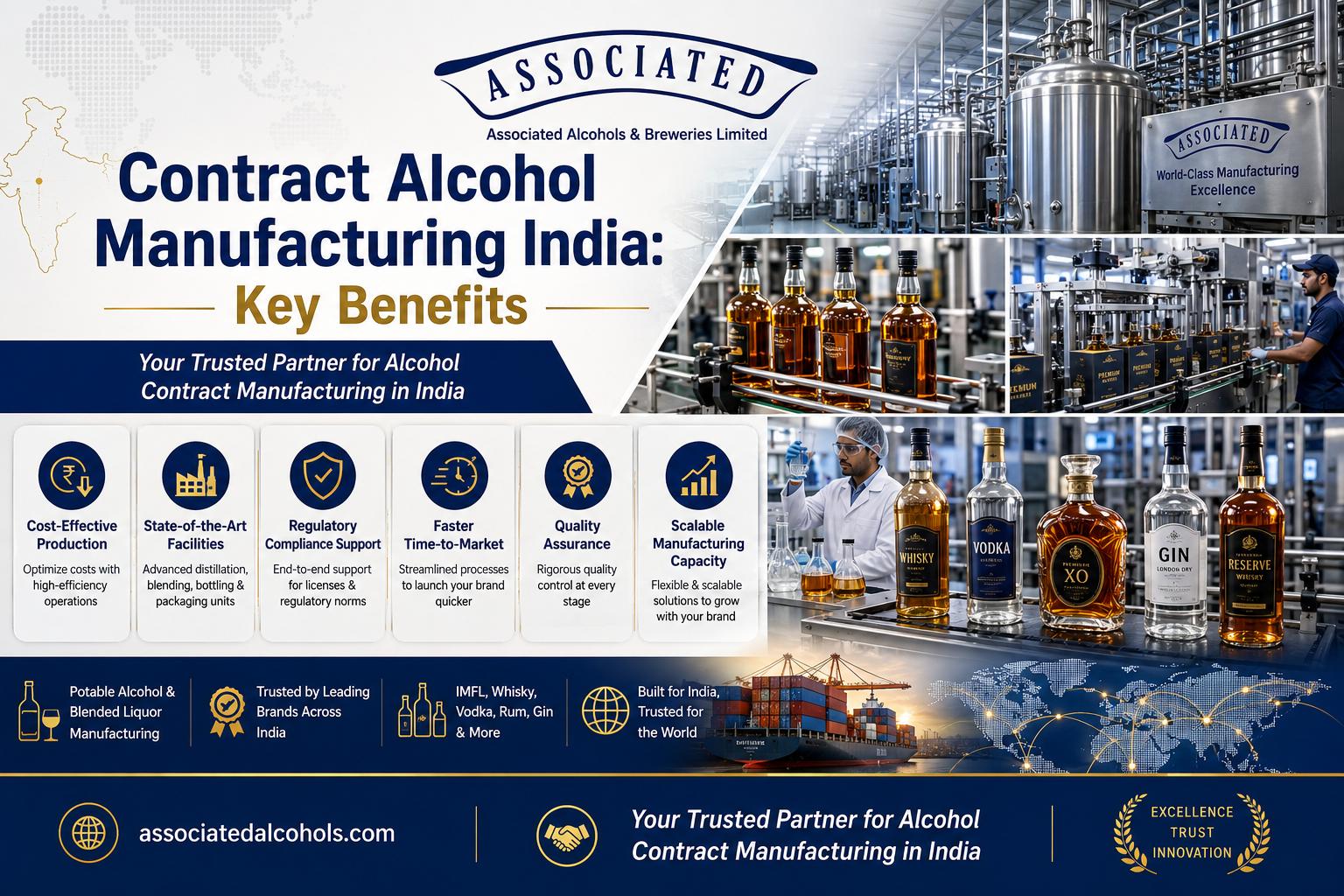
India's alcohol industry crossed ₹3.5 lakh crore in revenue in 2023, yet most emerging brands still struggle with two core challenges: capital investment and manufacturing compliance.
Contract manufacturing in the alcohol sector solves both. A brand owner signs an agreement with a licensed distillery, the facility handles production, bottling, and quality checks, and the brand owner focuses on sales and distribution.
This post explains how contract manufacturing alcohol in India works, why brands choose it, and what to look for in a manufacturing partner.
What Is Contract Manufacturing in the Alcohol Industry?
Contract manufacturing in the alcohol industry means a brand owner outsources production to a licensed third-party distillery. The manufacturer produces, blends, bottles, and labels the product under the brand owner's specifications. The brand owns the recipe and trademark; the facility owns the equipment and excise licences.
How the arrangement is structured
A typical agreement covers product specification, batch volume, quality benchmarks, packaging standards, and delivery timelines. The brand owner supplies the label design and formula. The contract manufacturer supplies the infrastructure, raw materials such as ENA or malt, and regulatory compliance across state excise rules.
Who uses contract alcohol manufacturing in India?
New entrants without distillery licences use it to enter the market fast. Established brands use it to scale volumes beyond their own plant capacity. Regional players use it to produce variants for new states without setting up fresh facilities.
What Are the Benefits of Using a Contract Alcohol Manufacturer?
The primary benefits are reduced capital expenditure, faster time-to-market, access to existing compliance infrastructure, and production flexibility. A brand avoids the cost of building or leasing a distillery, while the contract manufacturer carries the fixed overhead.
Lower capital and operational costs
Setting up a greenfield distillery in India costs between ₹10 crore and ₹50 crore depending on capacity and state. Contract manufacturing removes this barrier. A brand pays per batch or per case, converting a fixed cost into a variable one. This model works well for test launches where demand is unproven.
Speed to market
A new brand using contract manufacturing can go from formula finalisation to shelf in 90 to 120 days, depending on state excise approvals. Building a new plant takes 18 to 36 months. For brands targeting seasonal demand or trend-driven launches, this difference is material.
Compliance and quality assurance
Licensed contract manufacturers in India hold state excise permits, FSSAI registrations, and follow GMP standards. Brands that partner with compliant facilities inherit this infrastructure. For details on what a full-service contract manufacturing arrangement covers, this overview of alcohol contract manufacturing explains the process in depth.
How Does Alcohol Contract Manufacturing Work in India?
The process starts with product specification. The brand owner defines the spirit category, strength, flavour profile, and packaging format. The contract manufacturer then maps this to available raw materials, runs trial batches, and submits samples for approval. Once the recipe is locked, the manufacturer applies for the product's excise label approval in the target state.
State excise compliance is non-negotiable
India's alcohol regulation operates at the state level. Each state issues its own licences, sets excise duties, and governs label approvals separately. A contract manufacturer with multi-state experience handles these approvals as part of their service. Without this, a brand owner faces months of regulatory back-and-forth on their own.
Quality control checkpoints
Production batches go through input material testing, in-process quality checks, and finished goods analysis before dispatch. Parameters include alcohol strength, colour, clarity, and organoleptic profile. A contract manufacturer aligned with FSSAI guidelines runs these as standard. Brands should ask for certificate of analysis reports for every batch.
Is Contract Manufacturing Cost-Effective for Alcohol Brands?
Yes, particularly for brands at launch stage or mid-scale volumes. The per-unit cost from a contract manufacturer includes raw material, processing, packaging, and compliance overhead. When compared against the annualised cost of owning a plant at partial utilisation, contract manufacturing is almost always cheaper below a threshold of roughly 10 lakh cases per year.
When to consider building your own plant
At high volumes, the per-unit economics shift. Brands producing above 15 to 20 lakh cases annually often find that the savings from in-house production justify the capital outlay. Until that point, contract manufacturing preserves cash for marketing, distribution, and brand building.
Hidden costs to account for
Brands should budget for formulation development fees, sample approval costs, state excise label registration fees, and logistics from plant to warehouse. These are real costs but still far below the capital investment required for a captive facility. A transparent contract manufacturer discloses these upfront.
Final Thoughts
Contract manufacturing alcohol in India gives brands a practical path to market without the regulatory and capital burden of building a distillery. It delivers speed, compliance, and cost flexibility in one arrangement. The model works best when the brand invests the saved capital into distribution and consumer marketing.
The real question for any emerging alcohol brand is not whether to use contract manufacturing, but how quickly they plan to scale to a volume that justifies the shift to in-house production.
- Managerial Effectiveness!
- Future and Predictions
- Motivatinal / Inspiring
- Fitness and Wellness
- Medical & Health
- Manufacturing
- Education
- Real-Estate
- Food Industry
- Hospitality
- Online Games
- Sports
- Home Services
- Civil Engineering
- Safety and Protection
- Software Products & Services
- Fashion and Jewellery
- Artificial Intelligence
- Entrepreneurship
- Mentoring & Guidance
- Marketing
- Networking
- HR & Recruiting
- Literature
- Shopping
- Career Management & Advancement