

 SkillClick
Albert Einstein IQ: How His Intelligence Changed Science Forever
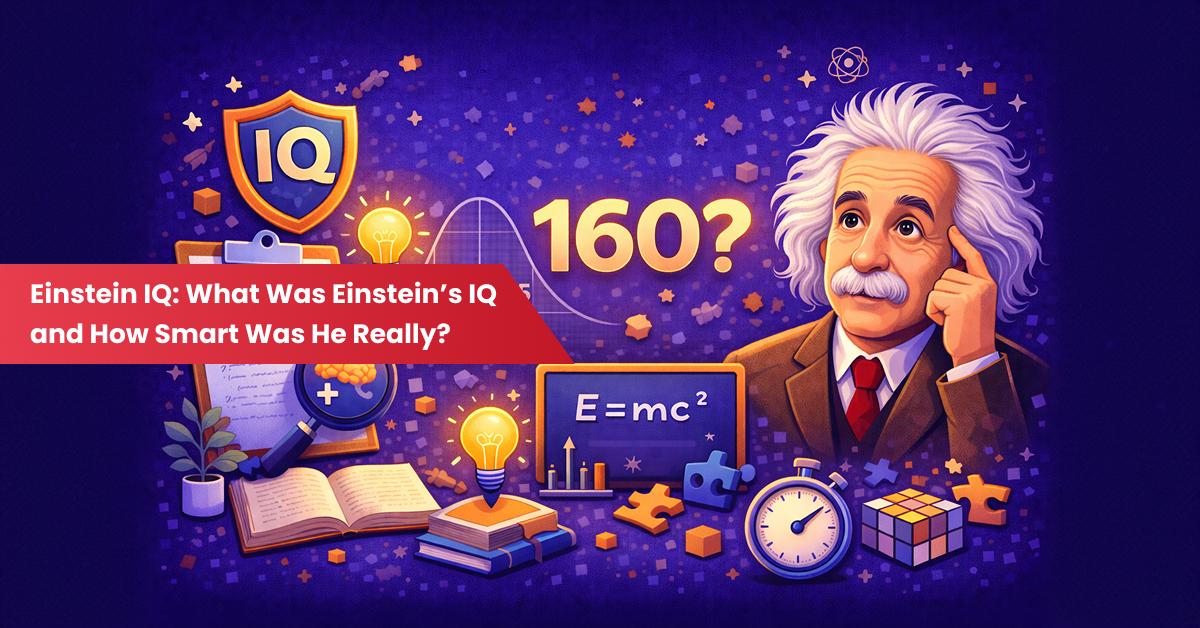
Few names in history are as strongly associated with genius as Albert Einstein. His scientific work transformed humanity’s understanding of the universe and continues to influence modern physics today. Because of his extraordinary reputation, one question is often repeated across the internet and classrooms: what was Einstein’s IQ, often phrased as einstein's iq.
While many people expect a precise number, the truth is more complex. Einstein never took a verified modern IQ test, and there is no official record of his score. Instead, his intelligence is understood through his groundbreaking ideas, which changed science forever.
To understand how Einstein’s intelligence shaped science, we need to move beyond the idea of a number and focus on how he thought, what he discovered, and why his mind was so revolutionary.
The Mystery Behind Einstein’s IQ
The question of einstein's iq has fascinated people for decades. Many websites claim that his IQ was around 160 or even higher, but these numbers are not based on scientific testing.
Einstein lived between 1879 and 1955, a time when IQ testing was still developing. Standardized intelligence tests were not widely used or refined enough to provide reliable historical data for figures like Einstein.
Because of this, there is no verified IQ score for him. Any number attached to his intelligence is an estimate created after his death, based on his achievements rather than actual test results.
Why Einstein Never Had an Official IQ Score
IQ testing in Einstein’s time was very different from what it is today. Early intelligence assessments existed, but they were not standardized or globally recognized.
Modern IQ tests measure specific cognitive abilities such as logical reasoning, spatial awareness, working memory, and verbal comprehension. These tests are administered in controlled environments and compared against large population samples.
Einstein’s work, however, required a different kind of thinking. His intelligence was not limited to solving structured problems but involved deep imagination and abstract reasoning. These qualities are not fully captured by IQ tests.
This is one of the reasons why the question einstein's iq cannot be answered with certainty.
The Nature of Einstein’s Intelligence
Einstein’s intelligence was not just analytical but also highly creative. He had the rare ability to imagine physical phenomena that could not be observed directly at the time.
One of his most famous methods was the use of thought experiments. He would mentally simulate scenarios such as riding alongside a beam of light or being in free fall inside an elevator. These imaginative exercises allowed him to explore scientific principles in new ways.
This combination of imagination and logic was key to his breakthroughs in physics.
How Einstein Changed Physics Forever
Einstein’s most famous contribution is the theory of relativity. His special theory of relativity, published in 1905, introduced the idea that time and space are relative depending on the observer’s motion.
Later, his general theory of relativity expanded this concept by describing gravity as the curvature of spacetime caused by mass and energy.
These ideas completely changed how scientists understand the universe. Before Einstein, space and time were considered fixed and absolute. After his work, they became dynamic and interconnected.
This transformation of scientific thinking is far more significant than any discussion about einstein's iq.
Why Einstein’s Thinking Was Revolutionary
Einstein did not simply improve existing scientific theories. He redefined the foundations of physics.
His ability to question fundamental assumptions allowed him to break away from traditional thinking. Instead of accepting established ideas about space, time, and motion, he asked deeper questions about how reality actually works.
This level of intellectual independence is rare and cannot be measured by standard IQ tests.
The Limitations of IQ in Explaining Genius
IQ tests are useful tools for measuring certain cognitive skills, but they do not capture the full complexity of human intelligence.
They primarily assess:
-
Logical reasoning
-
Mathematical ability
-
Pattern recognition
-
Verbal comprehension
-
Working memory
While these abilities are important, they do not include creativity, curiosity, or the ability to generate revolutionary scientific ideas.
Einstein’s genius was rooted in these unmeasurable qualities. This is why the concept of einstein's iq remains more symbolic than scientific.
The Role of Imagination in Einstein’s Work
One of the most important aspects of Einstein’s intelligence was his imagination. He often said that imagination is more important than knowledge because knowledge is limited.
This belief was reflected in his scientific work. His thought experiments allowed him to explore ideas that could not be tested experimentally at the time.
For example, imagining what it would be like to travel at the speed of light helped him develop key principles of relativity.
This imaginative capacity is one of the main reasons his intelligence cannot be reduced to a numerical IQ score.
Einstein’s Influence on Modern Science
Einstein’s theories continue to shape modern science. His work laid the foundation for technologies such as GPS systems, which rely on corrections based on relativity.
His ideas also influence cosmology, astrophysics, and quantum mechanics research today.
Scientists continue to build on his discoveries, showing that his intellectual legacy is still active and evolving.
This long lasting impact is a better measure of intelligence than any estimate of einstein's iq.
Why People Still Ask About Einstein’s IQ
The question of einstein's iq remains popular because people naturally want to quantify intelligence. A number feels simple and concrete, making it easier to compare individuals.
However, this desire for simplicity can be misleading. Intelligence is not a single measurable trait but a combination of many cognitive abilities.
Einstein’s life demonstrates that genius cannot be fully captured by a score on a test.
The Myth of the 160 IQ Score
The commonly cited figure of 160 is not based on official testing. It is a symbolic estimate created to represent Einstein’s exceptional abilities.
In modern IQ classification, a score above 140 is often considered genius level. Because Einstein is widely regarded as one of the greatest minds in history, people assume his IQ must be significantly higher.
However, there is no scientific evidence supporting this assumption.
Einstein’s Intelligence in Context
Einstein’s intelligence was shaped by more than just natural ability. It also involved deep curiosity, persistence, and a willingness to challenge established scientific beliefs.
He worked through complex problems over long periods of time, often revising his ideas as new insights emerged.
This process of continuous refinement and exploration is not captured by IQ tests, which measure performance at a single moment in time.
Why Einstein’s Legacy Matters More Than His IQ
Focusing on einstein's iq misses the most important part of his story. His legacy is not defined by a number but by the transformation of scientific understanding.
He changed how humanity perceives time, space, and gravity. His ideas continue to influence scientific research and technological development today.
This lasting impact is a far more meaningful reflection of his intelligence than any hypothetical IQ score.
Intelligence Beyond Measurement
Modern psychology recognizes that intelligence is multi dimensional. It includes analytical thinking, creativity, emotional understanding, and practical problem solving.
Einstein excelled in theoretical and conceptual intelligence. His ability to connect abstract ideas and develop new frameworks of understanding set him apart from most scientists of his time.
This complexity shows why reducing intelligence to a single IQ score is not sufficient.
Final Thoughts
The question of einstein's iq will continue to interest people, but the true answer is that there is no verified score for Albert Einstein. Any number associated with him is an estimate rather than a fact.
What truly defines Einstein is not a test score but his ability to revolutionize science. His intelligence changed how we understand the universe and continues to inspire scientific discovery today.
Einstein’s story shows that genius is not something that can be fully measured. It is something that is expressed through creativity, imagination, and the power to transform human knowledge forever.
- Managerial Effectiveness!
- Future and Predictions
- Motivatinal / Inspiring
- Fitness and Wellness
- Medical & Health
- Manufacturing
- Education
- Real-Estate
- Food Industry
- Hospitality
- Online Games
- Sports
- Home Services
- Civil Engineering
- Safety and Protection
- Software Products & Services
- Fashion and Jewellery
- Artificial Intelligence
- Entrepreneurship
- Mentoring & Guidance
- Marketing
- Networking
- HR & Recruiting
- Literature
- Shopping
- Career Management & Advancement