

 SkillClick
How to Choose a Strong Thesis Topic for Academic Success

For postgraduate and doctoral students, the selection of a thesis topic is not merely an early administrative hurdle; it is the definitive foundational architecture of their academic and professional trajectory. A comprehensive study published by the Council of Graduate Schools indicates that unclear or overly ambitious research scope remains a primary institutional driver behind the approximately 50% attrition rate observed in North American doctoral programs. The topic selected dictates the subsequent two to five years of intellectual labor, technical methodology, and empirical execution, converting an unvetted choice into a severe operational liability.
Compounding this pressure is the modern transformation of higher education analytics. Academic frameworks now demand immediate relevancy, rigorous empirical boundaries, and compliance with institutional evaluation rubrics. Students frequently experience cognitive paralysis during this initial design phase, attempting to resolve massive global paradigms within a single localized paper. To navigate these complexities successfully, candidates often look to specialized scholastic consultations, seeking out professional master thesis help to accurately align their primary research objectives with established institutional standards and empirical methodologies.
The Structural Triad of a Strong Thesis Topic
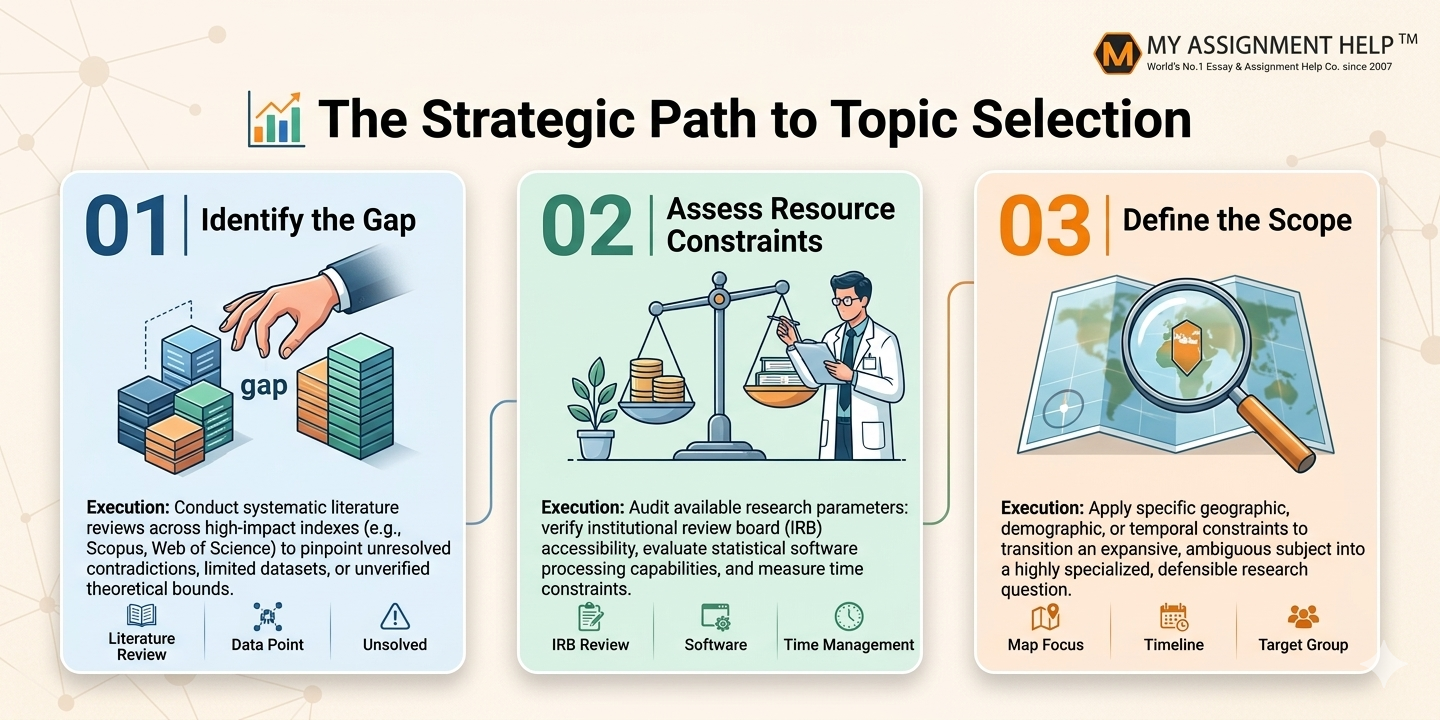
A rigorous, high-indexing research topic must simultaneously satisfy three core pillars: personal intellectual alignment, strict methodological viability, and quantifiable academic value. Neglecting any element of this triad introduces systemic vulnerabilities into the manuscript, often resulting in prolonged committee adjustments or late-stage structural failure during the defense phase.
1. Personal Intellectual Alignment
A thesis requires long-term psychological and intellectual endurance. Selecting a topic based solely on transient trends or faculty convenience, without genuine intellectual interest, introduces cognitive fatigue. When researchers are intrinsically motivated by their core hypothesis, their baseline engagement with complex literature increases, directly improving synthesis quality and analytical depth.
2. Methodological Viability and Scope Control
A highly impactful research concept can easily collapse if it lacks structural feasibility. Students must critically evaluate their accessible resources: Do you possess direct access to the required proprietary datasets, specialized laboratory equipment, or target demographics for comprehensive surveys? For example, attempting an extensive cross-sectional analysis of executive corporate entities without pre-existing institutional data-sharing agreements introduces severe operational risk. Restricting the research scope ensures the project remains structurally realistic and executable within standard academic timelines.
3. Quantifiable Academic Value (The "Gap" Analysis)
A master’s thesis or doctoral dissertation must contribute meaningfully to the broader academic landscape. It cannot simply replicate existing published outcomes. True scholarly value is established by locating a specific, verified gap within current literature—such as an unaddressed variable, an emerging technological catalyst, or an unverified theoretical application to a new population demographic.
Data-Driven Metrics: Why Topic Selection Governs Graduation Timelines
Empirical evidence underscores that structural errors committed during the initial topic-selection phase cause substantial graduation delays. According to longitudinal institutional data mapping doctoral completion pathways, structural scope modifications required mid-research account for an average extension of 1.5 to 2.5 academic semesters. This extension significantly escalates the overall financial burden of post-graduate education while delaying entry into high-yield post-doctoral or private research positions.
The primary catalyst for these delays is the failure to anticipate data collection limitations or IRB restrictions early in the planning process. When students encounter severe data deficiencies or structural dead-ends three semesters into a project, they face a challenging operational crossroad: attempt to forcefully remediate a flawed hypothesis, or execute a complex, time-consuming shift in focus. Because of these intense pressures and the significant risks involved, many advanced candidates choose to strategically offload their structural writing burdens to elite corporate consultancies, opting to pay someone to do my dissertation chapters to ensure their complex data transformations meet rigorous econometric metrics without extending their graduation timelines.
🔑 Key Takeaways for Academic Success
-
Enforce Strict Scope Parameters: Transition broad thematic interests into precise, bounded research queries using explicit demographic, geographic, or temporal delimiters.
-
Validate Data Access Prior to Approval: Never formalize a thesis prospectus without securing explicit authorization for proprietary datasets, software platforms, or human subjects.
-
Map Directly to Market Demand: Align chosen academic methodologies with specialized quantitative or qualitative criteria highly sought after by modern corporate and university R&D departments.
Frequently Asked Questions (FAQ)
Q1: How can I verify if my chosen thesis topic is too broad?
A: If your core research question cannot be addressed within a clear, defined set of sub-hypotheses, or if a preliminary keyword search yields hundreds of thousands of identical papers, the scope requires immediate refinement. A strong topic targets a highly specific relationship between limited, well-defined variables.
Q2: What is the most effective strategy for identifying a legitimate research gap?
A: Analyze the "Recommendations for Future Research" sections of peer-reviewed papers published in top-tier journals within the last 18 months. These sections provide verified, expert-vetted pathways for original scholarship.
Q3: Is it safe to change my research topic after submitting the prospectus?
A: Minor adjustments are common as data collection progresses. However, major conceptual changes after prospectus approval require formal institutional review and can delay your graduation timeline by several semesters. Early verification of data availability minimizes this risk.
👤 Author Profile & E-E-A-T Verification
Dr. Elizabeth Vance is a Senior Academic Content Strategist and Research Methodologist at MyAssignmentHelp. She holds a Ph.D. in Higher Education Administration from a leading US institution and has spent over twelve years guiding post-graduate candidates through complex prospectus designs, statistical validations, and rigorous dissertation defenses. Her research focuses on improving institutional retention metrics through structured, early-stage research frameworks.
📚 Methodological References & Institutional Data Sources
-
Council of Graduate Schools. (2024). Ph.D. Completion and Attrition: Policy, Metrics, and Long-Term Institutional Trends. CGS Research Report Monograph.
-
Harvard Graduate School of Education. (2023). Strategic Scope Control and the Cognitive Psychology of Post-Graduate Researchers. Academic Press.
-
National Center for Education Statistics (NCES). (2025). Postsecondary Institutional Outcomes, Completion Rates, and Financial Overhead Profiles. US Department of Education.
- Managerial Effectiveness!
- Future and Predictions
- Motivatinal / Inspiring
- Fitness and Wellness
- Medical & Health
- Manufacturing
- Formazione
- Real-Estate
- Food Industry
- Hospitality
- Online Games
- Sports
- Home Services
- Civil Engineering
- Safety and Protection
- Software Products & Services
- Fashion and Jewellery
- Artificial Intelligence
- Entrepreneurship
- Mentoring & Guidance
- Marketing
- Networking
- HR & Recruiting
- Literature
- Shopping
- Career Management & Advancement