

 SkillClick
Legacy Modernization Company: What They Do and How to Choose One
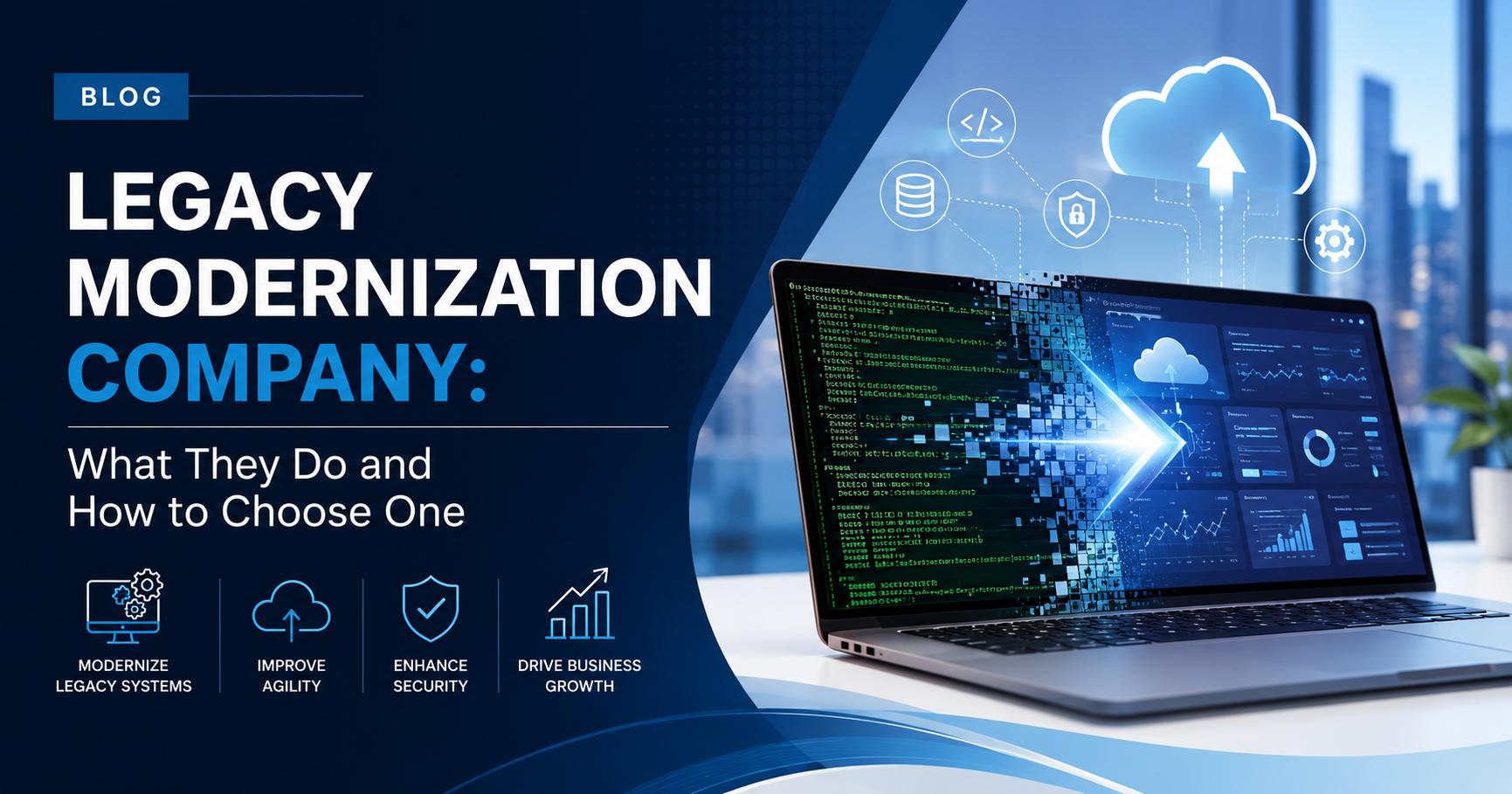
Enterprises running decade-old platforms spend more maintaining them than building anything new. Technical debt does not show up as a line item in quarterly results, but it shows up everywhere else in slow release cycles, integration failures, rising maintenance costs, and a shrinking pool of engineers who still know the legacy language. According to Gartner, organisations spend 70–80% of their IT budget maintaining existing systems, leaving 20–30% or less for innovation. A legacy modernization company takes those ageing systems COBOL mainframes, AS/400 platforms, monolithic Java applications and converts them into modern, cloud-native architectures that can support AI integration, real-time data, and continuous delivery. This post explains what these companies do, which modernization approach fits which scenario, and what separates providers that deliver from those that stall.
What Is a Legacy Modernization Company
A legacy modernization company is an engineering and consulting firm that specialises in transforming outdated software systems into modern architectures. The work is more than technical migration. It covers code discovery and analysis, business logic extraction, architecture redesign, data migration, security and compliance remediation, and post-migration validation.
The firms that do this well combine three capabilities: deep knowledge of legacy languages and platforms (COBOL, Natural/Adabas, PL/I, older Java frameworks), modern engineering skills in cloud-native development, microservices, containerisation, and DevOps, and domain expertise in the regulated industries where most legacy systems are concentrate financial services, healthcare, insurance, and government.
Firms that have only one of these capabilities produce modernisation programs that fail in predictable ways. Legacy language experts without modern architecture skills produce cloud-washed systems mainframe code moved to a cloud server without structural change. Modern engineers without legacy knowledge cannot understand what the existing code does well enough to replicate it correctly in the new system. Domain expertise without either produces architecturally correct systems that fail compliance review.
What Services a Legacy Modernization Company Provides
The service scope of a legacy modernization company covers the full journey from assessment through post-migration support.
Code Discovery and Technical Debt Assessment
The first and most important phase is understanding what the existing system actually does. Legacy codebases particularly COBOL system contain decades of undocumented business logic written by engineers who retired years ago. Business rules are embedded in procedural code, inter-programme dependencies are complex, and the relationship between code behaviour and regulatory requirements is rarely documented anywhere.
Legacy modernisation companies use a combination of static code analysis tools, AI-assisted documentation generation, and human expert review to map the existing codebase. The output is a technical debt assessment a structured understanding of what the system does, what dependencies exist between components, where regulatory and compliance logic is embedded, and what the risk and complexity of each modernisation pathway looks like.
This phase is where most enterprise-led modernisation attempts fail. Without a clear, verified understanding of what the existing code does, modernisation teams make incorrect assumptions about business logic, discover errors mid-migration, and either stall or produce a new system that does not replicate the correct behaviour of the legacy system.
Modernisation Strategy and Pathway Selection
After assessment, the modernisation company recommends a strategy based on the business's risk tolerance, timeline requirements, and target architecture. The main pathways are encapsulation wrapping legacy functionality with APIs to expose it to modern systems without changing the core rehosting moving the application to cloud infrastructure without changing the code replatforming upgrading the operating environment while keeping application logic intact refactoring decomposing monolithic logic into microservices using cloud-native design principles and rebuilding rewriting applications from scratch or replacing them with SaaS platforms when the existing logic no longer supports current requirements.
Most large enterprises use a hybrid approach across their application portfolio. Different systems within the same organisation often warrant different pathways based on their complexity, usage frequency, and the cost of getting them wrong.
AI-Assisted Code Transformation
Leading legacy modernisation companies use AI tooling to accelerate the transformation phase — translating COBOL or other legacy code into modern languages, generating documentation from code that has none, creating test cases from existing code behaviour, and identifying the specific code segments that carry regulatory and compliance logic. According to ISG Provider Lens 2025, organisations that use AI-augmented modernisation approaches reduce modernisation timelines by 40–60% compared to purely manual conversion programs.
AI acceleration does not eliminate human engineering oversight. The AI-generated translations and documentation need expert review to verify correctness, particularly for the embedded business logic that drives financial calculations, regulatory determinations, and compliance controls. The firms that use AI effectively treat it as an accelerator for the discovery and translation phases and apply human validation at the steps where errors carry the highest business risk.
For a current view of which legacy modernization companies are leading enterprise transformation in 2026 including their specific capabilities, delivery models, and the regulated industry specialisations that distinguish them the analysis covers both global integrators and specialist providers across financial services, healthcare, and government.
What Modernisation Approaches Legacy Companies Use
The six primary technical approaches to legacy modernisation each produce different outcomes and carry different risk profiles.
Encapsulation and API Wrapping
Encapsulation wraps existing legacy functionality with modern APIs, allowing digital front-ends and external systems to interact with the legacy core without changing it. This is the fastest approach and carries the least technical risk. It is appropriate when the legacy system's business logic is correct and stable, when the migration budget does not support deeper transformation, or when the organisation needs to enable digital channel integration immediately while planning deeper modernisation over a longer horizon.
The limitation of encapsulation is that it does not address the underlying technical debt. The legacy system still runs, still requires legacy expertise to maintain, and still carries the security and compliance risks of an unsupported platform. It is a tactical step that buys time for deeper modernisation, not a modernisation destination in itself.
Refactoring and Microservices Decomposition
Refactoring decomposes monolithic application logic into independently deployable microservices using containers, cloud-native design principles, and DevSecOps practices. This is the approach that produces the most complete modernisation outcome a system that is cloud-native, independently scalable, continuously deployable, and maintainable by modern engineering talent.
It is also the highest-risk and most time-intensive approach. The decomposition of complex business logic into correctly bounded microservices requires deep understanding of the existing code and clear decisions about service boundaries. Legacy modernisation companies that rush this phase or make incorrect service boundary decisions produce distributed systems that are more complex to maintain than the monolith they replaced.
Rebuilding for Systems With Obsolete Logic
Rebuilding is appropriate when the existing logic is so outdated that it no longer supports current business requirements, when the system has accumulated so many layers of patches and workarounds that the original architecture is no longer identifiable, or when a modern SaaS platform provides the required functionality more cost-effectively than maintaining a custom codebase.
The risk in rebuilding is scope the new system must replicate every business rule and compliance requirement of the existing system, including the undocumented ones. Legacy modernisation companies that do not invest in thorough discovery before rebuilding consistently miss embedded business rules that only surface when the new system processes a real transaction type the old system handled correctly.
How Long Legacy Modernisation Takes
Timeline depends on the approach, the complexity of the existing codebase, and the number of integrated systems that need to be migrated or rerouted. Rehosting programs for well-understood applications can complete in three to six months. Refactoring programs for large, complex codebases with deep regulatory logic typically take twelve to thirty-six months with phased delivery. Most large enterprise modernisation programs use a phased approach migrating the highest-risk or highest-value systems first, validating the approach, and extending it to the broader portfolio.
The most common cause of timeline overrun in legacy modernisation is not the transformation work itself it is the discovery phase taking longer than estimated because the existing code documentation is worse than anyone expected. Legacy modernisation companies that have run discovery on large codebases before set realistic expectations for this phase and build buffer into the program plan rather than discovering mid-program that the initial assessment was incomplete.
What Causes Legacy Modernisation Projects to Fail
Four failure patterns appear consistently across failed legacy modernisation programs. Discovery is treated as a brief preliminary phase rather than a sustained investment in understanding what the existing system does, producing incorrect assumptions about business logic that surface as errors in the new system. The modernisation approach is chosen based on technology preference rather than assessment findings, producing programs that apply the wrong strategy to specific systems. Regulatory and compliance logic embedded in the legacy code is not identified and preserved in the new system, requiring expensive post-migration remediation. And post-migration testing is insufficient to verify that the new system produces the same outputs as the legacy system for the full range of transaction types it handles.
Legacy modernisation companies that have run successful programs at scale have processes for preventing each of these failures. The most reliable evidence that a provider has those processes is a reference from a comparable engagement in your industry where they can walk through specifically how they managed discovery, compliance preservation, and testing.
How to Choose a Legacy Modernisation Company
The selection criteria that predict engagement success are domain experience in your specific regulated industry, evidence of AI-assisted code discovery capability, transparent track record with verifiable client references from comparable programs, clarity on post-migration testing methodology, and commercial models that tie payment to outcomes rather than hours.
Domain experience in regulated industries matters more for legacy modernisation than for most technology programs. The compliance and regulatory logic embedded in financial services, healthcare, and government legacy systems is specific and consequential. A modernisation company without experience handling FFIEC, OCC, SOC2, or HIPAA requirements in production migration programs will encounter those requirements for the first time in your engagement at your cost.
Conclusion
A legacy modernisation company provides the code intelligence, engineering execution, and domain expertise needed to transform systems that enterprise engineering teams cannot safely modernise alone. The technical debt, undocumented business logic, and regulatory complexity embedded in most enterprise legacy systems requires specialist capability. The programs that succeed are those run by providers who invest in thorough discovery, match the modernisation approach to assessment findings rather than to technology preference, preserve compliance logic through the transformation, and validate the new system against the full range of the legacy system's transaction types before go-live.
- Managerial Effectiveness!
- Future and Predictions
- Motivatinal / Inspiring
- Fitness and Wellness
- Medical & Health
- Manufacturing
- Education
- Real-Estate
- Food Industry
- Hospitality
- Online Games
- Sports
- Home Services
- Civil Engineering
- Safety and Protection
- Software Products & Services
- Fashion and Jewellery
- Artificial Intelligence
- Entrepreneurship
- Mentoring & Guidance
- Marketing
- Networking
- HR & Recruiting
- Literature
- Shopping
- Career Management & Advancement