

 SkillClick
Benefits of Digital Marketing: Then vs Now
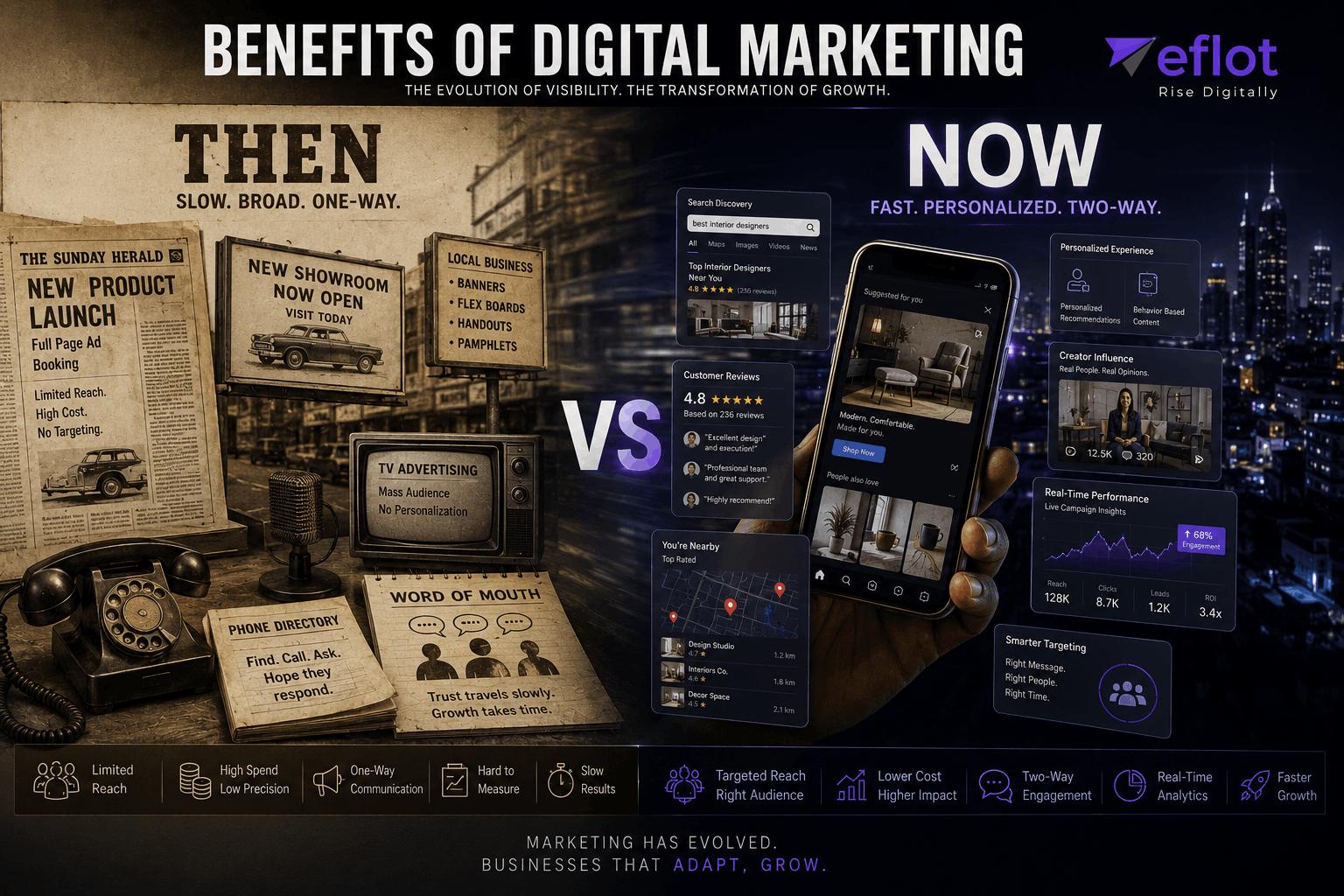
A decade ago, digital marketing looked very different from what businesses experience today.
Around 2013–2015, many companies were still transitioning from traditional advertising systems into online platforms.
At the time, simply having:
-
a website
-
a Facebook page
-
basic search visibility
-
online advertisements
already created competitive advantage.
Digital marketing was viewed mainly as a faster and cheaper alternative to traditional advertising channels.
Businesses compared it against:
-
newspaper promotions
-
television ads
-
outdoor banners
-
radio campaigns
-
direct mail systems
-
print media advertising
where marketing costs were often higher and performance tracking remained limited.
Back then, the biggest benefit of digital marketing was visibility itself.
If a business appeared online consistently, it immediately gained advantage over competitors that had little or no internet presence.
But over the last decade, the internet changed dramatically.
Today digital marketing no longer functions only as a promotional tool.
It increasingly shapes how businesses are:
-
researched
-
evaluated
-
compared
-
trusted
-
remembered
before customers ever make contact.
That shift changed the actual benefits of digital marketing completely.
Then: Businesses mainly used digital marketing to “be online”
In the early stages of digital adoption, many businesses approached digital marketing very simply.
The goals were usually:
-
create a website
-
appear on Google
-
run online ads
-
increase website traffic
-
build social media presence
At that time, internet competition was significantly lower.
Fewer businesses invested seriously in:
-
search engine optimization
-
paid advertising
-
content strategy
-
online branding
which meant visibility itself was easier to achieve.
Even basic digital activity often produced strong results because:
-
buyer attention was less fragmented
-
online competition remained limited
-
social media algorithms offered large organic reach
-
search rankings were easier to secure
In many industries, businesses experienced rapid growth simply by becoming digitally visible earlier than competitors.
Now: Visibility alone no longer creates advantage
Today almost every industry operates inside highly crowded digital markets.
Businesses now compete against:
-
thousands of ads
-
continuous content streams
-
short attention spans
-
faster comparison behavior
-
algorithm-driven visibility systems
Meaning:
Being online alone no longer creates meaningful differentiation.
Modern buyers increasingly expect businesses to already have:
-
websites
-
online reviews
-
social media presence
-
search visibility
-
digital communication systems
These are no longer exceptional advantages.
They are baseline expectations.
As a result, digital marketing now benefits businesses differently.
Instead of merely helping companies “appear online,” it increasingly helps businesses:
-
shape commercial perception
-
reduce buyer uncertainty
-
improve trust formation
-
influence comparison behavior
-
maintain category relevance
during longer research journeys.
Then: Buyers discovered businesses passively
Earlier internet behavior was simpler.
Buyers often:
-
clicked the first search result
-
trusted early website impressions
-
compared fewer companies
-
researched less deeply
Digital marketing mainly supported visibility and traffic generation.
In many cases, once a customer discovered a company online, conversion happened relatively quickly.
Today buyer behavior is far more research-driven.
Customers now:
-
compare multiple businesses
-
read reviews extensively
-
evaluate websites carefully
-
check social proof
-
validate credibility across platforms
before making decisions.
This especially changed how businesses approach local seo because buyers increasingly research businesses geographically before direct engagement happens.
For many industries, search behavior itself became more detailed and evaluation-focused over time.
Then: Social media mainly created reach
In the earlier years of social media marketing, platforms rewarded businesses heavily through organic distribution.
A company could often generate large audience reach simply by:
-
posting consistently
-
sharing updates
-
running contests
-
publishing basic promotional content
Organic engagement levels were significantly higher than today.
Businesses benefited from:
-
lower advertising competition
-
easier follower growth
-
inexpensive audience reach
-
stronger organic visibility
But modern social media ecosystems operate very differently.
Algorithms increasingly prioritize:
-
engagement quality
-
retention behavior
-
audience interaction depth
-
content relevance
-
watch time and behavioral signals
As competition increased, social media evolved from a simple broadcasting system into a highly competitive attention environment.
Then: Websites functioned like digital brochures
Earlier, many businesses treated websites as static information pages.
A basic website containing:
-
contact information
-
service descriptions
-
company details
was often enough to establish online legitimacy.
Today websites increasingly function as:
-
trust systems
-
evaluation platforms
-
conversion environments
-
buyer education systems
Modern customers interpret website quality as a signal of:
-
professionalism
-
operational seriousness
-
responsiveness
-
credibility
before inquiries happen.
This changed one of the biggest benefits of digital marketing:
websites no longer simply attract visitors — they influence business evaluation directly.
Then: Advertising costs were lower and attention was easier
A decade ago, digital advertising ecosystems were significantly less crowded.
Businesses often experienced:
-
lower cost-per-click rates
-
cheaper customer acquisition
-
easier targeting
-
less competitive bidding environments
because fewer advertisers competed aggressively online.
Today digital advertising became more complex due to:
-
increased competition
-
algorithm sophistication
-
audience saturation
-
higher acquisition costs
Meaning:
Businesses increasingly need stronger:
-
positioning
-
communication clarity
-
audience understanding
-
conversion systems
rather than simply larger advertising budgets.
Then: Digital marketing supported campaigns. Now it supports business ecosystems.
One of the biggest changes over the last decade is structural.
Earlier, digital marketing mostly supported:
-
promotions
-
campaigns
-
traffic generation
-
temporary visibility boosts
Today it increasingly supports entire business ecosystems.
Modern digital marketing now influences:
-
recruitment perception
-
procurement confidence
-
partnership credibility
-
investor impressions
-
customer trust
-
category authority
far beyond advertising alone.
This is especially visible in industries where customers spend significant time researching businesses before making decisions.
Why modern digital marketing became more psychological
Another major evolution is psychological influence.
Earlier internet marketing focused heavily on:
-
clicks
-
traffic
-
reach
-
impressions
Today digital marketing increasingly shapes:
-
familiarity
-
confidence
-
perception
-
category positioning
-
brand interpretation
across longer buyer journeys.
This is one reason businesses now invest heavily in influencer marketing because audiences increasingly trust repeated contextual familiarity more than direct advertising alone.
The internet gradually shifted from:
a traffic environment
into:
A perception environment.
Why digital marketing still matters more than ever
Despite increased competition and changing algorithms, digital marketing remains more important than ever because modern buyers now live inside digital evaluation ecosystems continuously.
Businesses today are researched through:
-
search engines
-
reviews
-
websites
-
social media
-
online discussions
-
recommendation systems
before most commercial decisions happen.
Meaning:
Digital marketing no longer simply helps businesses promote themselves.
It increasingly helps businesses participate in how modern markets evaluate credibility itself.
That is a much larger role than digital marketing had a decade ago.
How Eflot approaches modern digital marketing systems
Eflot focuses on helping businesses adapt to how modern digital ecosystems influence buyer evaluation, perception, and long-term market positioning.
This often includes:
-
integrated search visibility systems
-
conversion-oriented communication
-
content-driven authority building
-
audience-focused digital strategy
-
long-term growth optimization
designed for increasingly research-driven online markets.
FAQ
What was digital marketing mainly used for a decade ago?
Mostly for online visibility, website traffic, and cheaper advertising compared to traditional media.
How did social media marketing change over time?
Earlier platforms rewarded organic reach heavily, while modern systems prioritize engagement quality and behavioral signals.
Why are websites more important today?
Modern buyers evaluate trust, professionalism, and credibility through websites before contacting businesses.
Why did digital advertising become more competitive?
More businesses entered online markets, increasing bidding competition and customer acquisition costs.
Why is digital marketing still important today?
Because modern buyers increasingly research and evaluate businesses digitally before making decisions.
Key Takeaways
-
A decade ago, digital marketing mainly helped businesses become visible online
-
Today benefit of digital marketing is that it increasingly influences trust, perception, and buyer evaluation
-
Social media evolved from simple reach systems into competitive attention ecosystems
-
Websites now function as business evaluation platforms rather than static brochures
-
Modern digital marketing supports long-term business ecosystems, not just short-term campaigns
- Managerial Effectiveness!
- Future and Predictions
- Motivatinal / Inspiring
- Fitness and Wellness
- Medical & Health
- Manufacturing
- Education
- Real-Estate
- Food Industry
- Hospitality
- Online Games
- Sports
- Home Services
- Civil Engineering
- Safety and Protection
- Software Products & Services
- Fashion and Jewellery
- Artificial Intelligence
- Entrepreneurship
- Mentoring & Guidance
- Marketing
- Networking
- HR & Recruiting
- Literature
- Shopping
- Career Management & Advancement