

 SkillClick
Concrete Calculator & Concrete Slab Calculator Guide
Concrete Calculator and Concrete Slab Calculator: A Complete Practical Guide
Concrete is the backbone of modern construction. From small residential projects like patios and driveways to large commercial foundations, concrete plays a vital role in strength, durability, and longevity. However, one of the most common problems faced by contractors, builders, and even homeowners is estimating the right amount of concrete. Ordering too much leads to wasted money, while ordering too little can delay the entire project.
This is where a Concrete Calculator and Concrete Slab Calculator become essential tools. These calculators help you estimate the exact quantity of concrete needed for your project, saving time, money, and effort. In this detailed guide, we will explain what these calculators are, how they work, why they are important, and how to use them correctly for different construction needs.
What Is a Concrete Calculator?
A Concrete Calculator is a tool designed to estimate the volume of concrete required for various construction elements such as slabs, footings, columns, sidewalks, and walls. It uses basic measurements like length, width, thickness, and depth to calculate the volume of concrete, usually in cubic meters, cubic yards, or cubic feet.
Instead of relying on rough guesses or manual calculations, a concrete calculator provides accurate results within seconds. This accuracy helps avoid material shortages, reduces over-ordering, and improves overall project planning.
What Is a Concrete Slab Calculator?
A Concrete Slab Calculator is a specialized type of concrete calculator specifically focused on slabs. Slabs are flat, horizontal concrete surfaces commonly used for floors, patios, driveways, garage bases, and foundations.
This calculator takes into account:
-
Slab length
-
Slab width
-
Slab thickness
Based on these inputs, it calculates how much concrete is required to pour the slab. Some advanced slab calculators also allow users to add a waste factor (usually 5–10%) to ensure there is extra concrete available in case of spillage or uneven ground.
Why Accurate Concrete Estimation Matters
Accurate concrete estimation is critical for several reasons:
1. Cost Control
Concrete is expensive, especially for large projects. Even a small miscalculation can increase costs significantly. A concrete calculator helps you stay within budget by ordering the exact quantity needed.
2. Time Efficiency
Running out of concrete mid-project can cause delays, additional labor costs, and scheduling problems. Accurate calculations ensure uninterrupted workflow.
3. Reduced Waste
Over-ordering concrete leads to material waste, disposal costs, and environmental impact. Using a calculator promotes sustainable construction practices.
4. Professional Planning
For contractors and construction companies, precise calculations improve professionalism, client trust, and project efficiency.
How a Concrete Calculator Works
A concrete calculator follows a simple formula:
Volume = Length × Width × Thickness
For example:
-
Length: 10 feet
-
Width: 10 feet
-
Thickness: 4 inches (0.33 feet)
Volume = 10 × 10 × 0.33 = 33 cubic feet
This volume can then be converted into cubic yards or cubic meters depending on your requirements. Most calculators automatically handle these conversions.
How to Use a Concrete Slab Calculator Step by Step
Using a concrete slab calculator is straightforward:
Step 1: Measure the Area
Measure the length and width of the slab area using a tape measure. Ensure measurements are accurate and taken in the same unit (feet or meters).
Step 2: Decide Slab Thickness
Common slab thicknesses include:
-
4 inches for patios and sidewalks
-
5–6 inches for driveways
-
6–8 inches for heavy-load areas
Step 3: Enter Measurements
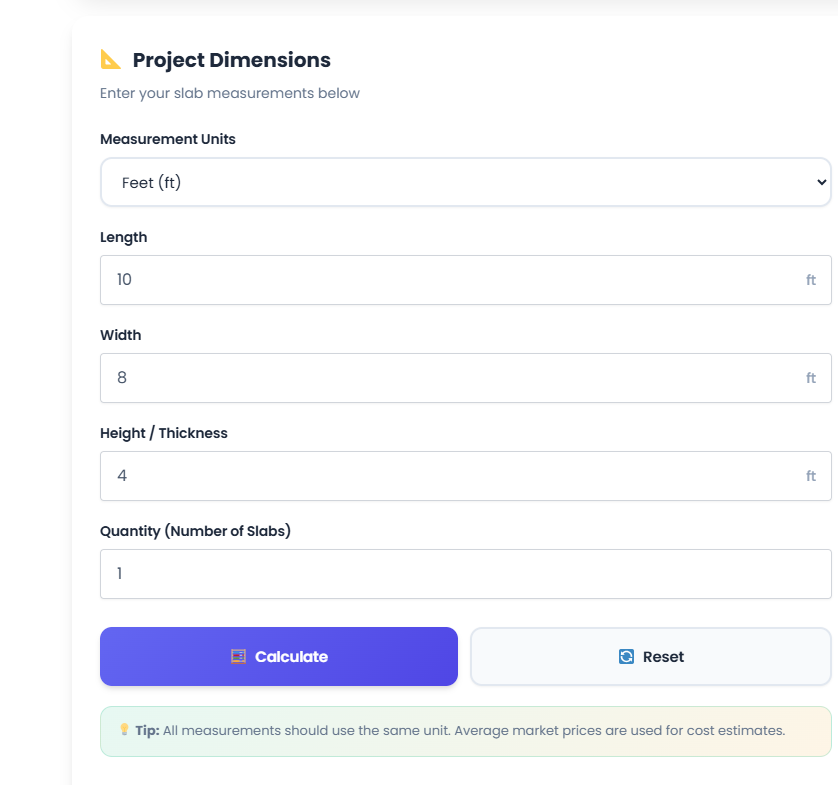
Input the length, width, and thickness into the concrete slab calculator.
Step 4: Add Waste Percentage
Add 5–10% extra to cover spillage, uneven surfaces, or minor errors.
Step 5: Review the Result
The calculator will display the total concrete required, usually in cubic yards or cubic meters.
Common Applications of Concrete Calculators
Concrete calculators are used in many construction scenarios, including:
Residential Projects
-
House foundations
-
Garage slabs
-
Driveways
-
Patios and walkways
Commercial Construction
-
Warehouse floors
-
Parking lots
-
Industrial slabs
-
Office building foundations
Landscaping Projects
-
Garden pathways
-
Concrete steps
-
Decorative slabs
Concrete Slab Thickness Guide
Choosing the correct slab thickness is just as important as calculating volume:
-
4 inches: Sidewalks, patios, light foot traffic
-
5 inches: Residential driveways
-
6 inches: Commercial driveways, garages
-
8 inches or more: Heavy machinery and industrial use
Using the right thickness ensures durability and prevents cracking over time.
Ready-Mix Concrete vs. Bagged Concrete
A concrete calculator also helps you decide whether to use ready-mix concrete or bagged concrete.
Ready-Mix Concrete
Best for large projects. Delivered by truck, it saves labor and ensures consistent quality.
Bagged Concrete
Suitable for small projects. Calculators can estimate how many bags are required based on bag size (40 lb, 60 lb, or 80 lb).
Benefits of Using Online Concrete Calculators
Online concrete calculators offer several advantages:
-
Instant results
-
Easy-to-use interface
-
No manual calculations
-
Unit conversion included
-
Accessible on mobile and desktop
These tools are especially useful for DIY homeowners and professionals who want quick, reliable estimates.
Common Mistakes to Avoid When Calculating Concrete
Even with calculators, mistakes can happen. Avoid these common errors:
-
Ignoring slab thickness variations
-
Forgetting to add waste factor
-
Mixing units (feet and inches incorrectly)
-
Not accounting for uneven ground
Double-checking measurements ensures accuracy.
Role and Context of Concrete Calculators in Construction
In modern construction, digital tools like concrete calculators have become standard. They bridge the gap between planning and execution by providing precise material estimates. Contractors rely on these tools to prepare quotations, schedule deliveries, and manage resources efficiently.
Task and Instruction for Best Results
To achieve the best results when using a concrete calculator:
-
Measure carefully and consistently
-
Select appropriate slab thickness
-
Include a waste margin
-
Review results before ordering
-
Consult a professional for large-scale projects
Following these steps ensures smooth project execution and optimal material usage.
Conclusion
A Concrete Calculator and Concrete Slab Calculator are essential tools for anyone involved in construction, whether you are a professional contractor or a DIY homeowner. These calculators eliminate guesswork, improve accuracy, save money, and reduce waste. By understanding how they work and using them correctly, you can plan your projects with confidence and precision.
From small patios to large foundations, accurate concrete estimation plays a critical role in project success. Investing a few minutes in proper calculations can prevent costly mistakes and delays. Ultimately, concrete calculators are not just tools—they are smart planning solutions that contribute to efficient, sustainable, and professional construction practices.
- Managerial Effectiveness!
- Future and Predictions
- Motivatinal / Inspiring
- Fitness and Wellness
- Medical & Health
- Manufacturing
- EĞİTİM BİLGİLERİ
- Real-Estate
- Food Industry
- Hospitality
- Online Games
- Sports
- Home Services
- Civil Engineering
- Safety and Protection
- Software Products & Services
- Fashion and Jewellery
- Artificial Intelligence
- Entrepreneurship
- Mentoring & Guidance
- Marketing
- Networking
- HR & Recruiting
- Literature
- Shopping
- Career Management & Advancement