

 SkillClick
What are A Level Grades? A Complete Guide

Understanding A Level grades is crucial, as they determine university admissions and future career paths. However, they can be confusing. What counts as a pass? Do exams only determine grades? And why do A Level grades look so different from GCSE grades?
A Levels (Advanced Level qualifications) follow a letter grading system. The highest grade is an A*, and the lowest passing grade is an E. Unlike GCSEs, where grades 9-1 are used, A Levels grade students from A*–E. Before 2019, students were graded from grade A (the highest) to Grade E (the lowest passing mark). However, from 2019 onwards, a new grade, the A*, was included to reward ‘outstanding performance’.
How are A Level grades worked out?
A Level grades are based on the total number of marks a student achieves in their exams and coursework (if applicable). However, there is no fixed score for each grade; grade boundaries change every year.
After all students have taken their exams, exam boards (like AQA, Pearson Edexcel, and OCR) review the overall performance. If an exam was challenging, the boundary for an A or B might be lowered to ensure fairness. Likewise, if most students performed very well, the boundary for top grades might be raised.
For each subject, examiners decide what raw marks (the number of marks you actually scored) translate into final A Level grades (A*, A, B, etc.). These boundaries are published on results day so students can see how their marks compare.
All of this means that there is no typical example of A*, or C grade work at A Level in a particular subject; it will change year on year. This system ensures that grades reflect not just individual performance but also how the whole year group performed in a fair and balanced way. Part of that is to ensure fairness when it comes to applying to university.
A Level grades and UCAS points
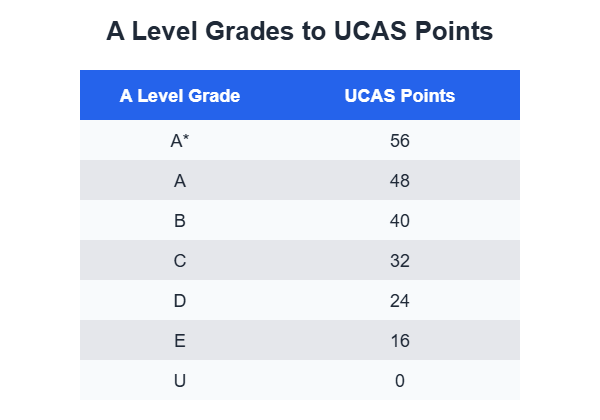
Some universities require specific grades for particular courses, but some use these points to determine eligibility for courses. For example, a university might set a minimum entry requirement of 120 UCAS Tariff points for a particular course. This could be made up of three B grades, but equally could be achieved with A Level grades of ABC. For students applying to UK universities, A Level grades are converted into UCAS Tariff points. For each grade, the tariff points are as follows:
What is a pass at A Level?
A pass at A Level is considered to be any grade from A* to E. If a student receives a U (ungraded), they have not met the minimum requirements to pass.
Many universities and employers require at least a C or above for specific subjects, particularly in competitive fields. However, achieving a D or E still means a student has passed the course.
It is always worth giving your all to each of your A Level courses, even if you are finding it tricky; students must understand that every UCAS Tariff point counts.
How are A Level grades calculated?
A combination of different assessments determines A Level grade:
- Final exams: Most A Level courses are assessed using only written exams taken at the end of Year 13.
- Coursework (if applicable): Some subjects, like English, History, and Art, include coursework that counts towards the final grade.
- Practicals (for science subjects): Science A Levels (e.g., Biology, Chemistry, Physics) include practical assessments. However, sometimes these do not affect the main grade (in these cases, they are graded separately as Pass/Fail).
Weighting assessments of A level
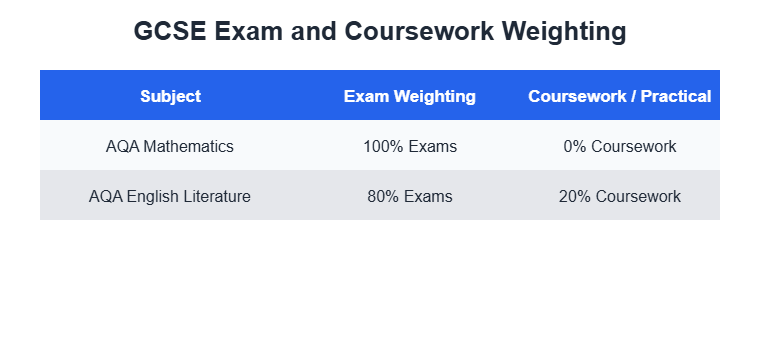
Practicals work a bit differently. In AQA A Level Chemistry, for example, the practical does not contribute to the final A Level grade, but is graded separately through what’s called the Practical Endorsement. There are only two grades: pass or fail. Even though this component does not affect your A Level grade, some universities may include passing this component as part of the entry requirements to some of their courses.
Additionally, at least 15% of the total A Level grade for AQA Chemistry is allocated to assessing practical knowledge and understanding. This is assessed in exam questions in the exam papers. It is therefore essential to take practicals seriously, because completing them and knowing the skills involved could be the difference between getting on to your top university course or not. Most A Levels are assessed through exams alone, but in subjects with coursework, the weighting varies.
How are A Level grade boundaries decided?
Grade boundaries are determined by exam boards (such as AQA, Pearson Edexcel, and OCR) after exams have been marked. The boundaries can change slightly each year, depending on:
- Overall student performance: If exams are more challenging than expected, grade boundaries may be lowered.
- Statistical analysis: Exam boards compare results from previous years to ensure fairness.
- Exam difficulty: If a particular paper is found to be more difficult than usual, adjustments may be made to ensure students are not unfairly penalised.
Grade boundaries are released after results day, so students can see how many marks were needed for each grade. It is advised to speak to your teacher or the careers staff at your school if you want to know more.
How to achieve the top A Level Grades in Exams?
To get the best A Level grades possible, use Mixt Academy resources, like past papers and even expert guides on A Level coursework assignments:
Understand Where You are Losing Marks
Before you can improve your grades, you need to know exactly what is holding you back. Start by reviewing your mock papers, class tests and teacher feedback. Look for patterns, not one-off mistakes.
Master Mark Scheme
A Level exams reward particular skills. Even if you understand the content, you may still miss marks if you are not giving examiners exactly what they expect. Learning how the mark scheme works is one of the quickest ways to improve your grades.
Use Active Recall
One of the biggest differences between students who make fast progress and those who stay stuck is how they revise. Simply rereading notes does not strengthen your memory.
To get better grades at A Level, you need revision methods that train your brain to retrieve information quickly and reliably. Two techniques make the most significant difference: active recall and spaced repetition.
Build Strong Revision Routines
You don’t need long study days, and cramming is rarely effective. Instead, you need to find your way to a steady, focused revision that fits around your life and keeps you moving forward.
Practice Under Exam Conditions
One of the fastest ways to improve your A Level grades is to practise the way you will be assessed. Timed, exam-style practice helps you:
- Get used to the pressure of working against the clock
- Build confidence with real question styles
- Spot where you run out of time or lose marks
- Learn how to structure answers without relying on notes
Ask for Expert help
If you are unclear on why you lost marks, ask. Your A-level tutors from an online tutoring platform like Mixt Academy will explain what examiners expect and show you where your answers went off track. They can offer advice to help you improve quickly. One-on-one A Level tutoring sessions can clear up something you’ve been struggling with for weeks.
Bottom Line
Improving your A Level grades is a steady process, and every small step you take helps you build confidence. With the proper revision habits and a clearer understanding of what examiners look for, you can make real progress in any subject. Focus on consistency, keep track of what is working for you and give yourself time to grow. Moreover, getting professional help from an online tuition center like Mixt Academy can help you improve your exam grades with confidence. An online A Level tutor understands the weak areas of the subject and offers a targeted plan that suits your learning style and unique goals.
FAQs
How to interpret your A Level results?
Understanding A Level grades helps you make informed decisions about your next steps, whether that means progressing to university, seeking employment, or improving your results through resits. Ultimately, the more you know, the better position you’ll be in to determine your own future.
How long does it take to improve A Level grades?
It depends on where you are starting from, but many students see progress within a few weeks once they use targeted revision. Bigger grade jumps usually take a term or more.
Can I turn a D into an A in one year?
Yes, it is possible, and many students do it every year through Mixt Academy. You will need a focused revision routine, regular practice with past papers and clear feedback on your work.
What’s the best revision method for A Levels?
Active recall and spaced repetition are the two most effective methods. Testing yourself, answering questions from memory and revisiting topics over time help you remember far more than re-reading notes.
What is the best online tutoring platform for A Levels?
Mixt Academy is the best online tutoring platform for A Levels and other curricula, offering one-on-one learning services to students of all age groups.
- Managerial Effectiveness!
- Future and Predictions
- Motivatinal / Inspiring
- Fitness and Wellness
- Medical & Health
- Manufacturing
- Ausbildung
- Real-Estate
- Food Industry
- Hospitality
- Online Games
- Sports
- Home Services
- Civil Engineering
- Safety and Protection
- Software Products & Services
- Fashion and Jewellery
- Artificial Intelligence
- Entrepreneurship
- Mentoring & Guidance
- Marketing
- Networking
- HR & Recruiting
- Literature
- Shopping
- Career Management & Advancement