

 SkillClick
Slash Cloud Bills Without Your App Exploding

Cloud costs don’t spiral because success happens.
They spiral because discipline disappears.
Over the last decade, I’ve worked with scaling product teams, infrastructure leaders, and founders navigating the same painful surprise: traffic grows 30%, but the cloud bill grows 120%. Panic follows. Finance demands cuts. Engineering braces for impact. Somewhere in that tension, someone says, “Let’s just reduce instances and see what happens.”
That’s when apps start exploding.
For any modern SaaS Company — especially those building platforms like CRM for Business or scaling distribution engines such as CRM for GuestPost ecosystems — cloud economics is not a backend detail. It is a strategic lever. And mishandling it affects customer trust, performance, and long-term viability.
This isn’t about trimming waste at the margins.
It’s about architectural maturity.
The Silent Explosion
Three months into a growth push, a mid-sized SaaS platform celebrated a surge in new enterprise signups. The product team high-fived. Marketing doubled down. Sales forecasted aggressively.
Then finance flagged something alarming.
The cloud bill had doubled.
Traffic had not.
No one had deployed anything reckless. There was no outage. No attack. Just quiet, invisible sprawl — test environments left running, duplicated logging pipelines, unused storage volumes, overly generous auto-scaling policies.
The app wasn’t broken.
The economics were.
That’s how cloud costs explode — silently.
The Myth of “Just Turn Things Off”
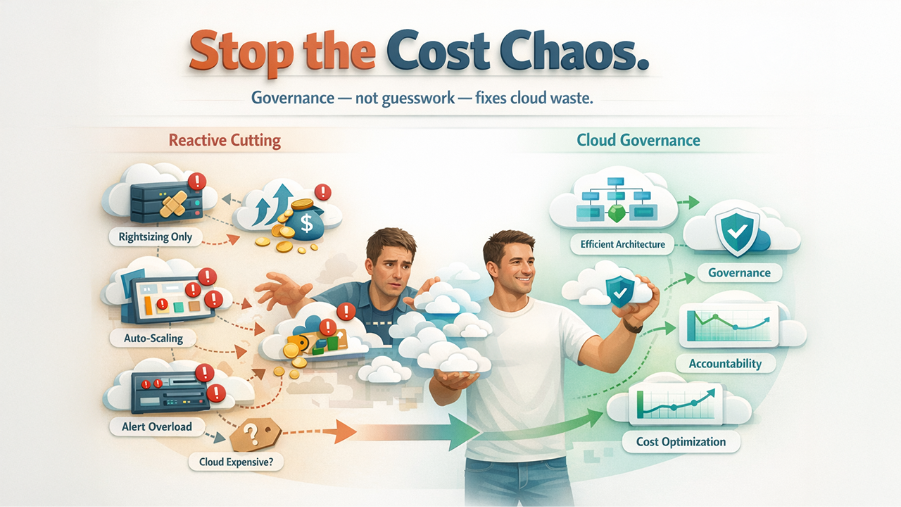
When bills surge, the instinct is simple: cut.
But reactive trimming often creates fragility. Here are the most common myths:
-
“Rightsizing instances will solve it.”
Sometimes it helps. Often it just masks deeper inefficiencies.
-
“Auto-scaling guarantees cost efficiency.”
It guarantees responsiveness — not optimal spending.
-
“More monitoring means lower cost.”
Monitoring without accountability is noise.
-
“Cloud providers are just expensive.”
Usually, architecture is.
If cost cutting feels urgent and chaotic, the issue is governance — not infrastructure pricing.
Where Cloud Waste Actually Hides
Cloud waste isn’t dramatic. It’s layered.
It hides in decisions that made sense in isolation but compound over time.
1. Architectural Sprawl
Microservices multiply. Each team optimizes for autonomy. Over time, duplication creeps in. Similar services run parallel pipelines. No one owns consolidation.
2. Redundant Data Flows
Event streams feeding dashboards that no one reads.
Backup systems backing up backups.
Data retained “just in case.”
For platforms like CRM for Business, excessive logging and duplicated customer data processing can quietly inflate storage and compute costs.
3. Overprovisioned Environments
Staging mirrors production. QA mirrors staging. Temporary testing environments remain permanent.
Finance asks:
“Why are we running five production-sized clusters?”
Engineering replies:
“Because we might need them.”
That word — might — is expensive.
4. CRM System Inefficiencies
In SaaS ecosystems, CRM for GuestPost management tools, marketing automation integrations, and analytics pipelines often run continuously, even when usage is cyclical.
Always-on systems rarely equal always-needed systems.
The Discipline of Intentional Architecture
Here’s the uncomfortable truth:
Cloud cost control is not a DevOps tactic. It is a leadership discipline.
Sustainable savings come from intentional design.
A Four-Pillar Framework
1. Workload Clarity
Every workload must justify its existence in measurable terms: revenue, user retention, compliance, or performance.
If it can’t, it’s a candidate for simplification.
2. Usage Accountability
Tie resource usage to teams.
When engineering sees cost as an abstract number, optimization stalls. When they see ownership, behavior changes.
3. Performance–Cost Alignment
Not every feature requires millisecond latency.
Differentiate between mission-critical systems and supportive infrastructure.
Over-engineering is expensive pride.
4. Strategic Simplification
Reduce layers. Consolidate services. Archive intelligently.
Eliminate duplicated tools across departments.
“Complexity compounds cost faster than traffic ever will.”
A Critical Shift in Cloud Strategy
Trend Shift: From Reactive Cost Cutting to Proactive Cost Design
The old model:
Deploy fast. Scale aggressively. Optimize later.
The new model:
Design with cost-awareness from day one.
Leading SaaS Company teams are embedding FinOps thinking into product roadmaps. Infrastructure decisions are evaluated alongside feature prioritization. CRM expansions are assessed not just for customer value — but operational load.
Cost awareness is becoming cultural, not tactical.
When Cutting Costs Breaks Trust
Aggressive trimming creates risk.
A SaaS platform once reduced instance sizes across its API layer after a budget review. Metrics looked stable in staging.
In production, under real-world traffic bursts, latency spiked. Response times doubled. High-value clients noticed.
Within weeks, churn increased.
The savings? Marginal.
The reputation damage? Significant.
For companies running CRM for Business systems where customer data access speed affects sales cycles, performance degradation translates directly to revenue impact.
Callout: If savings compromise reliability, you haven’t optimized — you’ve destabilized.
Cost efficiency without resilience is fragile success.
The New Cloud Operating Model
The future belongs to companies that treat cloud economics as strategy.
Here’s what that looks like:
-
FinOps Integration
Finance and engineering collaborate continuously — not quarterly.
-
Cost-Aware Development
Developers understand the cost implications of architectural choices.
-
Revenue-Linked Observability
Dashboards don’t just show CPU utilization — they show cost per active customer.
-
Roadmap-Aligned Budgeting
Cloud budgets evolve with product direction, not after it.
For platforms supporting CRM for GuestPost workflows or scaling multi-tenant CRM for Business ecosystems, this alignment ensures that growth and efficiency move together — not against each other.
Slash Without Breaking
Here’s the paradox:
The companies that successfully reduce cloud costs aren’t the ones slashing aggressively.
They are the ones simplifying intelligently.
They remove redundancy.
They align architecture with intent.
They tie cost to ownership.
They design with awareness.
Cloud infrastructure should amplify growth — not punish it.
And when approached strategically, cost optimization becomes a competitive advantage, not a survival tactic.
Because the goal isn’t just lower bills.
It’s resilient scale.
And resilient scale never explodes.
- Managerial Effectiveness!
- Future and Predictions
- Motivatinal / Inspiring
- Fitness and Wellness
- Medical & Health
- Manufacturing
- Education
- Real-Estate
- Food Industry
- Hospitality
- Online Games
- Sports
- Home Services
- Civil Engineering
- Safety and Protection
- Software Products & Services
- Fashion and Jewellery
- Artificial Intelligence
- Entrepreneurship
- Mentoring & Guidance
- Marketing
- Networking
- HR & Recruiting
- Literature
- Shopping
- Career Management & Advancement