

 SkillClick
Stone Cutting Quality Drift Mid-Shift | What Machine Buyers Overlook
In stone processing workshops, cutting quality drifting halfway through a shift is rarely an operating mistake and almost never a consumable problem. It is a machine selection problem that only shows itself after hours of real stone cutting.
This article explains why stone cutting machines that look “accurate” at acceptance often become unstable during production, what actually causes mid-shift drift in stone processing, and what buyers and production managers should evaluate before purchasing, not after problems appear.
If you operate, manage, or purchase stone cutting equipment and have experienced declining surface quality, unstable kerf width, or unexplained vibration after several hours of work, this article is written for that situation.
Why stone machines pass tests but fail mid-shift
Stone cutting machines are usually evaluated under short, controlled conditions.
During acceptance, machines cut limited samples, often with fresh tools, stable temperature, clean guide components, and conservative parameters. Under these conditions, most machines perform well enough to pass inspection.
Real stone production is different. Continuous cutting introduces slurry circulation, abrasive dust, heat accumulation, mechanical fatigue, and repeated load changes. These factors do not cause immediate failure. They cause gradual instability.
That instability appears mid-shift, when production pressure is highest and corrective options are limited.
Accuracy is not the same as production stability
Many buyers select stone cutting machines based on accuracy indicators.
Axis precision, positioning repeatability, CNC resolution. These numbers describe how precisely a machine can move. They do not describe how well it stays stable while cutting stone continuously.
Stone cutting stability depends on whether the mechanical structure, guide system, and control response can absorb vibration, manage slurry exposure, and maintain load balance over time. Two machines with similar specifications can behave very differently after four or six hours of cutting granite, marble, or quartz.
Mid-shift drift is the point where this difference becomes visible.
How cutting quality actually drifts in stone processing
In stone workshops, cutting quality rarely collapses suddenly. It degrades step by step.
The wire or blade begins to vibrate slightly more than usual.
Cooling water carries stone slurry back toward rotating components.
Guide wheels or support rollers lose smooth rotation.
Tension or feed compensation lags behind real cutting load.
Operators slow the process to regain surface quality.
Each step looks manageable. Together, they change the cut.
By the time surface finish becomes unacceptable, the system has already been unstable for a significant period. Replacing consumables or adjusting parameters treats the symptom, not the cause.
Guide wheels are not secondary parts in stone cutting
In stone cutting machines, guide wheels are structural components, not accessories.
Their bearing quality, sealing effectiveness, alignment accuracy, and resistance to slurry intrusion directly influence wire or blade stability. Stone slurry is abrasive, conductive, and persistent. Once it enters areas that were not designed for long-term exposure, smooth rotation degrades quickly.
Uneven guide wheel rotation does not stop production immediately. It introduces micro-vibration that slowly alters the cutting path. This is why many stone workshops experience declining cut quality without a clear failure point.
This issue becomes especially visible in CNC diamond wire saw applications where long cutting cycles and slurry circulation are unavoidable.
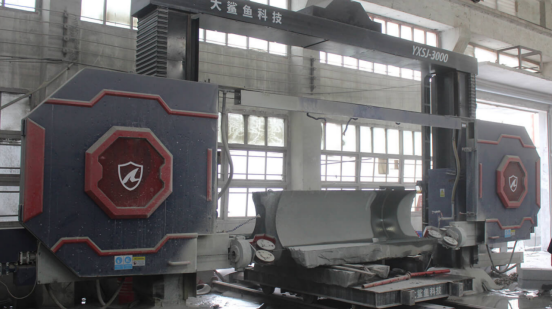
DINOSAW CNC wire saw cutting machine
Why tension control determines whether drift stabilizes or escalates
In stone cutting, tension is a dynamic condition, not a fixed value.
Material density changes, cutting direction shifts, and stone composition varies within the same block or slab. Machines that rely on slow or static tension adjustment appear stable at startup but struggle once cutting conditions fluctuate.
Delayed tension response allows vibration to build. Once vibration becomes part of the cutting system, surface consistency and kerf control degrade steadily.
Buyers who evaluate how tension is measured and adjusted during operation, rather than only checking maximum tension values, usually encounter fewer mid-shift quality issues.
Different stone cutting technologies drift in different ways
In stone processing, cutting quality drift is not a question of whether it happens, but where it starts.
Different stone cutting technologies develop instability through different mechanisms, and confusing them leads to wrong conclusions during machine selection.
Wire saws: drift begins with tension response and guidance stability
In stone wire saws, quality drift almost always begins with tension control and guide wheel behavior.
When cutting granite, quartz, or large stone blocks continuously, cutting resistance does not remain constant. Density changes, internal stress varies, and cutting direction shifts. If the wire tension system reacts slowly or relies on fixed compensation, load changes accumulate into vibration.
Once vibration appears, it feeds back through the guide wheels. Even slight degradation in guide wheel rotation smoothness amplifies wire oscillation over time. This is why many workshops report the same pattern: stable cutting early in the shift, followed by slower feed rates and declining surface quality later on.
The issue is rarely visible at startup and almost impossible to detect during short acceptance tests.
Blade-based machines: drift accumulates through heat and structural deflection
For bridge saws and blade-based stone cutting machines, drift usually does not start with tension. It starts with heat accumulation and micro-deflection.
During long production runs, thermal expansion affects spindles, blades, and machine structures unevenly. These changes are small, but stone cutting does not tolerate small deviations well. Over time, kerf consistency and surface finish begin to shift, especially under high feed rates or continuous thick-slab cutting.
Machines designed primarily for short cycles often perform well early and lose consistency as temperature stabilizes across the structure.
Multi-wire systems: small inconsistency scales into visible deviation
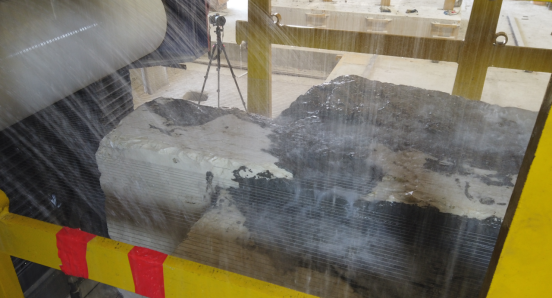
DINOSAW multi-wire saw machine for stone block cutting
Multi-wire stone cutting systems do not fail suddenly. They magnify small inconsistencies.
A minor synchronization issue that would be manageable in a single-wire system becomes a batch-level problem in multi-wire cutting. One unstable wire path quickly affects adjacent cuts, making surface variation harder to control and correct.
This is why selecting a multi-wire system based only on cutting speed or capacity often leads to disappointment later. Consistency across wires matters more than peak output.
What experienced stone buyers ask before problems appear
Stone factories that have already experienced mid-shift drift tend to evaluate machines differently the next time.
They stop asking only about specifications and start asking questions tied to real production behavior:
How does the machine behave after six or eight continuous hours of cutting
Which rotating components are constantly exposed to slurry and abrasive dust
How quickly does the system respond to load changes during cutting
Does vibration get absorbed, suppressed, or transferred through the structure
Is stability dependent on operator intervention or system design
These questions are rarely highlighted in brochures, but they directly determine whether cutting quality remains consistent throughout a shift.
Why mid-shift drift is a design philosophy issue
When cutting quality drifts repeatedly, the problem is no longer maintenance-related.
It reflects how a machine was designed to face real stone processing conditions. Some manufacturers design primarily for demonstration performance and acceptance results. Others design around long-duration cutting under slurry, heat, vibration, and fatigue.
Both machines may look similar on paper. Only one remains predictable after hours of continuous stone cutting.
This is why buyers who have dealt with drift problems eventually realize that machine selection is less about model comparison and more about how the manufacturer understands production reality.
When brand choice becomes unavoidable
Once buyers focus on stability instead of peak performance, brand evaluation becomes unavoidable.
Not because of marketing claims, but because long-term behavior exposes design priorities. Machines built around continuous stability reveal themselves during real production, not during presentations.
This is why, in many stone workshops, brands like Dinosaw enter shortlists only after buyers understand what mid-shift drift really means. The decision is not driven by features, but by how the system holds together when the shift is already halfway done.
- Managerial Effectiveness!
- Future and Predictions
- Motivatinal / Inspiring
- Fitness and Wellness
- Medical & Health
- Manufacturing
- Education
- Real-Estate
- Food Industry
- Hospitality
- Online Games
- Sports
- Home Services
- Civil Engineering
- Safety and Protection
- Software Products & Services
- Fashion and Jewellery
- Artificial Intelligence
- Entrepreneurship
- Mentoring & Guidance
- Marketing
- Networking
- HR & Recruiting
- Literature
- Shopping
- Career Management & Advancement