

 SkillClick
How Blockchain Development Services Boost Security
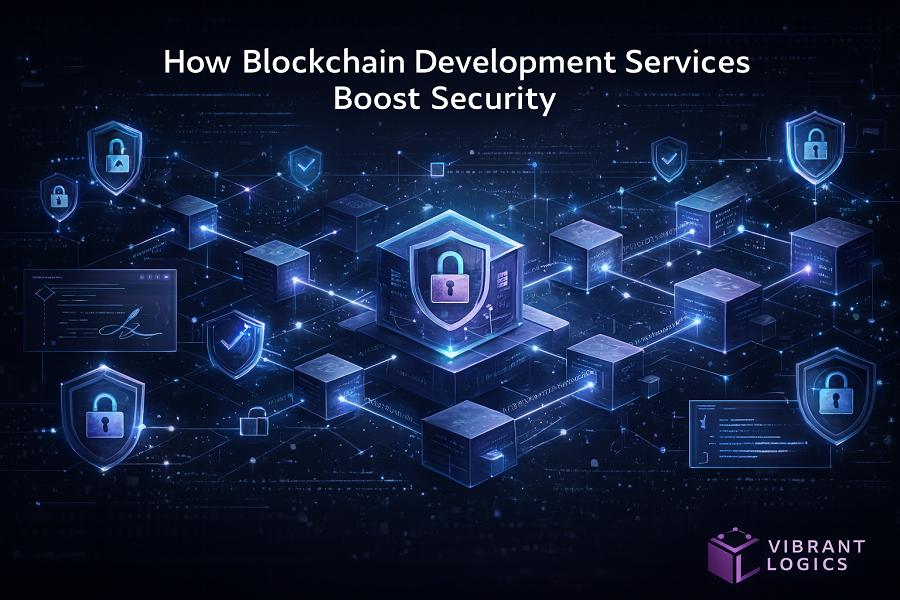
Blockchain software development services create decentralized systems that protect data through cryptographic encryption and distributed ledger technology. These services help businesses eliminate single points of failure, prevent unauthorized data tampering, and maintain transparent transaction records across industries like finance, healthcare, and supply chain management.
Companies invest in blockchain software development services because traditional centralized databases face constant breach risks. A distributed ledger spreads data across multiple nodes, making it nearly impossible for hackers to compromise the entire system.
What Makes Blockchain More Secure Than Traditional Databases?
Blockchain uses three core security mechanisms: cryptographic hashing, consensus protocols, and distributed data storage.
Every transaction receives a unique cryptographic hash—a digital fingerprint that changes if anyone alters the data. This hash links to the previous block, creating an unbreakable chain. If a hacker modifies one block, the entire chain becomes invalid.
Traditional databases store information in centralized servers. One successful attack compromises everything. Blockchain distributes identical copies across thousands of nodes. An attacker would need to simultaneously control 51% of all nodes—a task that becomes exponentially harder as networks grow.
Consensus mechanisms like Proof of Work and Proof of Stake require network agreement before adding new transactions. This prevents fraudulent entries from appearing in the ledger.
How Do Smart Contracts Reduce Security Vulnerabilities?
Smart contracts are self-executing agreements coded directly into blockchain networks. They eliminate intermediaries and human error from transaction processes.
These contracts trigger automatically when predefined conditions are met. A payment releases only after delivery confirmation. Insurance claims process instantly when verified conditions occur. Supply chain transfers happen without manual approval chains.
Key security benefits of smart contracts:
- Remove third-party access points that hackers exploit
- Execute transactions exactly as programmed without deviation
- Create permanent audit trails for compliance verification
- Prevent unauthorized modifications after deployment
Banks use smart contracts to automate loan disbursements. Healthcare providers secure patient consent records. Real estate platforms process property transfers without escrow vulnerabilities.
Why Is Decentralization Critical for Data Protection?
Decentralization spreads data across independent nodes rather than storing everything in one location.
Centralized systems create attractive targets for cybercriminals. Breach one server, access millions of records. The 2017 Equifax breach exposed 147 million people's data through a single vulnerability.
Blockchain networks operate differently. Each node maintains a complete ledger copy. Destroying one node doesn't affect the network. Data remains accessible and intact across remaining nodes.
This architecture provides three protection layers:
- Redundancy – Multiple copies prevent data loss from hardware failures
- Attack resistance – No central target for hackers to exploit
- Geographic distribution – Physical separation limits local disaster impact
Financial institutions use decentralized blockchain networks to prevent wire fraud. Healthcare systems protect patient records from ransomware attacks. Government agencies secure voting systems against manipulation.
How Does Cryptographic Hashing Prevent Data Tampering?
Cryptographic hashing converts transaction data into fixed-length alphanumeric strings through complex mathematical functions.
Each block contains its own hash plus the previous block's hash. Changing any transaction data changes that block's hash, breaking the chain connection. Network nodes immediately detect this inconsistency and reject the altered block.
SHA-256, the most common hashing algorithm, generates 2^256 possible combinations—more than atoms in the observable universe. Brute-force attacks become computationally impossible.
Hashing protects data through:
- Irreversible encryption that cannot be decoded backward
- Unique fingerprints for every transaction
- Instant tampering detection across the network
- Zero tolerance for unauthorized modifications
Supply chain companies hash product authenticity certificates. Pharmaceutical firms secure drug manufacturing records. Legal services timestamp document creation for court admissibility.
What Role Does Consensus Play in Network Security?
Consensus mechanisms require network participants to agree before validating transactions. This democratic process prevents malicious actors from adding fraudulent data.
Proof of Work forces miners to solve complex mathematical puzzles before adding blocks. The computational power required makes attacks prohibitively expensive. Bitcoin's network security costs billions to compromise.
Proof of Stake requires validators to stake cryptocurrency as collateral. Fraudulent validation attempts result in stake forfeiture. Validators protect the network to protect their investment.
These mechanisms create economic disincentives for attacks. Successful fraud requires more resources than potential gains justify.
How Do Private Blockchains Enhance Enterprise Security?
Private blockchains restrict network access to authorized participants only. This controlled environment suits businesses handling sensitive data.
Public blockchains allow anyone to join and view transactions. Private networks use permission systems to control participation. Only verified entities can read, write, or validate transactions.
Private blockchain advantages:
- Faster transaction processing with fewer nodes
- Compliance with data privacy regulations like GDPR
- Granular access controls for different user roles
- Protection of proprietary business information
Enterprises use private blockchains for internal supply chain tracking. Banks create consortium networks for interbank settlements. Healthcare systems share patient records among authorized providers only.
Can Blockchain Prevent Identity Theft?
Blockchain creates self-sovereign identity systems where users control their personal data instead of third parties.
Traditional identity management stores credentials in centralized databases—prime targets for data breaches. Over 1 billion personal records were stolen in 2023 alone.
Blockchain identity solutions store only cryptographic proofs, not actual personal data. Users share verified credentials without exposing underlying information. A driver's license proof confirms age without revealing birth date, address, or license number.
This approach eliminates honeypot databases that attract hackers. No central repository exists to breach. Users selectively disclose information for specific transactions only.
How Do Audit Trails Improve Accountability?
Blockchain creates permanent, timestamped records of every transaction. These immutable audit trails trace actions back to specific participants.
Every data modification leaves a transparent footprint. Regulators access complete transaction histories without requesting documentation. Compliance teams verify adherence to protocols in real-time.
Deleted or altered records in traditional databases hide fraudulent activity. Blockchain's append-only structure makes erasure impossible. Forensic investigators reconstruct events with complete accuracy.
Financial services track fund movements across jurisdictions. Manufacturers verify ethical sourcing claims. Government agencies demonstrate transparent procurement processes.
What Are the Limitations of Blockchain Security?
Blockchain networks face security challenges despite their robust architecture.
Smart contract bugs create vulnerabilities. The 2016 DAO hack exploited code flaws to steal $60 million. Professional auditing services now review contracts before deployment.
Private key management remains critical. Lost keys mean permanent data loss. Stolen keys grant complete access to associated assets. Hardware wallets and multi-signature authentication mitigate these risks.
51% attacks threaten smaller networks with limited node participation. Attackers controlling majority hash power can reverse transactions. Larger networks like Bitcoin and Ethereum maintain sufficient decentralization to prevent this.
Conclusion
Blockchain technology fundamentally transforms how businesses protect data through decentralization, cryptographic security, and transparent accountability. These systems eliminate single points of failure while creating permanent, tamper-proof records that traditional databases cannot match.
Organizations seeking enterprise-grade blockchain security need experienced development partners who understand both the technology and specific industry requirements. Vibrant Logics builds custom blockchain solutions that address real security challenges—from supply chain authentication to financial transaction protection. Their development teams create private networks with granular access controls, implement smart contracts with comprehensive security audits, and integrate blockchain systems with existing enterprise infrastructure. Whether you need decentralized identity management, tamper-proof audit trails, or consensus-based validation systems, Vibrant Logics delivers blockchain applications that protect your data while maintaining operational efficiency. Visit https://vibrantlogics.com/ to discuss how blockchain can eliminate your organization's security vulnerabilities.
- Managerial Effectiveness!
- Future and Predictions
- Motivatinal / Inspiring
- Fitness and Wellness
- Medical & Health
- Manufacturing
- Education
- Real-Estate
- Food Industry
- Hospitality
- Online Games
- Sports
- Home Services
- Civil Engineering
- Safety and Protection
- Software Products & Services
- Fashion and Jewellery
- Artificial Intelligence
- Entrepreneurship
- Mentoring & Guidance
- Marketing
- Networking
- HR & Recruiting
- Literature
- Shopping
- Career Management & Advancement